Belgium Peppol 4 Corner Model Explained: Requirements, Workflow, and Benefits

Understand how invoices flow through Belgium’s Peppol 4 corner model and what businesses must do to meet EN 16931 and Peppol BIS 3.0 compliance.
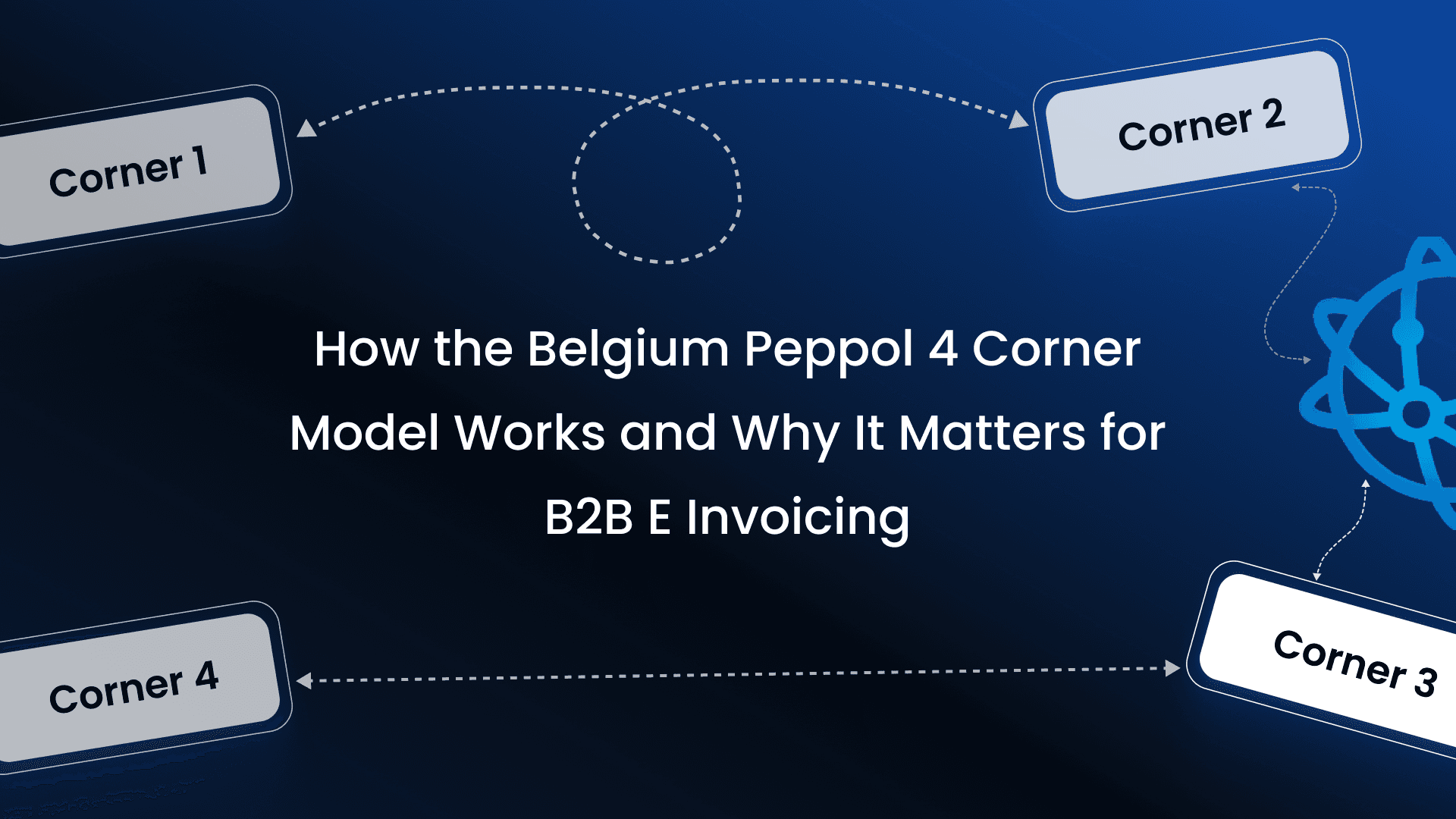
Table of Contents
In Belgium’s Peppol 4 corner model, an invoice moves from the seller to the buyer through certified Peppol Access Points.
The seller sends the invoice to their Access Point, which checks the format and routes it through the Peppol network to the buyer’s Access Point.
The buyer then receives a validated, structured e-invoice directly into their system.
Belgium is getting ready for the Belgium e-invoicing mandate 2026, which will require businesses to move from PDF or paper invoices to fully digital, structured e-invoices. This change supports Belgium’s plan to make invoicing faster, more accurate, and easier to automate for all companies.
The Belgium Peppol 4 corner model plays a key role in enabling this shift. This model is the foundation that allows suppliers and buyers to exchange invoices securely through the Peppol network. It ensures every business can send and receive e-invoices using their preferred provider without being forced into a single platform.
E-Invoicing in Belgium also follows the Electronic Invoice Standard EN-16931 and the Peppol BIS 3.0 format, which guarantees that invoices are consistent, machine-readable, and compliant with Belgian e-invoicing regulation. With these standards and the 4 corner model working together, Belgium is building a strong, interoperable system for both B2B and B2G e-invoicing across the country.
How the Belgium Peppol 4 Corner Model Works
The Peppol 4 corner model explains how an invoice moves from a supplier to a buyer through the certified Peppol Access Points. This model ensures secure delivery, correct formatting, and full interoperability across Belgium and the wider Peppol network.
Corner 1: The Sender
The supplier creates a standard invoice in their ERP or accounting system and sends this invoice data to their chosen Peppol Access Point.
Corner 2: The Sender’s Peppol Access Point (AP)
The sender’s Access Point converts the supplier’s invoice into the required Peppol BIS 3.0 and EN-16931 format. It validates the structure, checks the Belgian-specific e-invoice rules, and prepares the e-invoice for secure network transmission.
Corner 3: The Receiver’s Peppol Access Point (AP)
The sender’s AP sends the e-invoice through the Peppol network.
The Peppol network looks up the buyer’s details in the SMP directory, guided by the SML, to find the exact Access Point that should receive the invoice.
The receiver’s AP receives the structured e-invoice, performs additional validation checks, confirms sender identity, and ensures the document is correct and complete before passing it to the buyer.
Corner 4: The Receiver
The buyer receives the validated e-invoice directly in their ERP, accounting, or POS system.
Belgium-Specific Requirements for the Peppol 4 Corner Model
Belgium has adopted a clear set of technical and compliance rules for structured electronic invoicing as part of the Belgium e-invoicing mandate 2026.
These rules ensure that every invoice sent through the Peppol network follows the same structure, making it easier for systems to read, validate, and process invoices automatically.
1. Peppol BIS 3.0 and EN-16931 Format
All e-invoices in Belgium must follow three main standards:
- Peppol BIS 3.0 standard Belgium
- Electronic invoice standard EN-16931
These formats guarantee that invoices include all required VAT fields and can be understood by any ERP or accounting system.
Peppol is the secure network used to exchange electronic business documents between companies (B2B) and public sector organisations (B2G).
To make this work smoothly, every document on the network must follow a common structure. This structure is defined by Peppol BIS (Business Interoperability Specifications).
The version used in Belgium is Peppol BIS Billing 3.0, which is built on top of the European e-invoicing standard EN 16931.
- EN 16931 sets the core rules for what an electronic invoice must contain across the EU.
- Peppol BIS 3.0 provides the practical rules, format, and validation requirements used to implement EN 16931 in real systems.
By using Peppol BIS Billing 3.0, companies can send and receive invoices in a standardised format that ensures accuracy, compliance with EU VAT rules, and smooth processing across borders and industries.
2. Peppol Access Point Belgium
Businesses must connect through a Peppol Access Point Belgium provider to send and receive compliant invoices.
APs also register companies in the directory using a unique Peppol ID.
3. Structure and Data Requirements
Invoices must meet the Belgium e-invoicing mandate 2026 validation rules, including:
- Buyer and supplier identifiers
- VAT details
- Line item structure
- Payment data
- Business rules defined by the Belgian e-invoicing regulation
4. B2B and B2G Requirements
- B2B invoices must use Peppol BIS 3.0
- B2G invoices must be sent via the MERCURIUS platform, which is Belgium’s government Access Point, but still part of the Peppol 4 corner flow
Main Responsibilities of a Peppol Access Point
Network Connectivity
A Peppol Access Point connects businesses to the Peppol network. It makes sure invoices can be sent and received securely between different companies and systems.
Sending and Receiving Invoices
The Access Point sends invoices to the buyer’s Access Point and receives invoices from other suppliers. All documents are exchanged in the Peppol BIS 3.0 format required in Belgium.
Validation and Compliance
Before sending an invoice into the network, the Access Point checks if it follows EN 16931 rules, Belgian e-invoicing rules, and the correct Peppol BIS structure. It also checks that the Peppol ID is correct. This helps prevent errors and rejections.
Security and Delivery Assurance
The Access Point protects the invoice during transmission and ensures it reaches the right destination. It also tracks delivery status so businesses can see if an invoice was delivered, accepted, or failed.
Directory and Addressing
Access Points register businesses in the Peppol network and assign them a Peppol ID. This ID is used to route invoices automatically to the correct buyer without manual lookup.
Error Handling
If an invoice fails validation or cannot be delivered, the Access Point generates clear error messages. This helps businesses quickly fix issues and resend the invoice.
Integration With ERP or Accounting Systems
Most Access Points provide APIs or built-in connectors. These allow businesses to link their ERP or accounting systems directly to Peppol so that sending and receiving invoices becomes fully automated.
Benefits of the Peppol 4 Corner Model for Belgian Businesses
Full interoperability across Belgium and Europe
The Peppol network allows every business to exchange invoices with any other company or government body using the same standards. This removes compatibility issues between different systems and makes cross-border invoicing much easier.
A single AP connection links a business to all trading partners
Businesses do not need separate integrations for every customer or supplier. By connecting once to a Peppol Access Point, they can reach all trading partners already registered on the network. This reduces setup time and technical complexity.
Automated invoice processing reduces errors and manual work
Because invoices follow the EN 16931 and Peppol BIS 3.0 format, they enter the buyer’s ERP system in a structured way. This reduces manual data entry, prevents common mistakes, and speeds up approval and reconciliation workflows.
Strong compliance with Belgian e-invoicing regulation
Invoices exchanged through Peppol automatically follow Belgium’s e-invoicing requirements, ensuring the correct format, VAT fields, and validation rules are applied. This helps businesses stay compliant with the Belgian e-invoicing mandate 2026.
Faster payment cycles and improved financial accuracy
Structured invoices move through automated workflows, which reduces delays in verification and processing. Buyers can approve and pay invoices faster, and suppliers benefit from improved cash flow and more accurate financial records.
Secure, auditable, fraud-resistant invoice delivery
The 4 corner model uses secure channels, identity checks, and validated formats. This reduces risks like invoice tampering, fake invoices, or misrouting. Audit trails are built into the process, making compliance reviews easier.
Ready alignment with Belgium’s future real-time e-reporting plans
By adopting Peppol BIS 3.0 and EN 16931 now, businesses are better prepared for upcoming real-time or near-real-time reporting requirements. The structured format and network validation create a strong base for future compliance changes.
Conclusion
Belgium’s transition to mandatory structured e-invoicing is built on the reliability and openness of the Peppol 4 corner model.
By using Peppol-certified Access Points, businesses can automate invoice exchange, strengthen e-invoicing compliance, and prepare confidently for the Belgium e-invoicing mandate 2026.
Whether for B2B or B2G transactions via the MERCURIUS platform, the 4 corner framework ensures security, efficiency, and scalable e-invoicing for every organisation.
Frequently Asked Questions
No. Businesses do not need to replace their ERP. They need a connection to a certified Peppol Access Point that can convert invoice data from the ERP into the required Peppol BIS 3.0 format and send it through the Peppol network.
Yes. Belgium requires B2B structured e-invoices to be exchanged through the Peppol network. Businesses must use a certified Peppol Access Point to send and receive invoices in the required Peppol BIS Billing 3.0 format.
All VAT-registered businesses issuing B2B invoices in Belgium must comply from January 1st 2026. This applies to invoices exchanged between Belgian businesses, regardless of company size, as long as the transaction is subject to VAT.
About the Author

Swathy
Content Marketer
I’m a Content Marketer at Complyance, focused on e-invoicing. Over the years, I’ve created a wide range of content, including blog posts, whitepapers, and product guides, which have supported Complyance’s growth across markets such as the UAE and EU regions. My goal is to deliver content that is comprehensive, clear, accurate, and easy to understand, no matter how complex the topic.