How Logistics Companies in the UAE Can Simplify E-Invoicing with Complyance

Discover how logistics companies in the UAE can simplify e-invoicing using Complyance’s solution, built for handling multiple entities, managing bulk invoicing, supporting multi-ERP, and cross-border operations.
Table of Contents
Managing logistics operations involves a lot. From dealing with multiple entities across different countries to handling different ERPs, varying tax rules, and high volumes of transactions every single day. Each shipment, transaction, service, and invoice comes with its own set of legal and tax-specific requirements. It is a fast-paced environment where precision and scalability need to work together effortlessly. Read more: UAE e-invoicing for logistics industries.
That is where Complyance steps in. Our platform is designed to handle these complexities with ease, from cross-border e-invoicing compliance to bulk invoice processing, while seamlessly supporting multi-entity, multi-ERP setups. We make e-invoicing smoother, smarter, and faster so you can go live quicker and your teams can focus on what truly matters: delivering on time.
In this blog, we will walk you through the key challenges logistics companies will face with the UAE’s e-invoicing mandate and show how Complyance simplifies the process. Let’s break it down.
Key Challenges for Logistics Companies in E-Invoicing
Multi-Entity Operations
For logistics companies operating across multiple regions or countries, the complexity of managing invoices for different entities is a significant challenge. With each entity often operating in different tax jurisdictions, the task of consolidating invoices, adhering to local tax rules, and ensuring e-invoicing compliance becomes difficult and time-consuming.
Handling Multiple ERP Systems
Logistics companies often operate with multiple or custom ERP and billing systems across departments, warehouses, or regional offices. Each system may produce invoice data in a different structure, format, or field logic. This makes it challenging to standardize the output into a single, compliant e-invoicing format like PINT AE, especially when managing bulk transactions or country-specific requirements.
Complex Invoice Workflows
Logistics services ranging from warehousing and packing to customs clearance each have different VAT treatments. This adds layers of complexity to invoice workflows. Getting these details right is not just important for e-invoicing compliance but also for maintaining smooth operations across the supply chain.
Data Readiness
The readiness of data is a common stumbling block. Gaps in the system, incorrect data formats, or inconsistent tax category codes can cause significant delays during the e-invoicing process. Companies that are not prepared for data migration or transformation face higher chances of rework and penalties.
Continuous Updates from the Government
With the UAE government continuously updating its e-invoicing regulations, keeping up with these changes is another hurdle. Logistics companies need to be ready for frequent updates to ensure they remain compliant. Falling behind on these updates can lead to fines or even operational disruptions.
How Complyance Addresses These Challenges for Logistics Companies
Unified API for Multi-Entity Operations:
Complyance’s one API offers logistics companies a simple, unified platform for managing invoicing processes across multiple entities. No matter how many locations or service types a logistics company operates in, Complyance makes it easy to connect and centralize invoicing operations. This ensures smooth and consistent e-invoicing compliance across the entire network, saving time and reducing risk.
Supports Multiple ERP Setups:
Complyance is built to work with multiple ERP or billing systems, whether you're using SAP, Oracle, or a fully custom setup. There’s no need to change or standardize your internal systems. Each ERP simply pushes the invoice data, and Complyance handles the formatting, mapping, and e-invoicing compliance based on the UAE’s PINT AE requirements. This allows logistics companies to continue using their existing infrastructure while staying fully e-invoicing compliant across all regions and workflows.
AI-Powered Mapping for Complex Invoice Workflows:
In logistics, a single invoice often includes multiple line items across different services like warehousing, packing, domestic transport, and cross-border transactions. Each of these services has its own e-invoicing rules, required fields, and e-invoice structure. Complyance’s AI-powered GETS mapping engine is built to handle this complexity. It automatically detects, maps the right fields for each line item based on UAE’s PINT AE specifications. Complyance ensures every detail is captured correctly, making composite service invoicing smooth, accurate, and audit-ready.
Pre-Assessment for Data Readiness:
Before diving into the integration process, Complyance offers a gap assessment and impact assessment that checks for data gaps in your system. This approach ensures that any missing information or system misconfigurations are identified and addressed upfront, avoiding the delays and errors that could occur during the invoicing process. With Complyance, you are not just reacting to problems; you are solving them before they even arise.
Regulatory Updates Managed by Our Team:
The e-invoicing regulations in the UAE can change frequently, but you will not have to track every update yourself. At Complyance, our team closely monitors all government changes and ensures they are promptly reflected in the system. You will not need to modify your process or worry about technical adjustments. Just keep pushing the invoice data as usual, and we will handle the rest behind the scenes. This way, you stay compliant without any disruptions or extra effort.
| Key challenges | How Complyance Helps |
|---|---|
| Cross-Border Transactions | Logistics companies often manage cross-border shipments that involve different services, documentation formats, and country-specific e-invoicing rules. Each region may have its own invoice structure, field requirements, and e-invoicing compliance conditions. Complyance helps you handle all of this effortlessly. Whether it is a zero-rated export or an import requiring specific document references under PINT AE, our platform is built to support varying use cases across regions. You continue pushing invoice data, and we ensure it is processed correctly for each scenario, no matter the destination. |
| Bulk Invoice Processing | For logistics companies that process high volumes of invoices, the last thing you want is a backlog of rejections. Complyance’s e-invoicing solution is designed to reduce invoice rejections by ensuring each invoice is correctly structured based on UAE e-invoicing requirements. This reduces manual work and helps you avoid delays. |
| Limited Technical Resources | Not every logistics company has a large in-house tech team ready to manage e-invoicing setup and maintenance. That is why Complyance is built to be easy to integrate and manage, even with minimal technical support. Our platform works smoothly with your existing systems, so you can go live without a large in-house technical team.<br> |
| Domain Expertise | E-invoicing in the UAE involves more than just pushing data. It requires understanding regional mandates, formats like PINT AE, and edge cases. With Complyance, you are not navigating this alone. Our domain experts work closely with your team to guide implementation, answer e-invoicing compliance-related questions, and ensure everything runs as it should across all your operating regions.<br> |
How Complyance Simplifies API Integration for E-Invoicing in Logistics Industries Using Multiple ERPs
Use Case 1: Centralized Database for Multiple ERPs in Logistics Operations
Overview
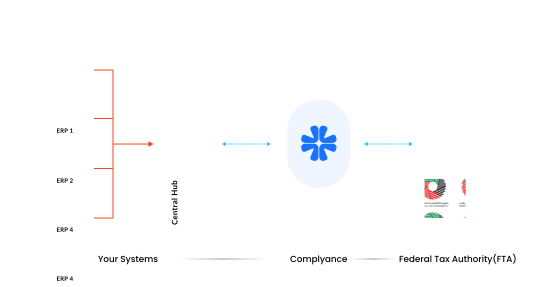
Large logistics companies often operate across multiple regions, each utilizing different ERP systems for different warehouses, transportation, or business units. This creates complexity when integrating e-invoicing across the organization. By establishing a centralized database or central hub, logistics companies can simplify how data from various ERPs is segregated and made available for e-invoicing.
Integration Approach
In this setup, all transactional data from multiple ERPs is stored centrally in a unified database. Complyance connects directly to this central database, pulling the invoice data through an SDK for automated mapping, real-time validation, and submission to the FTA’s e-invoicing network. This ensures a single source of truth for all e-invoicing transactions across the logistics operation.
Process Flow
- Data Segregation: All ERPs feed their invoice data into the central database.
- Data Extraction: Complyance retrieves the segregated data from the central database.
- Mapping & Validation: The platform automatically maps invoice field headers to the FTA’s PINT AE schema and performs validation checks.
- Submission: Validated e-invoices are submitted in real-time to the FTA via Complyance’s accredited platform.
- Monitoring: Every transaction’s status can be tracked from the centralized dashboard.
Outcome
- Faster Go-Live: Integration is completed quickly since data comes from a single, unified source.
- High Accuracy: Centralized data minimizes mismatches or duplication.
- Simplified Maintenance: Changes or updates in the schema or format only need to be applied once at the central level.
- Unified Compliance Monitoring: Your team can view all regions and operations through a single e-invoicing dashboard.
Advantages
- Centralized control of all invoice data.
- Reduced integration complexity.
- Faster deployment and easier scalability.
- Minimal manual intervention.
- Consistent and standardized data across all ERPs.
Disadvantages
- Requires upfront setup of a central database if one doesn’t exist.
- Data synchronization between individual systems and the database must be maintained continuously.
- If the central database faces downtime, it can temporarily affect invoice submission.
Which industries would be suited for?
Logistics enterprises operating across multiple regions, multi-unit warehouse operations, and companies managing different ERPs for various logistics divisions.
Summary:
The centralized database approach is the most efficient integration model for large logistics enterprises managing multiple ERPs. It simplifies the e-invoicing journey by offering centralized control, faster go-live, and real-time e-invoicing visibility, making it the recommended architecture for large-scale logistics operations.
Use Case 2: Multiple ERPs Without a Central Database in Logistics
Overview
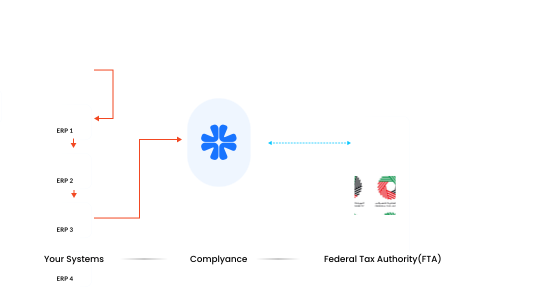
Some logistics companies operate with multiple ERPs but do not maintain a centralized database. In such cases, the data flow becomes more fragmented, as each ERP works independently. This structure can create integration challenges when implementing e-invoicing across multiple systems, as data must be collected and standardized before submission to the FTA.
Integration Approach
In this setup, ERP data is transmitted directly from each system to the Complyance platform through a secure API for validation and e-invoicing. Each ERP connection is managed separately, ensuring that invoice data from every system is processed accurately and in compliance with the UAE’s e-invoicing framework.
Process Flow
- ERP Data Push: Each ERP system pushes invoice data through a secure API to the Complyance platform.
- Mapping & Validation: Complyance automatically maps the data fields to the FTA’s PINT AE schema and validates each invoice.
- Submission: Validated e-invoices are submitted in real time to the FTA.
- Monitoring: Each ERP connection can be monitored individually for validation success and compliance status.
Outcome
- Smooth Multi-System Integration: Each ERP system is integrated independently while maintaining compliance across all systems.
- Data Consistency: Automated validation ensures that invoice formats and tax fields remain accurate across varied systems.
- Real-Time Compliance: Logistics companies can still achieve real-time validation and submission even without a central database.
Advantages
- Allows integration without major restructuring of existing systems.
- Complyance handles data from multiple ERPs simultaneously.
- Real-time processing ensures compliance continuity.
- Suitable for businesses that haven’t yet migrated to centralized data architecture.
Disadvantages
- Higher integration complexity due to multiple independent connections.
- Slightly longer setup time compared to centralized database integration.
- Data consistency depends on how effectively ERPs receive and process data from different systems.
Which industries would be suited for?
Logistics companies with decentralized systems, multi-regional logistics operations, and companies managing separate ERPs for different warehouses or fleet units.
Summary
The multiple ERPs without a central database model provide a flexible integration path for logistics companies that are still transitioning toward unified data systems. While it requires separate connections for each ERP, Complyance simplifies the entire process through SDK-driven automation, ensuring every invoice is validated, formatted, and submitted accurately in real time.
Use Case 3: Clustering ERP Systems in Logistics
Overview
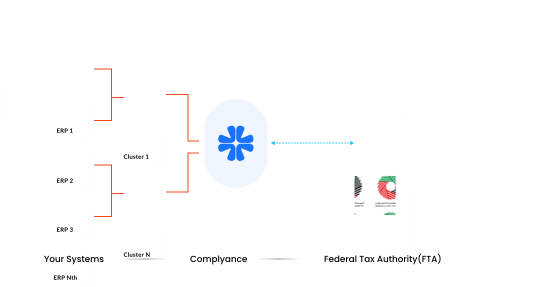
Logistics companies often operate multiple ERPs across different regions or business units. Managing integration for every ERP individually can be complex and time-consuming. To simplify this, many organizations cluster their ERP systems into groups, allowing them to manage and process data in smaller, more structured batches.
Integration Approach
In this setup, ERP systems are grouped into clusters by the logistics company, for example, by region, business unit, or service type. Complyance integrates with each cluster to process the data in batches, ensuring every transaction is mapped, validated, and submitted according to FTA requirements. This approach reduces data congestion and simplifies how large-scale logistics networks handle e-invoicing integration.
Process Flow
- ERP Clustering: The organization groups multiple ERPs into clusters based on operational logic (e.g., service type, location, or ERP linkage).
- Data Collection: Each cluster transmits its consolidated data for processing.
- Integration with Complyance: Complyance connects to each cluster to validate and map invoice data.
- Validation and Mapping: Data from each cluster is automatically aligned with the FTA’s PINT AE schema.
- Submission: Validated e-invoices are sent to the FTA through Complyance’s platform, with results tracked in real time.
Outcome
- Streamlined Data Management: Processing data in clusters helps logistics companies handle large volumes of invoices more efficiently.
- Faster Integration: Clustering minimizes the number of direct integrations needed and speeds up go-live timelines.
- Reduced Bottlenecks: Data from each cluster is processed in manageable batches, preventing overload or submission delays.
Advantages
- Simplifies the management of multiple ERP systems.
- Improves performance and reduces load on individual systems.
- Enables parallel processing of invoice data from different clusters.
- Easier monitoring and troubleshooting for large logistics networks.
Disadvantages
- Requires internal coordination to establish and maintain clusters.
- Cluster-level data synchronization must be managed to avoid inconsistencies.
- May still require ERP-level alignment if clusters feed into different back-end systems.
Which industries would be suited for?
Logistics companies with multiple ERP systems spread across regions, multinational logistics networks, and businesses that need to process high daily transaction volumes from distributed systems.
Summary
The ERP clustering model offers logistics companies an efficient way to manage large volumes of transactional data across many business units or regions. By grouping ERPs into clusters and integrating them with Complyance, businesses can achieve faster validation, streamlined reporting, and reduced operational load, making it an effective approach for large logistics companies preparing for e-invoicing compliance.
Use Case 4: Multiple ERPs directly connecting to the E-invoicing Platform
Overview
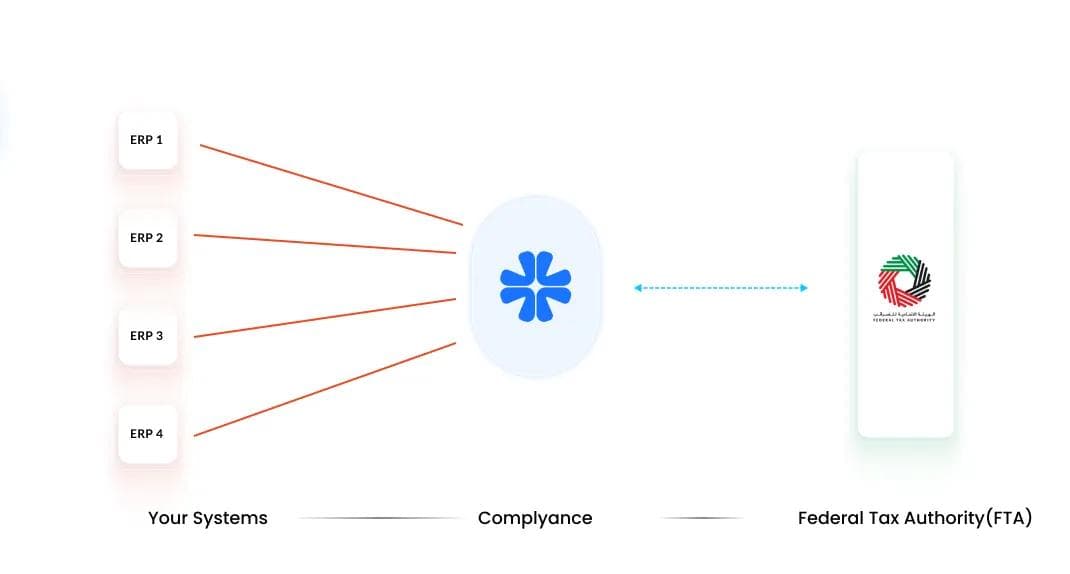
Some logistics companies operate with multiple ERP systems but without a central database to unify their data. Each ERP functions independently for different regions or business units, and data needs to be validated and submitted separately for each system while maintaining consistency across the organization.
Integration Approach
Each ERP system is integrated directly with Complyance via secure API. Complyance handles the mapping, validation, and submission of each ERP’s invoice data individually, ensuring compliance with the UAE’s e-invoicing framework. This decentralized setup ensures each ERP system meets the e-invoicing requirements without the need for a centralized database.
Process Flow
- Data Extraction: Each ERP system prepares its invoice data for e-invoicing.
- API Integration: Invoice data from each ERP is sent to Complyance through secure API endpoints.
- Mapping and Validation: Complyance automatically maps and validates the data according to the FTA’s PINT AE schema.
- Submission: Validated e-invoices are submitted in real time to the FTA.
- Monitoring: Each ERP’s transaction flow is tracked independently within the Complyance dashboard.
Outcome
- Independent ERP Integration: Each ERP system connects directly to Complyance through a single API, maintaining full compliance across all entities.
- Automated Validation: Complyance handles schema mapping and validation automatically for every ERP.
- Regulatory Compliance: Ensures all e-invoices meet the UAE’s e-invoicing standards, even without a centralized data structure.
Advantages
- No need for central data restructuring or major architectural changes.
- Enables logistics companies with multiple ERP systems to become compliant quickly.
- Provides flexibility to scale or modify ERP systems independently.
Disadvantages
- Integration and validation must be performed for each ERP separately, which can extend go-live timelines.
- Invoices from different ERPs may require additional reconciliation efforts.
- More maintenance is required compared to a centralized or clustered data setup.
Which industries would be suited for?
Logistics companies use diverse ERP systems across different business units, multinational logistics providers, and organizations managing separate ERP systems for fleet management, warehouses, and logistics centers.
Summary
The multiple ERPs without a central database model are ideal for logistics companies that operate in distributed environments but lack centralized infrastructure. By connecting each ERP directly via API, Complyance ensures every invoice is validated, mapped, and submitted in real time, providing a scalable path to compliance in a decentralized setup.
Benefits of Going Live with Complyance for Logistics Companies
Faster Go-Live
Complyance helps logistics companies implement e-invoicing quickly with a user-friendly platform and pre-configured solutions.
Cost-Effective and Scalable
The platform grows with your business, handling large invoice volumes and multi-country operations without additional resources or system changes.
No Workflow Disruption
Continue using your existing ERPs and processes. Just push the invoice data, and Complyance handles the rest.
Ongoing Compliance Assurance
Our team actively tracks and implements all regulatory updates, so you stay compliant without having to monitor changes yourself.
Reduced Risk of Errors and Rejections
AI-powered mapping and pre-submission checks ensure each invoice is structured correctly and ready for submission.
Conclusion
The UAE logistics industry operates in a complex environment, and complying with the e-invoicing mandate adds another layer of operational responsibility. But with Complyance, these challenges are not just manageable, they are simplified.
From handling multi-entity operations and complex service workflows to ensuring your data is always e-invoice ready, Complyance streamlines the entire process end-to-end.
Whether it is faster implementation, ongoing e-invoicing compliance, or seamless integration with your existing systems, our e-invoicing software gives logistics companies in the UAE everything they need to go live with confidence. Read more: step-by-step implementation guide with Complyance.
Frequently Asked Questions
Yes, logistics companies fall under the UAE’s phased e-invoicing mandate. They must comply with structured invoice requirements using PINT AE standards.
Not necessary. An e-invoicing solution provider like Complyance integrates with your existing ERP system. You only need to push the invoice data; Complyance takes care of the rest in the background.
With Complyance, logistics companies can go live in days, not months. Our GETS auto-mapping engine accelerates field mapping across complex logistics workflows. You don’t need to reconfigure your ERP or map fields manually. This means faster implementation, fewer errors, and zero disruptions to your day-to-day operations.
Not a problem. Complyance is designed for teams with or without big IT support. Our domain experts will guide the setup and testing process.
- Multi-Entity Operations: Managing invoices across various entities and tax jurisdictions can get complex.
- Complex Invoice Workflows: Each service line (like warehousing or freight) may have a different structure or tax rule.
- Data Readiness: Inconsistent data formats or missing fields delay compliance.
- Regulatory Update: Frequent FTA updates make manual tracking and changes difficult.
- Fast go-live without major ERP changes
- Works with multiple ERP, POS, or TMS
- Zero invoice rejections
- Handles multi-country and multi-service invoicing
- Fully aligned with UAE PINT AE e-invoicing standards
- Complyance acts as your domain expert
About the Author

Swathy
Content Marketer
I’m a Content Marketer at Complyance, focused on e-invoicing. Over the years, I’ve created a wide range of content, including blog posts, whitepapers, and product guides, which have supported Complyance’s growth across markets such as the UAE and EU regions. My goal is to deliver content that is comprehensive, clear, accurate, and easy to understand, no matter how complex the topic.