ZATCA E-Invoicing Requirements in Saudi Arabia: Phase 1, Phase 2 & Wave 25 Guide

Learn ZATCA e-invoicing requirements in Saudi Arabia, including Phase 1, Phase 2 integration, FATOORA, invoice formats, QR codes, and the Wave 25 deadline of 1 February 2027.
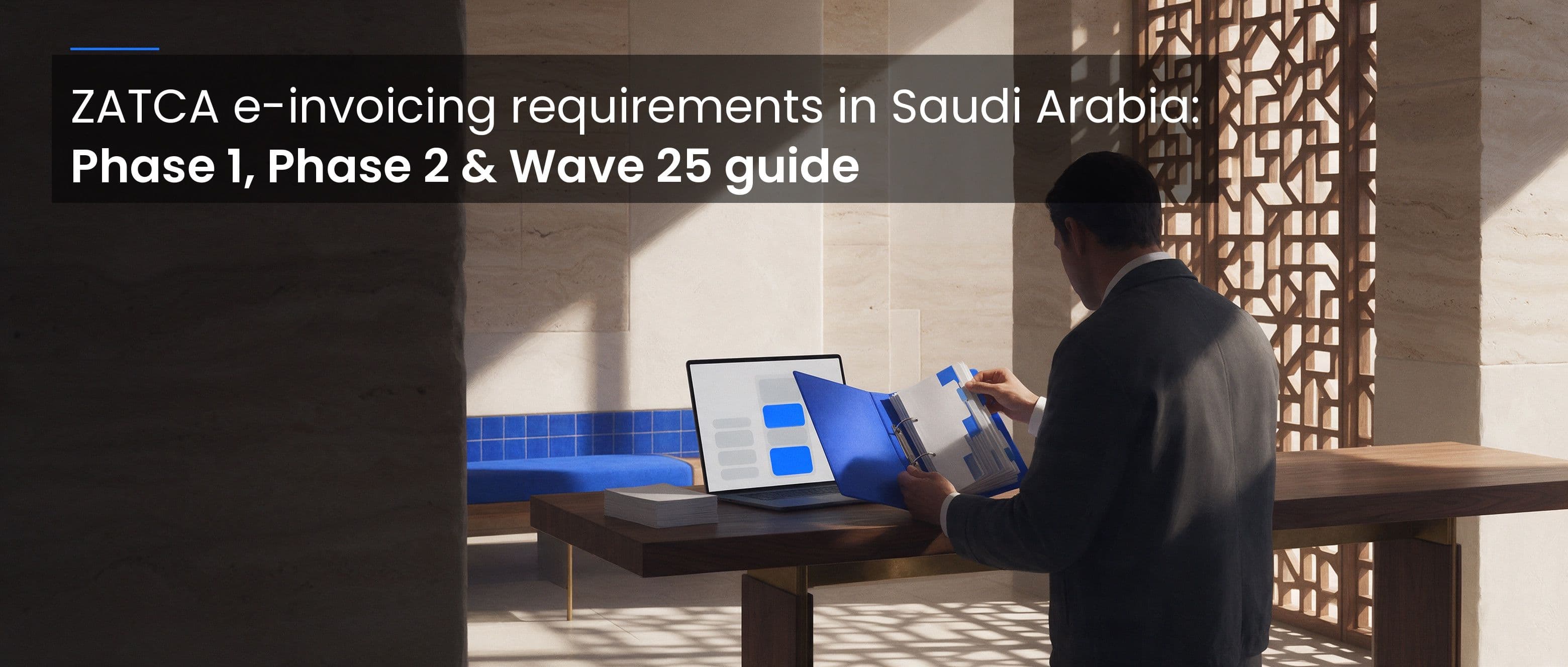
Table of Contents
Introduction
Saudi Arabia's electronic invoicing framework, known as FATOORA, requires businesses covered by the regulations to generate and manage tax invoices through compliant electronic invoicing solutions.
Administered by the Zakat, Tax and Customs Authority (ZATCA), the framework is being implemented in two phases: the Generation Phase and the Integration Phase. These phases establish requirements for electronic invoice generation, record management, and integration with ZATCA's systems.
For businesses operating in Saudi Arabia, understanding ZATCA e-invoicing requirements is essential for maintaining VAT compliance, preparing invoicing systems, and meeting applicable integration deadlines.
This guide explains who must comply, the requirements for electronic invoices, the differences between Phase 1 and Phase 2, and how businesses can prepare for integration with ZATCA.
What Is ZATCA E-Invoicing?
ZATCA e-invoicing is the electronic process of generating and managing tax invoices and associated debit and credit notes through a compliant electronic solution.
A scanned paper invoice or a document created using a word processor or spreadsheet and then saved electronically does not, by itself, qualify as an electronic invoice under the framework.
ZATCA administers the framework through its FATOORA platform, which supports the integration and compliance processes required under Phase 2.
The system aims to improve tax compliance, strengthen transaction transparency, and support the digitalisation of invoicing across Saudi Arabia.
For more information, refer to ZATCA's official e-invoicing overview.
Who Needs to Comply With ZATCA E-Invoicing Requirements?
E-invoicing applies to persons subject to VAT in Saudi Arabia and other parties issuing tax invoices on behalf of suppliers subject to VAT, in accordance with the applicable regulations.
Non-resident taxable persons are excluded from the e-invoicing requirements under ZATCA's published guidance.
Businesses should assess their obligations based on their VAT status, transaction types, and applicable regulatory requirements. They should also determine whether ZATCA has notified them to integrate their e-invoicing solution under a specific Phase 2 wave.
What Are the Main ZATCA E-Invoicing Requirements?
Businesses must use an electronic invoicing solution that complies with the requirements applicable to them. Specific obligations depend on the invoice type and whether the business is subject to Phase 1 requirements alone or has been notified to integrate under Phase 2.
Key requirements include:
- Generating electronic invoices and associated debit and credit notes through a compliant solution.
- Including the mandatory invoice fields required under Saudi VAT and e-invoicing regulations.
- Using the invoice format applicable to the relevant phase and invoice type.
- Maintaining electronic invoice records in accordance with applicable record-retention requirements.
- Meeting the applicable technical and security requirements.
- Integrating the e-invoicing solution with the FATOORA platform when required under Phase 2.
- Following the relevant clearance or reporting process.
- Applying the QR code and other technical elements required for the relevant invoice type and phase.
Businesses should consult ZATCA's current technical documentation for detailed specifications rather than relying on a general checklist alone.
Official reference: ZATCA E-Invoicing Portal.
Understanding Phase 1 and Phase 2 of ZATCA E-Invoicing
ZATCA introduced e-invoicing through two phases. Phase 1 established electronic invoice generation, while Phase 2 introduced integration with ZATCA's systems.
| Requirement | Phase 1: Generation | Phase 2: Integration |
|---|---|---|
| Start date | 4 December 2021 | 1 January 2023 |
| Electronic invoicing solution | Required | Required, with additional technical requirements |
| Integration with FATOORA | Not required under Phase 1 alone | Required for taxpayers notified to integrate |
| Invoice formats | Compliant electronic generation and storage | Prescribed formats and XML submission requirements |
| QR code | Mandatory on simplified invoices; optional on standard invoices under Phase 1 | QR code and technical requirements depend on invoice type and Phase 2 specifications |
| Standard tax invoices | Generate and store according to applicable requirements | Clearance before issuance to the buyer |
| Simplified tax invoices | Generate and store according to applicable requirements | Reporting to ZATCA within 24 hours of issuance |
Phase 1: Generation Phase
Phase 1 became mandatory on 4 December 2021.
Under this phase, businesses covered by the regulations must stop issuing handwritten invoices and invoices generated through general-purpose text-editing or spreadsheet software. They must use a compliant electronic invoicing solution to generate and store invoices.
Key requirements include:
- Generating invoices through a compliant electronic system.
- Including the required invoice information and additional fields applicable to the invoice type.
- Generating a QR code on simplified tax invoices.
- Including the appropriate invoice title and the buyer's VAT registration number where required.
- Maintaining electronic invoice records in accordance with applicable requirements.
For Phase 1, QR codes are mandatory on simplified tax invoices and optional on standard tax invoices.
Phase 2: Integration Phase
Phase 2 began on 1 January 2023 and is being implemented gradually through waves announced by ZATCA.
Businesses are notified when they are selected for integration. ZATCA states that targeted taxpayers are notified at least six months before their integration date.
Compared with Phase 1, Phase 2 introduces additional technical and procedural requirements, including:
- Integrating the e-invoicing solution with ZATCA's FATOORA platform.
- Generating invoices in the prescribed electronic format.
- Including additional invoice fields and technical elements required by ZATCA.
- Applying the relevant security features and invoice validation requirements.
- Following the applicable clearance or reporting process.
Standard tax invoices generally follow the clearance process, while simplified tax invoices follow the reporting process. The applicable workflow depends on the invoice type and ZATCA's technical specifications.
Official references: ZATCA E-Invoicing Portal and ZATCA Educational Library.
ZATCA Phase 2 Wave 25: Who Must Integrate by 1 February 2027?
On 24 July 2026, ZATCA announced the selection criteria for Wave 25 of the Integration Phase.
The announcement states that Wave 25 includes taxpayers whose revenues subject to VAT exceeded SAR 187,500 during any of the years 2022, 2023, 2024, or 2025.
ZATCA will notify the targeted taxpayers, who must integrate their e-invoicing solutions with the FATOORA platform no later than 1 February 2027.
This criterion applies to the specified Wave 25 group. It should not be interpreted as a single integration deadline for every business in Saudi Arabia. Businesses should check their own notifications and applicable integration dates.
As ZATCA continues to announce additional waves, companies should monitor official updates and prepare their systems in advance.
Official reference: ZATCA Wave 25 Announcement.
What Invoice Formats Does ZATCA Require?
Invoice format requirements differ between Phase 1 and Phase 2.
During Phase 1, businesses must generate invoices through a compliant electronic solution and include the fields required for the relevant invoice type.
For Phase 2, ZATCA's specifications distinguish between the format used to generate and store an invoice and the format submitted to the Authority.
Businesses must generate and store invoices in the prescribed format, which can include XML or PDF/A-3 with embedded XML, as applicable under ZATCA's requirements. However, the e-invoicing generation solution must submit invoice documents to ZATCA in XML format, not PDF/A-3.
ZATCA's XML implementation standard is based on UBL 2.1 and includes the applicable business rules, data elements, validation requirements, and technical specifications.
The human-readable invoice must also comply with applicable presentation and language requirements. Invoice information must be presented in Arabic, although another language, such as English, may also be included.
Businesses should not assume that an ordinary PDF invoice, a scanned document, or an XML file without the required structure is sufficient. Their solutions must meet the applicable business, data, format, and security specifications.
Official references:
Understanding Clearance and Reporting
The clearance and reporting processes are central to Phase 2 integration. The process followed depends on the type of invoice being issued.
Clearance for Standard Tax Invoices
Standard tax invoices and their associated credit and debit notes must follow the applicable clearance process.
The e-invoicing solution submits the invoice in XML format to ZATCA. The platform validates the submitted document against the applicable business rules, technical specifications, and validation checks.
Once the invoice passes the required clearance process, the cleared invoice is returned to the taxpayer's solution. The cleared version must then be issued to the buyer in accordance with the applicable requirements.
Businesses should also prepare for validation failures and rejection responses, as these can affect invoice processing and customer transactions.
Reporting for Simplified Tax Invoices
Simplified tax invoices and their associated credit and debit notes follow the reporting process.
Under ZATCA's detailed technical guidance, simplified invoices must be submitted to FATOORA in XML format within 24 hours of issuance. PDF/A-3 is not the submission format.
The e-invoicing solution should therefore support timely reporting, response handling, and the retention of relevant invoice records.
Official reference: ZATCA Detailed Technical Guideline (PDF).
How Invoice Security Works Under ZATCA Phase 2
Phase 2 introduces technical and security requirements designed to support invoice integrity, authenticity, and traceability.
Relevant elements include the following.
Cryptographic stamp: A security mechanism used by the compliant e-invoicing solution to help establish invoice integrity and authenticity in accordance with ZATCA's specifications.
Cryptographic Stamp Identifier (CSID): A credential associated with onboarding an e-invoicing solution unit to ZATCA's platform.
Universally Unique Identifier (UUID): A unique identifier assigned to an invoice or related document as required by the technical specification.
Invoice hash: A cryptographic value calculated from invoice data to support integrity checks.
Previous invoice hash and invoice sequence: Technical mechanisms that help establish continuity between invoices and support the detection of unauthorised changes or gaps in the sequence.
QR code: A machine-readable code containing prescribed invoice information. Its required content depends on the applicable invoice type and phase.
These elements must be implemented according to ZATCA's technical and security specifications. Businesses should confirm that their solution handles them correctly rather than treating them as optional add-ons for Phase 2.
Official reference: ZATCA E-Invoice Specifications.
Key Terms in ZATCA E-Invoicing
Understanding the terminology helps businesses coordinate their finance, tax, and technical teams.
| Term | Meaning |
|---|---|
| Tax invoice | An invoice issued for a transaction that requires a tax invoice under the applicable VAT rules. |
| Simplified tax invoice | An invoice used for transactions that qualify for simplified invoicing under Saudi VAT requirements. |
| Debit note | A document used to increase or adjust an amount relating to an earlier transaction, where permitted under the applicable rules. |
| Credit note | A document used to reduce or correct an amount relating to an earlier transaction, in accordance with the applicable VAT requirements. |
| FATOORA platform | ZATCA's platform used for the onboarding, integration, clearance, and reporting processes associated with Phase 2. |
| E-Invoice Generation Solution (EGS) | The electronic system or solution used to generate invoices and perform the technical functions required under ZATCA's specifications. |
| Cryptographic stamp | A security mechanism used in the applicable integration process to support invoice integrity and authenticity. |
| Cryptographic Stamp Identifier (CSID) | A credential associated with onboarding an e-invoicing solution unit to ZATCA's platform. |
| UUID | A universally unique identifier used to identify an invoice or related document according to the technical requirements. |
| Invoice hash | A cryptographic value used to support integrity checks and identify changes to invoice data. |
| Clearance | The process through which standard tax invoices and associated notes are submitted to ZATCA for the required validation before being issued to the customer. |
| Reporting | The process through which simplified tax invoices and associated notes are submitted to ZATCA in XML format within the applicable 24-hour reporting window. |
| UBL 2.1 | The Universal Business Language standard used as the basis for ZATCA's XML invoice structure. |
How to Integrate an E-Invoicing Solution With FATOORA
Businesses selected for Phase 2 need to onboard their e-invoicing solution and establish the required integration with FATOORA.
The general process involves the following steps.
1. Confirm Your Integration Notification
Check whether ZATCA has notified your business about its Phase 2 integration date. Review the deadline and prepare an implementation plan accordingly.
2. Select or Prepare a Compliant E-Invoicing Solution
Assess whether your existing invoicing system can meet ZATCA's business, format, security, and integration requirements. If it cannot, work with your internal technical team or a suitable solution provider to upgrade or replace it.
3. Access the FATOORA Portal
Use the appropriate taxpayer credentials to access the portal and follow ZATCA's current onboarding instructions.
4. Onboard the E-Invoicing Solution
The onboarding process involves generating the required one-time password (OTP) through the portal and using it within the e-invoicing solution to complete the relevant onboarding process and obtain the required credentials, including the applicable cryptographic stamp identifiers.
The exact procedure depends on the solution and onboarding scenario.
5. Test the Integration
Validate invoice generation, mandatory fields, XML structure, security features, and the required clearance or reporting workflows. Test standard invoices, simplified invoices, and associated credit and debit notes where applicable.
Businesses should also test error handling, rejected invoices, API responses, and the processing of corrected documents.
6. Go Live and Monitor Compliance
After completing the required onboarding and integration steps, operate the solution in line with the applicable requirements. Continue monitoring ZATCA announcements and technical updates to maintain compliance.
The exact steps may vary by solution and onboarding scenario. Businesses should use the official FATOORA portal user manual for the latest procedural guidance.
Official reference: ZATCA E-Invoicing Guidelines and User Manuals.
Common ZATCA Phase 2 Integration Mistakes to Avoid
Businesses preparing for ZATCA integration should pay attention to several common technical and operational risks.
- Assuming a PDF is sufficient for submission: ZATCA requires invoice documents to be submitted in XML format. PDF/A-3 with embedded XML is not a substitute for XML submission.
- Missing the simplified invoice reporting deadline: Simplified invoices must be reported to ZATCA within the applicable 24-hour window.
- Overlooking mandatory invoice fields: Missing or incorrect data can cause validation failures.
- Ignoring clearance responses: Standard tax invoices must follow the clearance workflow before being issued to the buyer.
- Failing to test credit and debit notes: Related documents must also comply with applicable technical and business rules.
- Misconfiguring security features: Stamps, identifiers, QR codes, and invoice hashes must follow the relevant specifications.
- Waiting until the integration deadline: Businesses should allow time for system changes, data mapping, testing, and operational readiness.
Identifying these risks early can reduce implementation delays and help businesses maintain reliable invoice processing.
How to Prepare Your Business for ZATCA E-Invoicing
Preparation involves more than choosing software. Businesses should review the systems, data, processes, and people involved in issuing and managing invoices.
Consider the following checklist:
- Confirm applicability: Determine your VAT status and identify the e-invoicing requirements that apply to your business.
- Check your Phase 2 status: Review ZATCA notifications and confirm your integration date, if applicable.
- Review your invoicing systems: Assess whether your ERP, accounting software, point-of-sale system, or custom application can support the required functionality.
- Validate invoice data: Check customer information, VAT registration numbers, tax calculations, invoice identifiers, and other mandatory fields.
- Plan the integration: Define the technical approach, responsibilities, testing requirements, and implementation timeline.
- Test key workflows: Check invoice generation, clearance, reporting, rejection handling, and credit or debit note processes where applicable.
- Prepare your teams: Ensure finance, tax, IT, and operations teams understand the changes affecting their responsibilities.
- Review record retention: Confirm that electronic invoices and supporting records are retained in accordance with applicable Saudi VAT and e-invoicing requirements.
- Monitor official updates: Review ZATCA's latest regulations, guidance, technical specifications, and wave announcements.
Early preparation gives businesses more time to identify system gaps, correct data issues, and coordinate implementation across departments.
How Complyance Helps With ZATCA E-Invoicing
Complyance provides an e-invoicing platform designed to help businesses connect their existing business systems with electronic invoicing requirements across markets.
For businesses preparing for ZATCA e-invoicing, relevant capabilities to assess include:
- Integration with existing ERP, accounting, and business systems.
- Support for invoice data mapping and validation.
- Electronic invoice processing and status visibility.
- Integration workflows aligned with applicable market requirements.
- Support for implementation and ongoing operational needs.
The appropriate configuration depends on your existing systems, transaction volumes, and applicable ZATCA requirements. Businesses should confirm specific capabilities and implementation scope with the Complyance team.
Preparing for ZATCA Phase 2? Review your invoicing systems and integration requirements before your applicable deadline.
Explore Complyance to learn more about the platform and discuss your e-invoicing requirements.
Frequently Asked Questions
E-invoicing applies to persons subject to VAT in Saudi Arabia and other parties issuing tax invoices on behalf of suppliers subject to VAT, in accordance with the applicable regulations. Non-resident taxable persons are excluded under ZATCA's published guidance.
Phase 1, the Generation Phase, became mandatory on 4 December 2021. Phase 2, the Integration Phase, began on 1 January 2023 and is being implemented in waves for taxpayers notified by ZATCA.
For Wave 25, ZATCA announced an integration deadline of 1 February 2027 for the targeted taxpayers. Businesses should check their own ZATCA notifications because deadlines differ by wave.
Under Phase 1 requirements, QR codes are mandatory for simplified tax invoices and optional for standard tax invoices. Businesses must also follow the applicable Phase 2 specifications for their invoice type.
For Phase 2, invoices may be generated and stored in XML or PDF/A-3 with embedded XML, as applicable under ZATCA's requirements. However, invoice documents submitted to ZATCA must be in XML format, not PDF/A-3.
Under Phase 2, simplified tax invoices and associated notes must be submitted to ZATCA in XML format within 24 hours of issuance. Standard tax invoices follow the clearance process instead.
FATOORA is ZATCA's platform for the onboarding and integration processes associated with Phase 2. It supports the required workflows for connecting compliant e-invoicing solutions with ZATCA.
Businesses should use an e-invoicing solution that meets ZATCA's applicable business, technical, and security requirements. ZATCA publishes an indicative list of solution providers, but businesses should confirm their chosen solution's compliance and integration capability rather than relying on list inclusion alone.
Official reference: ZATCA E-Invoicing Portal.
UBL 2.1 is the Universal Business Language standard used as the basis for ZATCA's XML invoice structure. The XML must also comply with ZATCA's applicable data dictionary, implementation standard, and business validation rules.
Businesses should confirm their integration notification, review their existing systems, validate invoice data, plan the technical integration, test clearance and reporting workflows, and monitor ZATCA's official updates.
Businesses can consult ZATCA's official e-invoicing portal, which provides regulations, FAQs, technical specifications, educational guidance, and FATOORA resources.
Official references:
About the Author

Ajith Kumar
Im a skilled content writer and SEO expert crafting engaging articles that rank. Passionate about making complex topics clear, discoverable, and valuable to readers.Dedicated to driving organic growth through high-quality, search-optimized content