Penalties for ZATCA E-Invoicing and VAT Violations in Saudi Arabia

Understand Saudi Arabia’s VAT and e-invoicing penalties, including common violations, corrective notices, escalation rules, and how businesses can reduce compliance risks.
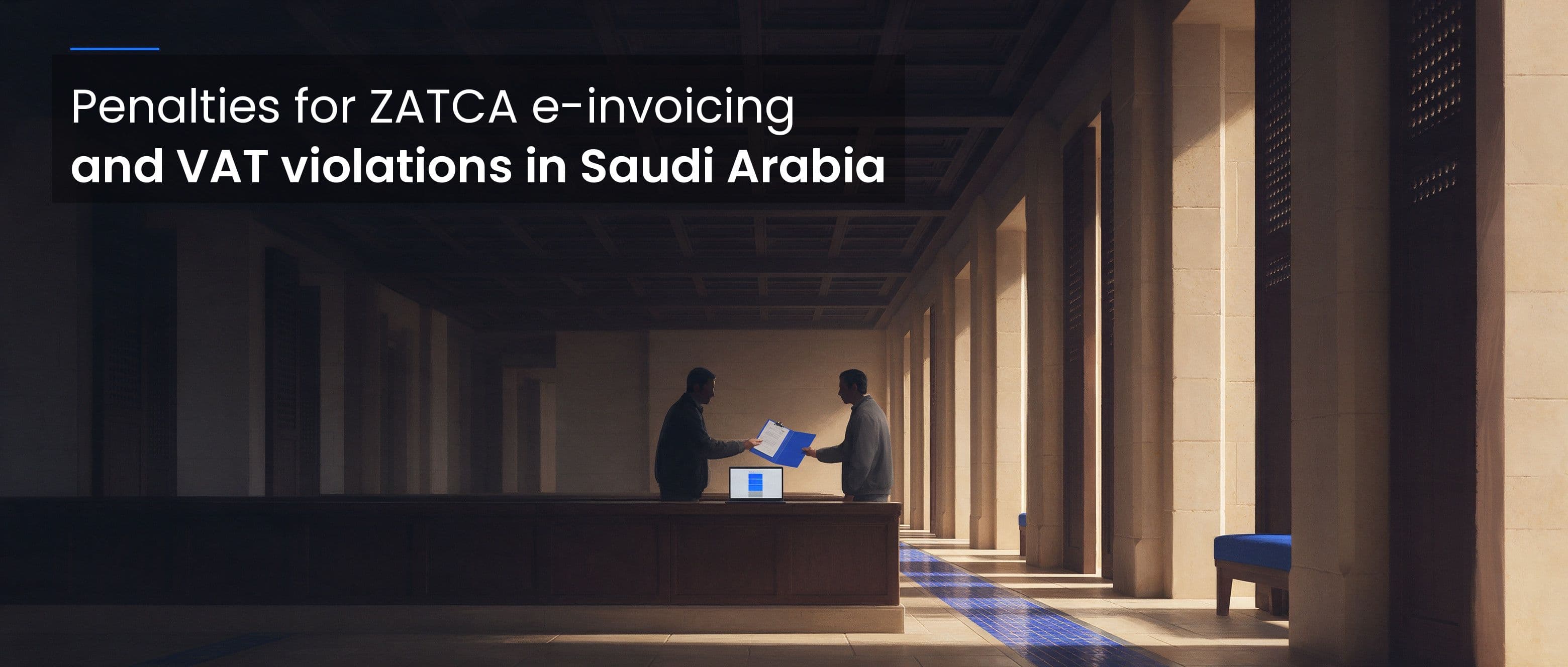
Table of Contents
Saudi Arabia’s Zakat, Tax and Customs Authority (ZATCA) administers VAT and the Kingdom’s e-invoicing requirements. Businesses need to understand the obligations that apply to their transactions and invoicing systems, as well as the consequences of failing to comply.
Penalty rules can depend on the type of violation, the applicable legal provision, the taxpayer’s history, and any corrective process available under the relevant decision. Because penalties and procedures can change, businesses should verify the current position against official ZATCA guidance and the applicable legislation before relying on a specific amount or deadline.
VAT violations in Saudi Arabia
VAT-related violations may include:
- Failing to issue a tax invoice when required.
- Omitting required information from a tax invoice, credit note, or debit note.
- Failing to retain invoices, accounting records, or other required documents for the prescribed period.
- Failing to issue or provide a required credit note or debit note.
- Obstructing authorised ZATCA officials in carrying out their duties.
- Incorrectly calculating VAT due or otherwise failing to comply with VAT law and its implementing regulations.
The penalty applicable to a particular case depends on the relevant legal provision and the circumstances. Do not assume that every VAT violation follows the same penalty ladder or corrective-notice process.
Separate from the field-violation reclassification approach, ZATCA’s general taxation-violation guidance sets different fines for particular offences. For example, violation of a VAT Law or Regulations provision can attract a fine of up to SAR 50,000, and repetition of the same violation within three years of the final decision may permit the fine to be doubled. Check the applicable provision and current guidance for the case at hand.
E-invoicing violations in Saudi Arabia
For taxpayers in scope, e-invoicing violations may include:
- Failing to generate and store invoices or notes electronically as required.
- Failing to include required invoice data, such as a QR code where applicable.
- Failing to retain electronic invoices and notes in the required form.
- Using prohibited functions in an e-invoicing solution.
- Failing to notify ZATCA of a malfunction when notification is required under the applicable rules.
- Deleting or modifying an invoice or electronic note after issuance in a manner prohibited by the regulations.
- Breaching other applicable e-invoicing provisions or executive decisions.
The precise requirements differ by invoice type and implementation phase. For Phase 2 taxpayers, standard tax invoices and related notes must be cleared by ZATCA before being shared with the buyer, while simplified tax invoices and related notes must be reported within 24 hours of generation/issuance.
ZATCA’s reclassification decision applies a progressive approach to specified VAT and e-invoicing field violations. Depending on the violation, the first step may be a warning or notice with a correction period of up to three months; subsequent repetitions can attract escalating fines. For some categories, the schedule begins at SAR 1,000, then SAR 5,000, SAR 10,000, and SAR 40,000; other violations begin at different amounts, such as SAR 5,000 or SAR 10,000. The applicable schedule depends on the exact violation, its legal classification, and the taxpayer’s violation history.
How penalty escalation and corrective notices work
Some ZATCA violation categories have been subject to a reclassification approach that uses notices and escalating fines for repeated violations. The exact process, eligibility for a corrective period, and applicable fine must be checked against the current decision and the specific violation.
Do not apply one penalty schedule to every VAT or e-invoicing breach. In particular, confirm all of the following before communicating a penalty amount:
- The exact violation and legal provision.
- Whether a corrective notice or rectification period applies.
- How the authority counts repeat violations and the relevant lookback period.
- The fine specified for that category and stage.
- Whether any separate penalty or legal consequence also applies.
ZATCA’s guidance uses a 12-month period to assess recurrence: if the same violation recurs after 12 months from discovery, it may be treated as a new violation and begin again with an alert, subject to the applicable decision and facts. Confirm the exact start point, correction period, and sequence against the current decision for the violation concerned.
Examples: how businesses should respond
Example 1: A missing required QR code
A business discovers that an invoice was generated without a QR code where one is required. It should correct the invoice-generation process and retain evidence of remediation. Under ZATCA’s published violation guidance, this category begins with a warning, with further consequences depending on recurrence and the applicable decision.
Example 2: Missing electronic credit notes
A retailer has not generated required credit notes electronically. The business should identify affected transactions, correct the process for issuing and retaining credit notes, and seek professional advice on how to remediate prior non-compliance. Any penalty depends on the applicable provision and the history of the violation.
Example 3: Inadequate invoice retention
A business cannot retrieve electronic invoices for a period under review. It should restore access where possible, review its recordkeeping controls, and confirm the applicable retention obligations. A failure to retain records may trigger consequences under the relevant rules, but the outcome depends on the facts and applicable law.
These examples illustrate compliance responses, not predictions of a specific fine.
Penalty-relief initiatives
ZATCA has from time to time announced penalty-exemption or fine-waiver initiatives covering specified VAT and e-invoicing violations. Eligibility, covered violation types, and application periods are initiative-specific and should be verified against the current official announcement. Do not assume that a relief initiative is open or applies to every violation.
How to reduce the risk of VAT and e-invoicing penalties
1. Review invoice requirements
Check that invoices and related notes contain the required information for the document type and tax treatment. For Phase 2, confirm that the integration supports the applicable XML, security, clearance, and reporting workflows.
2. Validate data before submission
Use appropriate validation checks to identify missing or inconsistent information before a document is submitted. Pre-validation can reduce avoidable errors, but it does not replace ZATCA’s own validation.
3. Monitor invoice status
Track whether documents have been cleared, reported, rejected, or remain unresolved. Do not treat a successful HTTP response alone as proof that the document has reached its final status.
4. Maintain accessible records
Retain invoices, related notes, and supporting accounting records in accordance with applicable requirements. Ensure authorised staff can retrieve them and that access controls, backups, and audit trails are in place.
5. Establish a process for incidents
Define how staff should handle system malfunctions, rejected documents, delayed submissions, and possible duplicate submissions. Where the rules require notification to ZATCA, follow the official process and keep records of the incident and response.
6. Keep staff and systems up to date
Train finance, tax, and IT teams on their responsibilities. Assign someone to monitor official ZATCA announcements and assess whether changes affect invoice generation, integration, retention, or internal controls.
How an e-invoicing solution can help
A suitable e-invoicing solution may help businesses validate invoice data, generate the required document format, manage submissions, track document status, and maintain an audit trail. The capabilities available depend on the solution and its configuration, and businesses remain responsible for their own tax obligations.
Complyance documents its Saudi Arabia workflow, including onboarding, invoice-data submission through Unify, XML generation and security-field handling, and status tracking. ERP connectivity, source-data extraction, and ERP updates remain separate implementation decisions. Review the Complyance Saudi Arabia documentation and Unify API reference for documented capabilities.
Conclusion
Understanding ZATCA’s VAT and e-invoicing requirements helps businesses reduce compliance risks and respond more effectively when issues arise. Penalties depend on the specific violation and applicable rules, so businesses should verify the current legal position before relying on a particular fine, corrective period, or repeat-violation schedule.
Maintain accurate invoice data, follow the correct clearance and reporting workflows, preserve accessible records, and review official ZATCA updates regularly. If a potential violation has occurred, seek advice on the appropriate corrective steps and applicable procedure.
Resources
Frequently Asked Questions
Examples include failing to issue a required tax invoice, omitting mandatory information, failing to retain required records, not issuing required credit or debit notes, obstructing authorised officials, and incorrectly calculating VAT. The applicable consequence depends on the relevant legal provision and circumstances.
They may include failing to generate or store invoices electronically as required, omitting required fields, using prohibited system functions, failing to follow applicable malfunction-notification rules, or improperly deleting or modifying issued invoices or notes.
No. Penalties and procedures depend on the violation category and applicable legal provision. Some field violations may begin with a warning or notice and progress through escalating fines; other e-invoicing breaches may begin with a fine, such as SAR 5,000 for failure to issue electronic invoices or SAR 10,000 for deleting or amending an invoice after issuance. Confirm the current official decision before applying a fine or corrective-notice timeline to a particular case.
Review the notice and the legal provision cited, record any deadline, identify the affected transactions or system behaviour, and take corrective action in accordance with the notice. Consider consulting a Saudi VAT adviser where the matter may have legal or financial consequences.
No solution can guarantee compliance in every circumstance. Validation and status monitoring can help reduce errors, but businesses must configure and operate their systems correctly and meet their own tax and recordkeeping obligations.
Use ZATCA’s official website, current e-invoicing guidance, technical specifications, and applicable VAT legislation. For technical implementation, consult the current ZATCA E-Invoicing Detailed Guideline and E-Invoice specifications.
About the Author

Ajith Kumar
Im a skilled content writer and SEO expert crafting engaging articles that rank. Passionate about making complex topics clear, discoverable, and valuable to readers.Dedicated to driving organic growth through high-quality, search-optimized content