Oman’s E-Invoicing Five-Corner Model Explained

Understand Oman’s five-corner e-invoicing model, the role of suppliers, buyers, accredited service providers and the OTA, and how invoice data moves.
Table of Contents
Introduction
Oman’s Fawtara e-invoicing system uses a five-corner model. An invoice does not simply travel from a supplier to a buyer as an attachment. Structured invoice data moves through connected service providers, while the Oman Tax Authority (OTA) receives the required tax information.
This arrangement is known as the five-corner model. Each corner has a defined role in the process, from creating the invoice to delivering it to the buyer and reporting information to the authority.
Understanding the model helps businesses identify which systems and teams are involved, where validation takes place and who to contact when an invoice has a problem.
This article focuses on the five parties and the flow of invoice data. It does not cover the rollout dates or the technical details of XML and PINT-OM, which should be checked separately.
What is the five-corner model?
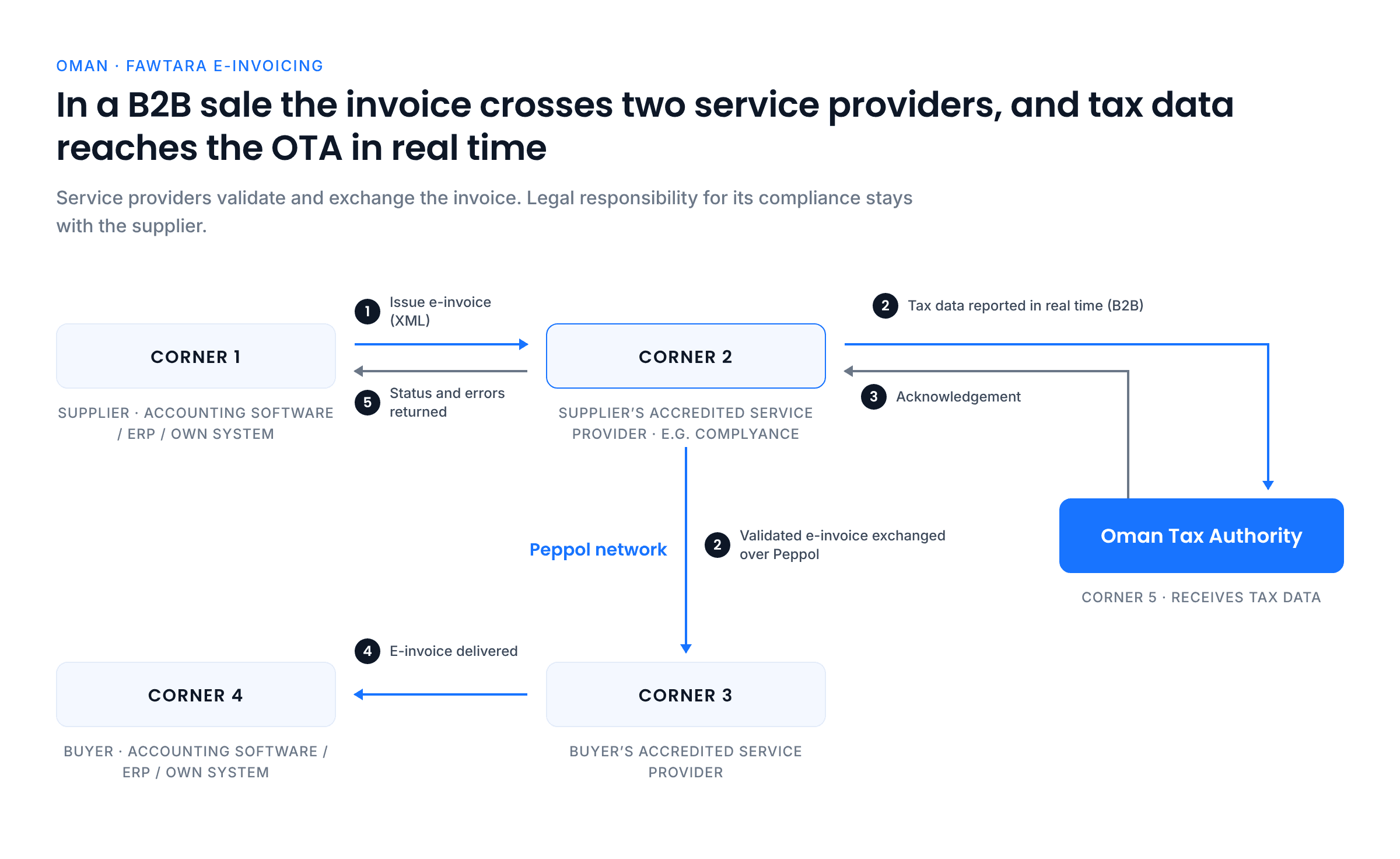
The five-corner model is an e-invoicing arrangement involving five participants:
- The supplier, which issues the invoice.
- The supplier’s accredited service provider (ASP), which validates and sends invoice data.
- The buyer’s ASP, which receives and routes invoice data to the buyer.
- The buyer, which receives the invoice.
- The OTA, which receives the required tax data for compliance and oversight.
The model separates the business transaction from the technical services used to exchange the invoice. The supplier and buyer remain the parties to the transaction, while service providers help move the structured data between systems.
The OTA’s official e-invoicing overview describes Oman’s five-corner approach and the roles involved.
What does each corner do?
| Corner | Participant | Main responsibility |
|---|---|---|
| 1 | Supplier | Creates the invoice and is responsible for the accuracy of the transaction and tax information. |
| 2 | Supplier’s ASP | Validates the invoice against the applicable rules and sends it through the network. |
| 3 | Buyer’s ASP | Receives and routes the invoice data to the buyer’s connected system. |
| 4 | Buyer | Receives the invoice and processes it within its own business controls. |
| 5 | OTA | Receives the required tax data to support reporting and compliance oversight. |
The service providers handle important technical checks, but they do not take over the supplier’s legal responsibility for the invoice. Businesses must still ensure that their transaction details and tax treatment are correct.
How does a standard B2B invoice move?
For a business-to-business (B2B) transaction, the general flow follows the five corners.
Step 1: The supplier creates the invoice. The supplier prepares the invoice in its ERP, accounting or billing system. The data should reflect the actual transaction, including the parties, items, amounts and applicable tax details.
Step 2: The supplier’s ASP validates the invoice. The provider checks the invoice against the applicable technical and business rules. If validation identifies an issue, the supplier needs to correct the relevant data or configuration.
Step 3: The supplier’s ASP exchanges the invoice with the buyer’s ASP. The service providers handle the structured invoice exchange through the e-invoicing network, rather than relying on a PDF attachment as the main exchange method.
Step 4: The buyer’s ASP routes the invoice data. The buyer’s provider makes the structured data available to the buyer’s connected system. This can support automated processing when the buyer’s systems are configured for it.
Step 5: The buyer processes the invoice. The buyer uses the received information in its accounts payable workflow, subject to its own checks and business controls.
Tax data is reported to the OTA in parallel with invoice exchange. This allows the OTA to receive the required information for tax reporting and oversight as part of the process. The OTA’s service provider guidance states that B2B submission takes place in real time.
How does the flow differ for consumer transactions?
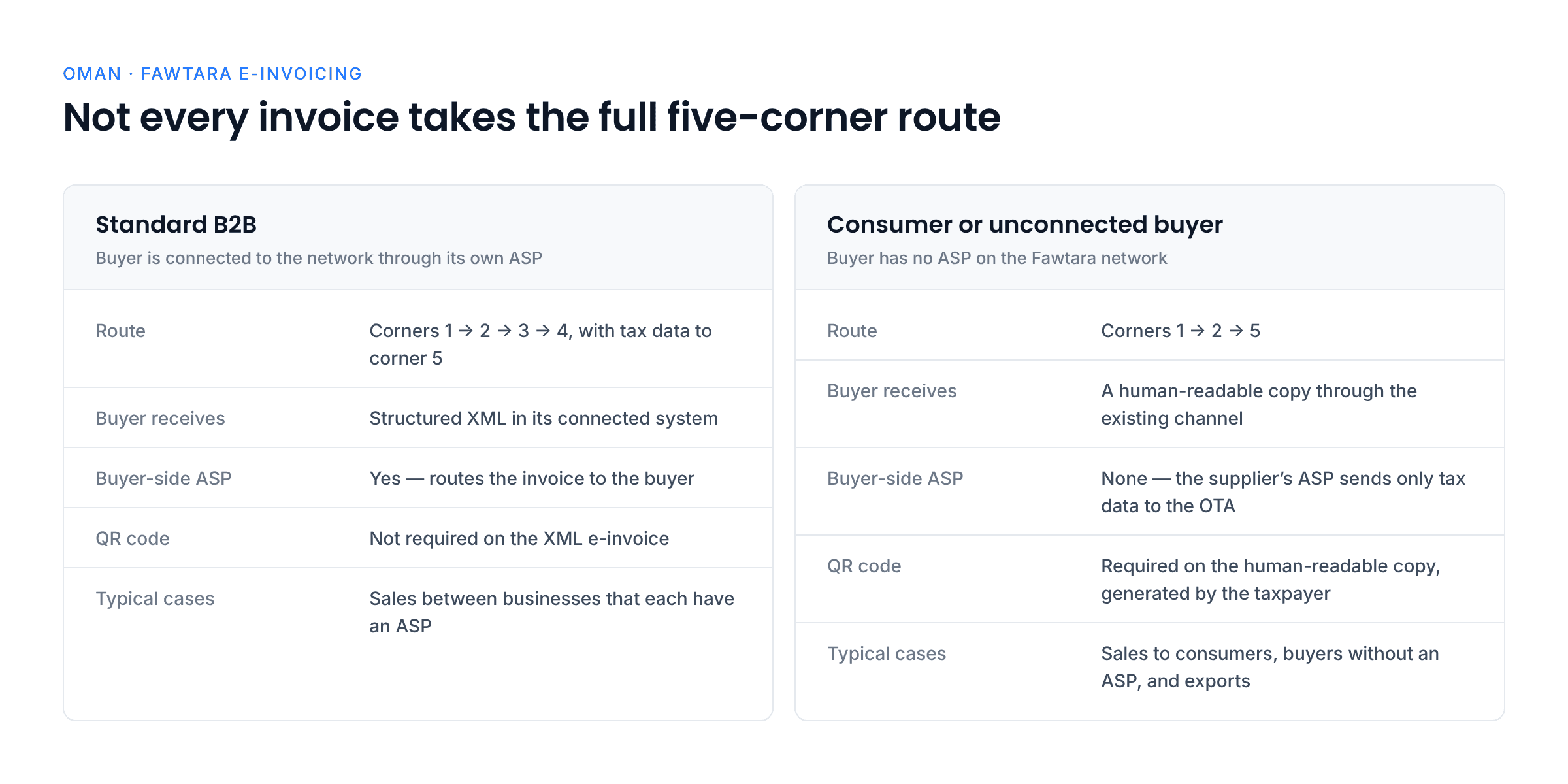
Not every transaction uses the full supplier-to-buyer route in the same way. For specified transaction types, such as sales to consumers or other buyers who are not VAT-registered and do not have an ASP, the buyer does not receive the invoice through a buyer-side ASP.
In this scenario, the supplier submits the invoice through its ASP, and the ASP submits the required tax data to the Oman Tax Authority (OTA). The supplier can exchange a compliant human-readable version of the invoice with the buyer outside the Fawtara network. Under the OTA’s current guidance, this version requires a QR code that allows the buyer to validate the e-invoice.
This matters for businesses that sell to both VAT-registered businesses and consumers. Their systems may need to support more than one transaction route rather than assume every invoice follows the same five-corner path.
The OTA’s service provider FAQ should be checked for current rules on transaction types, reporting and timing. The OTA states that B2B invoices are submitted in real time. For B2C invoices, it has not yet stipulated a submission timeframe, so businesses should monitor official guidance and confirm the applicable requirements with their provider.
What is the role of the accredited service provider?
An accredited service provider connects the business’s invoicing systems to the Fawtara network. It validates invoice data, supports exchange and reports the required tax information according to the applicable process.
The provider is a key part of the technical flow, but it is not a replacement for the business’s own invoice controls.
When assessing a provider, businesses should ask:
- Is the provider officially accredited? Check the OTA’s accredited service provider list rather than relying only on a provider’s own marketing claims.
- Can it connect to your current systems? Confirm support for your ERP, accounting or billing software so invoice data can move without unnecessary manual handling.
- How are validation errors explained? Clear error details help your team find the cause of a failed invoice and correct the source data.
- Can you track invoice status? Status visibility helps Finance and IT understand whether an invoice was processed, rejected or needs follow-up.
- How are updates and support handled? Ask how the provider manages rule changes, testing and technical incidents so your implementation stays aligned with official requirements.
Businesses should select a provider accredited by the OTA. For example, businesses may consider accredited service providers like Complyance; always verify current accreditation and supported capabilities on the OTA’s official list.
What remains the supplier’s responsibility?
Using an ASP does not remove the supplier’s responsibility for issuing a compliant invoice. The service provider can validate data against technical rules, but it cannot independently guarantee that every commercial fact supplied by the business is correct.
The supplier should:
- Provide accurate transaction data: Ensure customer details, goods or services, prices and tax treatment match the actual transaction. Incorrect source data can remain incorrect even if the file is technically valid.
- Maintain tax controls: Check that VAT codes, rates and calculations are applied correctly. These are business and tax decisions, not simply file-format checks.
- Correct invoice errors: Review validation messages and fix the underlying issue when an invoice is rejected. The source system or mapping may need to be corrected to prevent repeat errors.
- Keep required records: Maintain invoice records and supporting information under the applicable record-keeping rules. Businesses should not assume the OTA will provide archived copies back to them.
- Monitor official requirements: Keep up with OTA guidance and coordinate changes with the service provider. This helps prevent outdated settings from creating recurring issues.
The OTA’s service provider FAQ states that the taxpayer remains responsible for invoice compliance.
What should the buyer prepare?
The buyer also has work to do. Receiving structured invoice data can improve processing, but only if the buyer’s systems and internal controls are ready to use it.
- Confirm the receiving setup: Work with your ASP and software team to confirm how incoming invoices will reach your ERP or accounts payable system. This reduces the risk of invoices arriving in a place no one monitors.
- Map supplier information: Check how supplier identifiers and invoice fields match your internal records. Consistent data helps reduce duplicate supplier records and reconciliation issues.
- Define exception handling: Decide who reviews rejected, incomplete or mismatched invoices. Clear ownership helps exceptions reach the right person quickly.
- Update accounts payable procedures: Review how invoices are matched, approved and recorded after receipt. Structured data may support automation, but internal approval controls still matter.
- Train relevant teams: Help Finance, Tax and IT understand the new statuses and exception process. Teams need to know what action to take when an invoice cannot be processed automatically.
The buyer should also coordinate with its service provider to understand the exact receiving workflow, supported document types and reporting available.
What happens if an invoice fails validation?
If the invoice data does not meet the applicable rules, the service provider can identify a validation issue and return information needed to correct it. The exact error handling depends on the implementation and the rule that failed.
Common causes include missing required fields, invalid identifiers, incorrect tax values, mismatched totals or an incorrect document structure. The supplier should review the error message and correct the source data or configuration rather than repeatedly changing the generated file without addressing the cause.
The buyer and supplier should also agree how to handle business disputes separately from technical validation. An invoice can pass technical checks while still needing commercial review, such as confirming that the goods or services were received.
Final thoughts
Oman’s five-corner model defines how structured invoice data moves between suppliers, service providers, buyers and the OTA. Understanding the flow helps businesses prepare their systems, assign responsibilities and resolve invoice issues more effectively.
Suppliers should focus on accurate invoice data and source-system controls. Buyers should prepare their receiving and accounts payable processes. Both should confirm the workflow with their accredited service provider and follow the latest OTA requirements.
Official sources
- Oman Tax Authority: E-invoicing overview
- Oman Tax Authority: Service provider FAQs
- Oman Tax Authority: E-invoicing FAQs
- Oman Tax Authority: Accredited service providers
- Oman Tax Authority: Taxpayer guidance hub
Editorial note: This article is general information, not legal or tax advice. Check the latest OTA guidance for the rules that apply to your transaction types and implementation.
Frequently Asked Questions
It is called the five-corner model because five participants have defined roles: supplier, supplier’s ASP, buyer’s ASP, buyer and OTA. Together, they support invoice exchange and tax reporting.
No. The standard B2B flow includes both the supplier’s and buyer’s ASP. For specified transaction types where the buyer does not receive the invoice through a buyer-side ASP, the supplier’s ASP sends the required data to the OTA and the supplier provides a human-readable copy with the required QR code.
No. The service provider validates and exchanges invoice data, but the taxpayer remains responsible for invoice compliance. Businesses must maintain their own controls over transaction details and tax calculations.
The OTA’s service provider guidance states that B2B invoices are submitted in real time. For B2C invoices, the OTA has not yet stipulated a submission timeframe. Businesses should monitor official updates and confirm the applicable requirement with their provider.
Use the OTA’s official accredited service provider list. Confirm the provider’s current listing and ask about its supported systems, validation process and implementation support.
About the Author

Swathy
Content Marketer
I’m a Content Marketer at Complyance, focused on e-invoicing. Over the years, I’ve created a wide range of content, including blog posts, whitepapers, and product guides, which have supported Complyance’s growth across markets such as the UAE and EU regions. My goal is to deliver content that is comprehensive, clear, accurate, and easy to understand, no matter how complex the topic.