Oman E-Invoicing Requirements: A Complete Business Compliance Guide

Understand Oman e-invoicing requirements under Fawtara, including invoice formats, service providers, system readiness and the official guidance businesses should check.
Table of Contents
Introduction
Oman is moving towards electronic invoicing through a national system called Fawtara, led by the Oman Tax Authority (OTA).
This change affects more than the way an invoice looks. Businesses will need to issue invoice data in a prescribed digital format and work with a compliant e-invoicing solution. They also need to review their current invoice data, software and internal process.
If your business issues tax invoices in Oman, start by understanding the OTA's published guidance and checking which rollout group applies to your company. This guide explains the main points in plain language and links to official sources.
What is e-invoicing in Oman?
E-invoicing means issuing and exchanging invoices as structured digital data through an approved process. A PDF invoice sent by email is not the same as a structured e-invoice.
The OTA says Fawtara is intended to improve tax compliance, reduce invoice fraud, support accurate data and make invoice exchange more efficient.
For businesses, this means that invoice details must be stored in a form that systems can read and check. Your team should review the information held in its ERP, accounting software, billing system or point-of-sale system before integration begins.
How does Fawtara work?
Oman's published guidance describes a five-corner model. Each party has a clear role.
| Party | Role |
|---|---|
| Supplier | Creates the invoice in its business system. |
| Supplier's service provider | Checks the invoice and sends it through the network. |
| Buyer's service provider | Receives the invoice and passes it to the buyer. |
| Buyer | Receives the electronic invoice. |
| Oman Tax Authority | Receives the required tax data. |
The OTA's e-invoicing overview explains this model. Its service provider FAQ also explains the role of service providers in validating and exchanging invoices.
Businesses should check that their chosen provider is officially accredited. The Fawtara portal's accredited provider list is the place to verify that status.
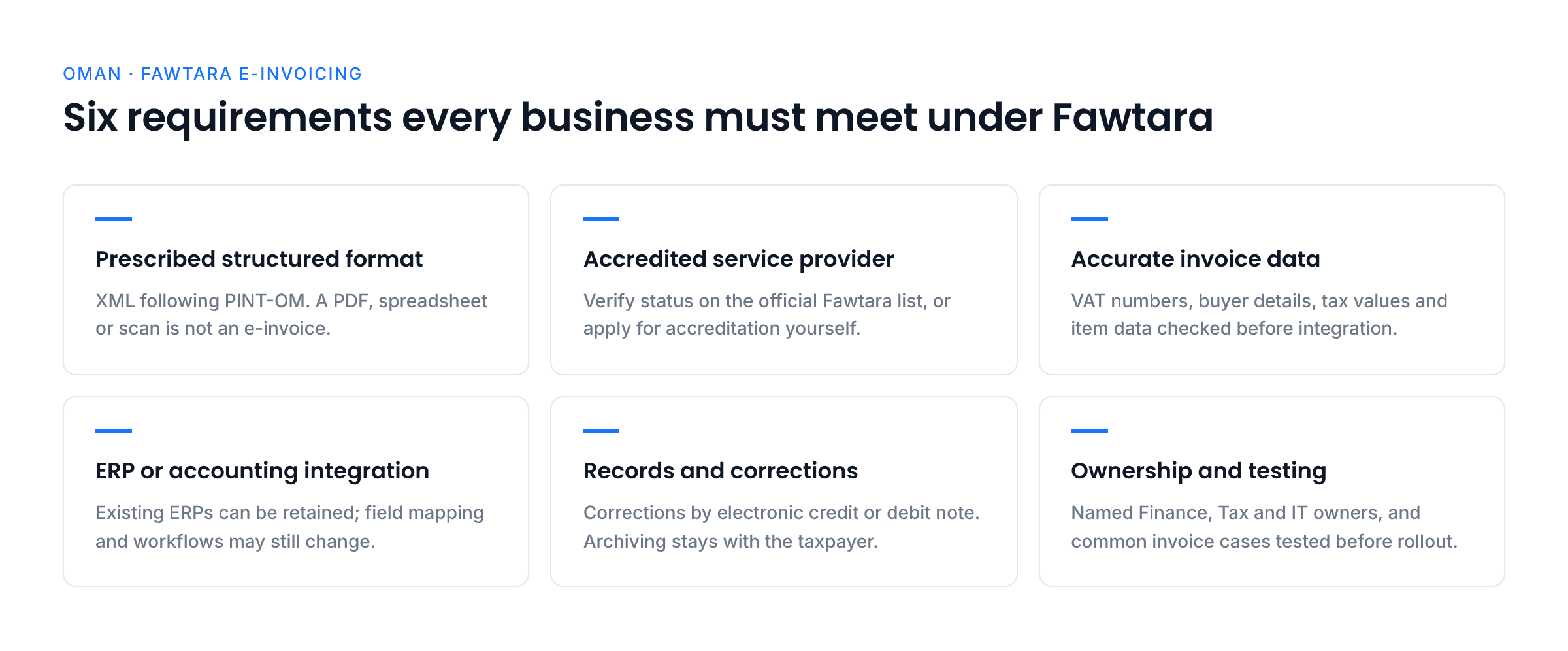
What are the main Oman e-invoicing requirements?
| Requirement | What the business should do |
|---|---|
| Structured invoice format | Prepare invoice data in the required XML format and follow the latest applicable technical specifications. |
| Accredited service provider | Check the provider's status on the official Fawtara list before signing up. |
| Accurate invoice data | Review supplier, buyer, tax and item data before integration and testing. |
| ERP or accounting integration | Confirm how the current system will connect to the e-invoicing solution. |
| Records and corrections | Agree how invoices, credit notes, debit notes and supporting records will be stored and retrieved. |
| Ownership and testing | Assign Finance, Tax and IT owners and test common invoice cases before rollout. |
1. Use the prescribed structured format
The OTA's published Fawtara FAQ says XML is the mandatory structured format. The final invoice output must follow the technical rules that apply to the business and its document type.
The Oman-specific Peppol specification is known as PINT-OM. Businesses should use the latest official technical material and the guidance provided by their accredited service provider when mapping invoice data.
Do not assume that a PDF, spreadsheet or scanned image alone meets the structured e-invoicing requirement.
2. Choose an accredited service provider
The OTA says taxpayers should select an accredited service provider or apply for accreditation themselves if they meet the required criteria.
A provider helps validate and exchange invoices through the Fawtara network. Before choosing one, check the official list and ask how the provider will connect to your existing systems, report errors and show invoice status.
3. Check invoice data before integration
Invoice errors can begin long before an invoice is sent. A missing VAT number, incorrect tax value, incomplete buyer details or inconsistent item data can create problems during validation.
Start by listing the systems that create invoices. Review the data they hold and compare it with the latest official data dictionary and business rules available for your rollout.
The OTA's FAQ says that service providers validate invoice formats and business rules, but the taxpayer remains responsible for invoice compliance.
4. Review your ERP and accounting software
You may not need to replace your existing ERP. The OTA's Fawtara FAQ says current ERP systems can be retained, depending on the arrangement with the accredited service provider.
Your business may still need to update field mapping, invoice workflows or integration settings. Ask your provider to show how invoice data moves from your system into the required format, how errors are returned, and how the team can track each invoice.
5. Plan for secure records and corrections
Businesses should understand how electronic invoices will be stored and retrieved under the applicable VAT rules. They should also know how to correct an invoice after it has been issued.
The OTA FAQ says that an issued invoice can be adjusted through an electronic credit note or debit note. Confirm the final process and record-retention rules against current official guidance before changing your procedures.
When does Oman e-invoicing become mandatory?
Check this section against the latest official notice before publication. The OTA's public pages reviewed for this article do not show one consistent timeline.
The OTA E-invoicing FAQs currently display this four-phase plan:
| Phase | Timeline shown on the OTA FAQ | Group |
|---|---|---|
| Phase 1 | August 2026 | 100 large VAT-registered companies |
| Phase 2 | February 2027 | All large VAT-registered companies |
| Phase 3 | August 2027 | Remaining VAT-registered taxpayers |
| Phase 4 | Year not stated | Government institutions and entities |
The OTA also provides a potential rollout checker that asks for a VAT identification number and current and expected annual taxable supplies, with a threshold of OMR 5 million.
Some recent third-party articles cite Decision No. 189/2026 and report two mandatory dates based on annual supplies. However, the OTA's public VAT law page checked for this article did not list that decision, and the current FAQ still displays the four-phase timeline.
For that reason, businesses should check their rollout group directly with the OTA and confirm the applicable legal instrument before relying on a date. Complyance should update this section when the official legal text or written OTA confirmation is available.
How should businesses prepare?
Use this checklist to begin:
- Check the latest OTA rollout information for your company.
- List the systems that create or change invoices.
- Review buyer, supplier, tax and item data.
- Ask your ERP or accounting provider how it will support Fawtara.
- Check the OTA's accredited service provider list.
- Confirm how invoice validation errors and corrections will be handled.
- Plan tests for regular invoices and credit notes.
- Assign owners from Finance, Tax and IT.
- Monitor OTA updates and record the source and date checked.
| Team | Suggested task |
|---|---|
| Finance | Check invoice fields, tax calculations and credit/debit note workflows. |
| Tax | Confirm applicable rules, reporting needs and rollout information. |
| IT | Review system connections, field mapping, testing and error handling. |
| Procurement or management | Assess provider accreditation, service scope and support arrangements. |
Starting early gives the team time to find data gaps and test the process before its rollout date.
Final thoughts
Oman e-invoicing readiness starts with a few practical steps: understand the Fawtara process, review your invoice data, check your systems and confirm your rollout group through official channels.
Keep checking the OTA's latest material as technical rules and rollout information are updated. This helps your business prepare without relying on dates or technical claims that have not been confirmed by the official source.
------------------------------------------------------------------------
Official sources
- Oman Tax Authority: E-invoicing overview
- Oman Tax Authority: E-invoicing FAQs
- Oman Tax Authority: Fawtara FAQ document
- Oman Tax Authority: Potential rollout checker
- Fawtara portal: Accredited service providers
- Oman Tax Authority: VAT Law & Regulations
- Oman Tax Authority: Taxpayer guidance hub
Editorial note: This article is general information, not legal or tax advice. Recheck the official legal text, rollout dates and technical guidance before publication.
Frequently Asked Questions
Oman is implementing Fawtara in phases. Businesses should check the latest OTA notices and confirm the rollout group that applies to them. Do not rely only on a third-party article or an older timeline.
The OTA's published FAQ says XML is the mandatory structured format. A PDF alone should not be treated as a replacement for the required structured e-invoice.
Not always. The OTA says existing ERP systems can be retained, depending on the arrangement with the accredited service provider. Integration or data-mapping changes may still be needed.
Check the provider's status on the official Fawtara accredited service provider list. Do not rely only on a vendor's marketing claim.
Start with the OTA e-invoicing overview, the OTA e-invoicing FAQs, the Fawtara FAQ document, and the OTA rollout checker.
About the Author

Swathy
Content Marketer
I’m a Content Marketer at Complyance, focused on e-invoicing. Over the years, I’ve created a wide range of content, including blog posts, whitepapers, and product guides, which have supported Complyance’s growth across markets such as the UAE and EU regions. My goal is to deliver content that is comprehensive, clear, accurate, and easy to understand, no matter how complex the topic.