Oman E-Invoicing Timeline: Mandatory Dates and Implementation Phases

Check Oman’s Fawtara e-invoicing dates, the OMR 5 million turnover test, VAT group rules and how to confirm your business’s implementation period.
Table of Contents
Introduction
For businesses in Oman, knowing that e-invoicing is coming is not enough. The key question is when the requirement applies to your business.
The Oman Tax Authority (OTA) has published updated rollout information that links implementation dates to annual taxable supplies. Under the OTA FAQ PDF updated on 30 September 2026, the key dates are 1 April 2027 and 1 October 2027.
The date for a business depends on whether its taxable supplies exceed OMR 5 million during either of the specified periods. Businesses that are part of a VAT group also need to assess the threshold at group level.
This guide explains the dates, the threshold test and how to check your likely implementation period.
Oman e-invoicing mandatory dates
The OTA’s updated FAQ PDF sets out two main dates based on annual taxable supplies in Oman.
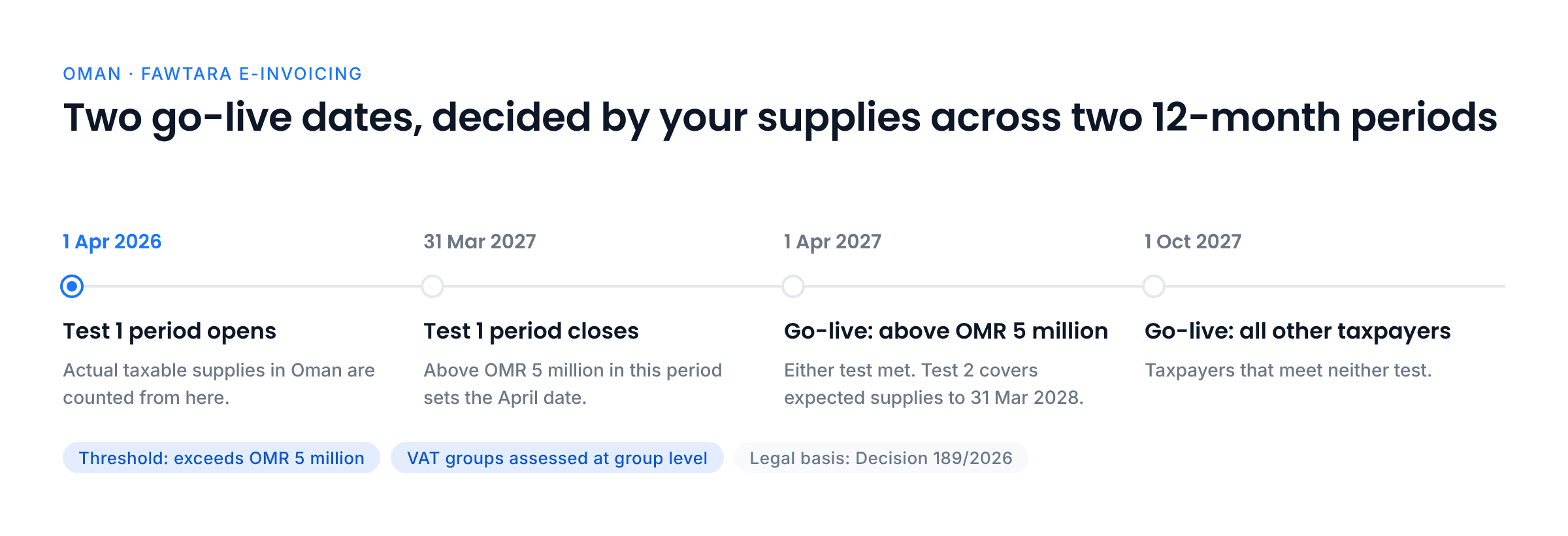
| Implementation date | Who it applies to | What to check |
|---|---|---|
| **1 April 2027** | Taxpayers whose supplies exceed OMR 5 million under either of the specified turnover tests. | Check actual supplies for 1 April 2026 to 31 March 2027, and expected supplies for 1 April 2027 to 31 March 2028. If either period exceeds OMR 5 million, the earlier date applies. |
| **1 October 2027** | Taxpayers who do not meet the OMR 5 million test for the earlier date. | Review your taxable supplies and confirm your position against the latest OTA guidance. |
The relevant legal basis is Decision 189/2026, which amends the VAT Executive Regulation. Businesses should review the applicable official decision and OTA guidance when confirming their legal obligations.
Important: The threshold is based on taxable supplies, not simply profit or the value of cash collected. Finance teams should use the measure specified by the OTA and keep records supporting their assessment.
Official source: OTA Fawtara FAQ PDF, updated 30 September 2026
How the OMR 5 million threshold works
The earlier implementation date applies if taxable supplies exceed OMR 5 million in either of two periods. This means businesses need to consider both their actual supplies for the first period and their expected supplies for the following period.
Test 1: Actual supplies from 1 April 2026 to 31 March 2027
Review the business’s taxable supplies in Oman for the 12-month period ending 31 March 2027. If the total is more than OMR 5 million, the 1 April 2027 implementation date applies.
Test 2: Expected supplies from 1 April 2027 to 31 March 2028
Estimate taxable supplies for the next 12-month period. If expected supplies exceed OMR 5 million, the earlier implementation date applies even if the previous period did not exceed the threshold.
| Example | Actual supplies, 1 Apr 2026 to 31 Mar 2027 | Expected supplies, 1 Apr 2027 to 31 Mar 2028 | Likely date under the published test |
|---|---|---|---|
| Business A | OMR 5.4 million | OMR 5.8 million | 1 April 2027 |
| Business B | OMR 4.6 million | OMR 5.2 million | 1 April 2027 |
| Business C | OMR 4.2 million | OMR 4.7 million | 1 October 2027 |
These examples illustrate how the two tests work. They are not official determinations for any particular taxpayer. Businesses should confirm their position using the OTA’s published guidance and rollout checker.
What if supplies are exactly OMR 5 million?
The earlier-date test uses the wording exceed OMR 5 million. Exactly OMR 5 million is not more than the threshold. However, businesses should assess both specified periods and confirm their interpretation against the latest OTA guidance.
How are VAT groups assessed?
The threshold should not be assessed only by looking at each company in isolation. According to the updated guidance, businesses in a VAT group are assessed at the group level.
This matters when several legal entities share a VAT registration. A company whose own supplies are below OMR 5 million may still be part of a group that meets the threshold.
VAT groups should:
- Review the group’s taxable supplies: Use the relevant group-level figures for the specified periods. Looking only at one entity may give an incomplete view of the implementation date.
- Coordinate across group companies: Make sure Finance teams use consistent figures and assumptions when assessing actual and expected supplies. This reduces the risk of different entities reaching different conclusions.
- Confirm the group’s implementation arrangements: Check the OTA instructions and coordinate the e-invoicing setup across the group. Related companies may need a coordinated onboarding plan.
For a definitive assessment, refer to the updated OTA FAQ and seek clarification from the OTA or a qualified tax adviser if the group structure or threshold calculation is unclear.
How to check your business’s implementation period
The OTA provides an online rollout checker. It asks for your VATIN and whether current and expected annual taxable supplies are up to or over OMR 5 million.
Use the OTA Potential Fawtara Implementation Period checker to review the period indicated for your business.
Before using it, prepare the following:
- Your VATIN: The checker uses your VAT identification number to identify the taxpayer record.
- Actual annual taxable supplies: Have the figures for the period from 1 April 2026 to 31 March 2027 ready, using the measure required by the OTA.
- Expected annual taxable supplies: Prepare a reasonable estimate for 1 April 2027 to 31 March 2028, based on your business outlook and available financial data.
- VAT group information, if applicable: Confirm whether the threshold needs to be assessed at group level rather than for a single company.
The OTA labels the checker as a tool for awareness, preparation and readiness. Treat its result as guidance, not a substitute for checking the applicable legislation and official rollout communication.
What about the older rollout schedule?
Some OTA web pages and older FAQ materials have shown an earlier phase-based schedule, including August 2026, February 2027 and August 2027. That schedule does not match the turnover-based dates in the OTA FAQ PDF updated on 30 September 2026.
When sources differ, use the latest applicable official guidance and confirm which document governs your implementation date. For the turnover-based dates in this article, refer to the updated OTA FAQ PDF.
The OTA’s HTML e-invoicing FAQ page may still display the older phase schedule. Do not rely on that page alone to determine your date if it conflicts with the updated PDF or direct communication from the OTA.
What should businesses do once they know their date?
After confirming the likely implementation period, turn the date into an internal deadline. The work should be planned early enough to allow for system changes, testing and issue resolution.
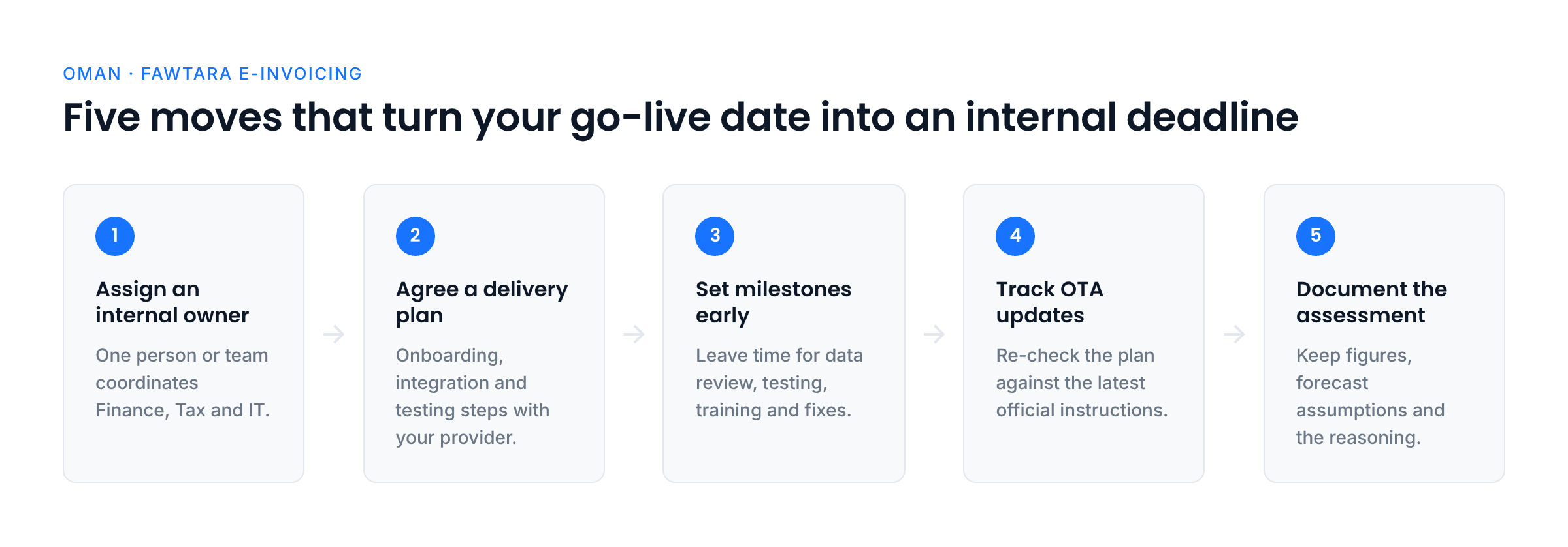
- Assign an internal owner: Name a person or team responsible for tracking the deadline and coordinating Finance, Tax and IT. Clear ownership makes it easier to monitor progress.
- Agree a delivery plan with your provider: Set out the steps required for onboarding, integration and testing. This helps the business understand what must be completed before its applicable date.
- Set internal milestones ahead of the deadline: Plan time for data review, testing, user training and issue correction. Leaving every task until the final weeks increases delivery risk.
- Track official updates: Review OTA announcements and technical guidance as implementation details evolve. A planned date should be checked against the latest official instructions.
- Keep evidence of your threshold assessment: Save the actual figures, forecast assumptions and the reasoning used to determine the date. This helps explain the decision if it is reviewed later.
Businesses should select a provider accredited by the OTA. accredited service providers like Complyance (check the OTA’s official accredited provider list) can support the required e-invoicing setup, but each taxpayer should confirm its implementation date and responsibilities separately.
Final thoughts
The important step is to identify which date applies to your business and document how you reached that conclusion. The OMR 5 million test considers both actual taxable supplies for 2026–2027 and expected supplies for 2027–2028, with VAT groups assessed at group level.
Review the updated OTA FAQ, use the rollout checker as a guide and confirm any uncertainty with the authority or a qualified tax adviser. Once the date is clear, set internal milestones well ahead of it so your business has time to complete the required work.
Official sources
- OTA Fawtara FAQ PDF, updated 30 September 2026
- OTA Potential Fawtara Implementation Period checker
- OTA HTML e-invoicing FAQ page
- OTA taxpayer guidance hub
- OTA accredited service providers
Editorial note: This article is general information, not legal or tax advice. Confirm the applicable date against the latest official OTA guidance before making a compliance decision.
Frequently Asked Questions
Under the OTA FAQ PDF updated on 30 September 2026, the key dates are 1 April 2027 for taxpayers who exceed OMR 5 million under either specified turnover test, and 1 October 2027 for other taxpayers. Confirm your own position using the latest OTA guidance.
The test is based on taxable supplies in Oman for the periods specified by the OTA. Businesses should assess actual supplies from 1 April 2026 to 31 March 2027 and expected supplies from 1 April 2027 to 31 March 2028.
The earlier date applies if taxable supplies exceed OMR 5 million in either specified period. For example, expected supplies above the threshold in the 2027–2028 period can bring a business into the 1 April 2027 group even if its previous period was below the threshold.
The threshold is assessed at group level for VAT groups. Businesses should use the relevant group-level figures and coordinate their implementation planning across the entities involved.
No. The OTA describes the checker as a tool for awareness, preparation and readiness. Use it to help understand your likely period, then check the applicable official guidance and any direct communication from the OTA.
Some older FAQ content still shows a phase-based schedule. The updated FAQ PDF dated 30 September 2026 contains the turnover-based dates described in this article, so readers should check the latest applicable official document rather than rely on an older web page alone.
About the Author

Swathy
Content Marketer
I’m a Content Marketer at Complyance, focused on e-invoicing. Over the years, I’ve created a wide range of content, including blog posts, whitepapers, and product guides, which have supported Complyance’s growth across markets such as the UAE and EU regions. My goal is to deliver content that is comprehensive, clear, accurate, and easy to understand, no matter how complex the topic.