Oman E-Invoicing: Who Must Comply and When?

Find out whether your business falls under Oman's Fawtara e-invoicing rollout. Understand the OMR 5 million threshold, VAT groups, rollout checker and next steps.

Table of Contents
Introduction
If your business operates in Oman, one of the first questions to answer about Fawtara is simple: When does e-invoicing apply to us?
The answer depends on the Oman Tax Authority's (OTA) rollout rules and the information used to assess your business. Revenue or annual supplies are important, but businesses should not rely on a general article or a single figure alone. They should check the latest official guidance, consider whether they belong to a VAT group, and use the OTA's rollout checker to review their potential implementation period.
This guide explains the main applicability questions businesses should work through and what to do if the answer is not yet clear.
Who Needs to Comply with Oman E-Invoicing?
To determine whether your business needs to implement Fawtara, check the Oman Tax Authority’s rollout criteria and the implementation period that applies to your circumstances. The key factors include your current and expected annual taxable supplies, whether your business belongs to a VAT group, and the latest official guidance.
Oman is introducing e-invoicing in phases. The OTA provides a Potential Fawtara Implementation Period checker where taxpayers can enter their VAT identification number (VATIN) and select their current and expected annual taxable supplies in Oman.
The checker is intended to support awareness and preparation. It should be used alongside the latest OTA announcements and guidance, not as a substitute for checking official requirements.
Oman E-Invoicing Rollout: The OMR 5 Million Threshold
The OTA's rollout checker asks businesses to classify both their current and future expected annual taxable supplies in Oman against the OMR 5 million threshold. The threshold is therefore a key part of the applicability assessment.
The current threshold-based rollout guidance identifies these implementation dates:
----------------------------------------------------------------------- Potential implementation period Threshold assessment ----------------------------------- ----------------------------------- 1 April 2027 Businesses whose annual taxable supplies exceed OMR 5 million under the applicable assessment criteria
1 October 2027 Businesses whose annual taxable supplies are OMR 5 million or less under the applicable assessment criteria -----------------------------------------------------------------------
The exact assessment should be made using the current OTA guidance and rollout checker, which asks for both current and expected future annual taxable supplies. Do not decide your phase based only on a past financial year or a rough estimate without checking the applicable criteria.
Important: Some OTA web pages and FAQs have displayed older phase descriptions and dates. Because official materials have not always been fully aligned, businesses should check the latest OTA taxpayer resources and use the current rollout checker before making implementation decisions.
Official resources: - OTA Potential Fawtara Implementation Period checker - OTA taxpayer guidance and updates - OTA e-invoicing overview
How to Check Your Business's Potential Implementation Period
Use the OTA rollout checker as an early step in your planning.
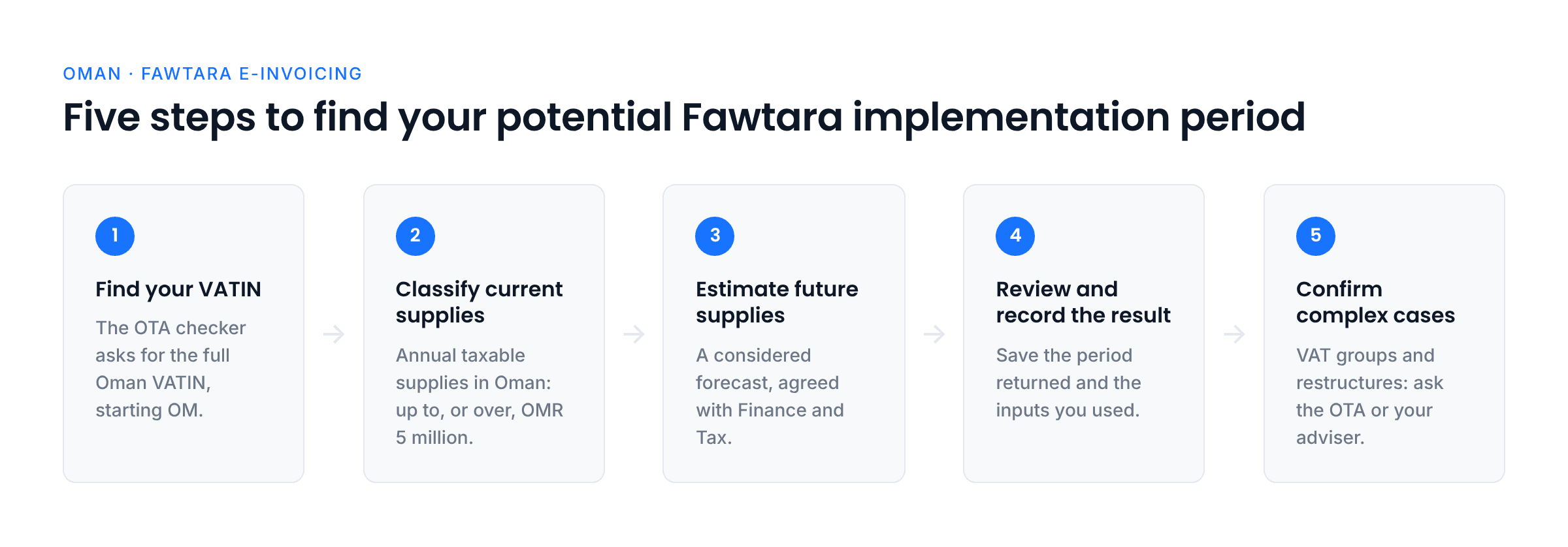
Step 1: Find your VATIN
Keep your business's Oman VAT identification number available. The checker asks for the full VATIN.
Step 2: Review current annual taxable supplies
Check your records and select the relevant range shown in the tool: up to OMR 5 million or over OMR 5 million.
Step 3: Estimate future annual taxable supplies
The checker also asks about expected future annual taxable supplies. Use a considered estimate based on your business plans and available financial information. If the estimate is uncertain, involve Finance and Tax before submitting it.
Step 4: Review the result
Use the potential implementation period returned by the checker as part of your readiness planning. Save a record of the assessment and the information used.
Step 5: Confirm if your circumstances are complex
If your business is part of a VAT group, has recently changed structure, or is unsure how its supplies should be assessed, seek clarification through the OTA's official channels or your tax adviser. Do not assume that the treatment of one legal entity automatically applies to every related company.
What If Your Business Is Part of a VAT Group?
VAT groups need particular attention when assessing Fawtara applicability.
The OTA's Service Provider FAQ states that companies within the same tax group that share one tax number must follow the e-invoicing procedures and must have a single, shared service provider. The OTA also notes that further details for VAT groups will be provided in due course.
For this reason, a group should not assess each company in isolation without considering its VAT-group arrangement.
VAT-group readiness checks:
- Confirm which legal entities are members of the VAT group.
- Verify the VAT number used for the group.
- Review how invoices are issued by each member.
- Identify the systems used by each company.
- Plan for a common service-provider arrangement in line with OTA guidance.
- Confirm any unclear group-specific assessment details with the OTA.
Read the current OTA Service Provider FAQ for the published guidance.
Does Being a Small or Medium-Sized Business Mean You Are Exempt?
No. A business should not assume that it is permanently outside Fawtara simply because it is small or medium-sized.
The OTA describes a phased rollout that extends beyond the initial group of large taxpayers. The threshold-based rollout checker allows taxpayers to assess annual taxable supplies both at present and for the future. Businesses below OMR 5 million should therefore check the potential implementation period rather than conclude that no action is required.
Even if your implementation date is later, early preparation can help you avoid having to clean data, change systems, choose a provider and test workflows at the same time.
What About Businesses With Out-of-Scope Supplies?
The OTA's Service Provider FAQ says that issuing e-invoices will not be mandatory for out-of-scope supplies, while also recommending that taxpayers await further clarification from legislation.
This is an important distinction: a business may have a mixture of transaction types, and the treatment of one type of supply should not be assumed to determine the treatment of all its invoices.
If your business makes supplies that may be outside the scope of VAT, work with your Tax team to identify the transaction types and check the latest OTA guidance. Avoid treating an entire business as exempt from Fawtara based only on the nature of some of its supplies.
Source: OTA Service Provider FAQ.
What If Your Business Has Not Been Contacted by the OTA?
Do not treat the absence of a notice or direct communication as confirmation that your business is outside the rollout.
Instead:
- Check the OTA's current taxpayer guidance.
- Use the potential rollout checker with the relevant VATIN and annual supplies information.
- Review your VAT-group status, if applicable.
- Keep a record of the result and assumptions used.
- Contact the OTA or seek professional advice if your position remains unclear.
The OTA says its taxpayer guidance is updated periodically to reflect implementation phases and regulatory or technical developments. Check the official resources regularly.
What Should Businesses Do Once They Know Their Potential Phase?
After checking applicability, turn the result into a practical plan. The exact work will depend on your systems and transaction profile, but most businesses should start with these steps.
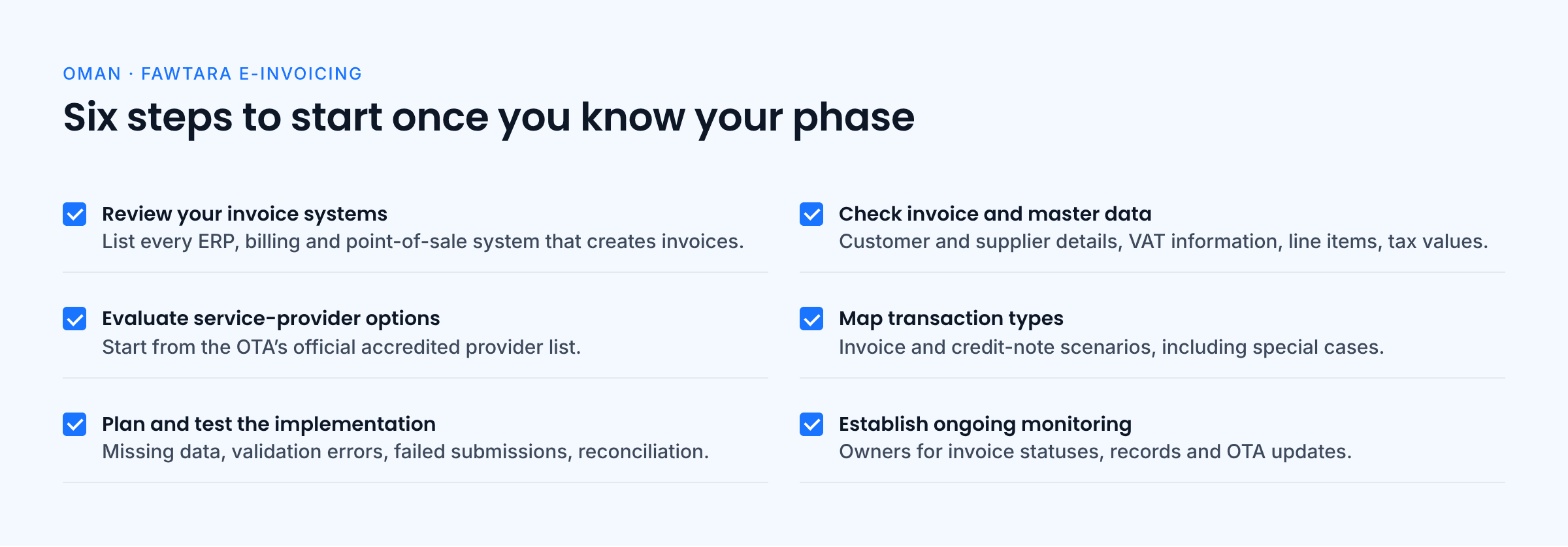
Review your invoice systems
List the ERP, accounting, billing, point-of-sale and other systems that create invoices. Identify how each system's data can be provided to your e-invoicing service provider.
Check invoice and master data
Review customer and supplier details, VAT information, invoice numbers, dates, line items, tax values and references. Correct inconsistent records and document how important fields are maintained.
Evaluate service-provider options
Review the OTA's official accredited service provider list. Compare providers based on integration, validation, testing, support, security and ongoing maintenance. Businesses assessing accredited service providers like Complyance should confirm the provider's current status and suitability for their own requirements.
Map transaction types
Identify the invoice and credit-note scenarios your business handles, including any special cases relevant to its activities. Ask your Tax team and service provider to confirm how each scenario should be handled under the current Oman requirements.
Plan and test the implementation
Agree on responsibilities, integration requirements, test scenarios and go-live criteria. Test how the process handles missing data, validation errors, failed submissions and reconciliation.
Establish ongoing monitoring
Define who reviews invoice statuses, investigates problems, maintains records and checks for OTA updates. Applicability is the first decision; maintaining compliance requires a process after implementation as well.
Applicability Checklist
Use this checklist to organise your initial review.
- Confirm your Oman VATIN.
- Review current annual taxable supplies in Oman.
- Estimate future expected annual taxable supplies.
- Use the OTA's rollout checker.
- Check whether your business belongs to a VAT group.
- Identify transaction types that may need separate treatment.
- Review current OTA guidance for updates or clarifications.
- Record the potential implementation period and the basis for the assessment.
- Assign owners for data, ERP, provider selection and testing.
- Revisit the assessment if business circumstances or official guidance change.
Conclusion: Confirm Applicability Before Planning Your Implementation
The first step in preparing for Oman e-invoicing is to understand when Fawtara may apply to your business. The OMR 5 million threshold is central to the current rollout assessment, but businesses should also review current and expected annual taxable supplies, VAT-group arrangements and the latest OTA guidance.
Use the official rollout checker, keep a record of the result and seek clarification if your situation is not straightforward. Once you have a clearer view of your potential implementation period, you can plan the work needed across systems, data, service-provider selection, testing and internal processes.
The safest approach is to treat applicability as a documented business assessment and revisit it when your circumstances or official guidance change.
Official Sources
Frequently Asked Questions
The OTA's current rollout checker asks taxpayers whether their current and future expected annual taxable supplies in Oman are up to or over OMR 5 million. This information helps determine the potential implementation period. Check the current OTA criteria before deciding which date applies to your business.
The current threshold-based guidance identifies 1 April 2027 and 1 October 2027 as implementation dates for different groups of taxpayers. Because some OTA pages have shown older phase information, use the current rollout checker and latest OTA guidance to confirm your potential period.
Small businesses should not assume they are permanently exempt. The rollout is phased, and the OTA checker allows taxpayers to assess their potential implementation period based on annual taxable supplies. Check your circumstances using the official tool.
The OTA's Service Provider FAQ says that companies in the same tax group sharing one tax number must follow the e-invoicing procedures and use a single, shared service provider. Check the latest OTA guidance for further details that may affect your group.
The OTA's Service Provider FAQ says e-invoicing is not mandatory for out-of-scope supplies but recommends awaiting further legislative clarification. Businesses should confirm how the guidance applies to their particular transaction types.
Use the OTA Potential Fawtara Implementation Period checker. It asks for your VATIN and current and future expected annual taxable supplies in Oman.
About the Author

Swathy
Content Marketer
I’m a Content Marketer at Complyance, focused on e-invoicing. Over the years, I’ve created a wide range of content, including blog posts, whitepapers, and product guides, which have supported Complyance’s growth across markets such as the UAE and EU regions. My goal is to deliver content that is comprehensive, clear, accurate, and easy to understand, no matter how complex the topic.