Oman Fawtara E-Invoicing: What Businesses Need to Know

Learn how Oman’s Fawtara e-invoicing system works, the 2027 go-live dates, mandatory ASP requirements, Peppol PINT-OM, and how businesses can prepare.
Table of Contents
Introduction
A business may create an invoice in its accounting system, send a PDF to a customer, and then enter the same details into another system for reporting. This can create extra work and increase the chance of errors.
Oman’s Fawtara system is designed to move invoice processing towards structured electronic data. It connects businesses, accredited service providers and the Oman Tax Authority (OTA) through a shared e-invoicing network.
For businesses, two questions matter most: when must they go live, and what must they do before that date? The OTA’s FAQ PDF, updated on 30 September 2026, sets out two mandatory implementation dates based on annual supplies. It also confirms that taxpayers must use an accredited service provider (ASP), or apply to become accredited themselves.
This guide explains how Fawtara works, the dates businesses need to know, and the practical steps to prepare.
What is Fawtara in Oman?
Fawtara is Oman’s national e-invoicing system, led by the Oman Tax Authority. The Arabic word fawtara (فوترة) means “invoicing.” The system supports the electronic issuance, validation, exchange and reporting of invoice data.
A PDF invoice is not an e-invoice under the OTA’s guidance. The mandatory structured format is XML, using Oman’s Peppol PINT-OM specifications. Paper invoices may still be issued, but the OTA states that only e-invoices will be considered valid invoices for tax purposes once the applicable mandate applies.
The system is intended to improve data quality, reduce manual work and support tax compliance. Businesses can read the OTA’s e-invoicing overview and the official Fawtara FAQ PDF, updated 30 September 2026.
When does Oman Fawtara become mandatory?
The OTA’s FAQ PDF updated on 30 September 2026 sets out these dates:
| Go-live date | Who must implement e-invoicing? |
|---|---|
| **1 April 2027** | Taxpayers whose supplies from 1 April 2026 to 31 March 2027 exceed OMR 5 million, or whose expected supplies from 1 April 2027 to 31 March 2028 exceed OMR 5 million. |
| **1 October 2027** | Taxpayers who do not meet either of the OMR 5 million tests above. |
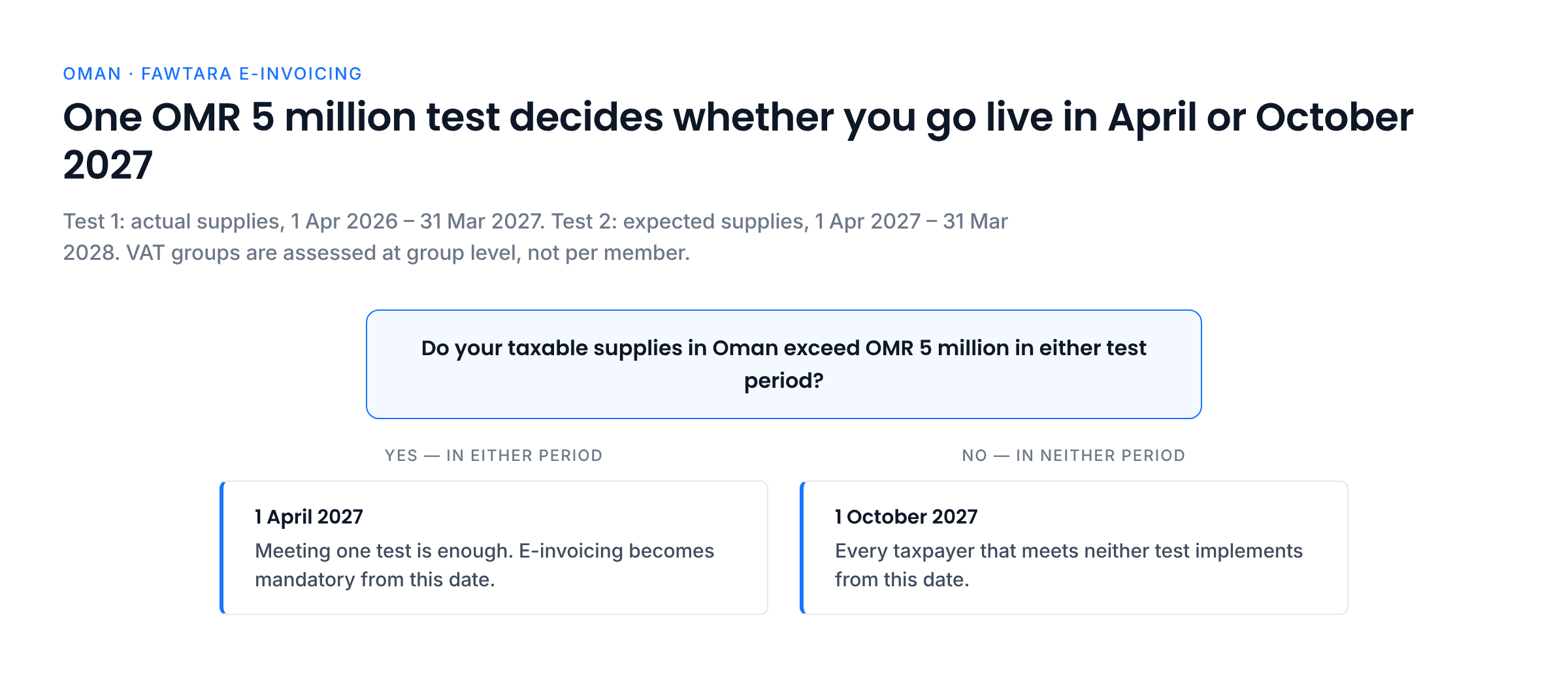
The threshold is assessed at VAT-group level, not separately for each company in the group. For non-resident taxpayers, the calculation is based on supplies made in Oman. The OTA’s calculation includes taxable supplies excluding capital asset supplies, supplies subject to the reverse-charge mechanism, and intra-GCC supplies of goods and services.
The legal basis is Decision 189/2026, which amends provisions of the VAT Executive Regulation. Businesses should use the updated OTA FAQ PDF rather than older web summaries that still show the previous phased schedule.
You can also use the OTA’s rollout checker as an awareness and preparation tool. It asks for your VATIN and information about your supplies. It does not replace checking the applicable rules or confirming your position with the OTA.
Is an accredited service provider mandatory?
Yes. Every e-invoice must be validated by the issuer’s accredited service provider. The OTA instructs taxpayers to select an ASP or apply for accreditation themselves. A business cannot treat the ASP as an optional extra if it is required to issue e-invoices under the mandate.
Taxpayers connect to an ASP through the Fawtara portal. A taxpayer can be connected to only one service provider at a time, although it can disconnect and link to another provider later.
The ASP validates invoice data against Oman’s applicable Schematron rules, exchanges invoice data where required, and reports the specified tax data to the OTA. The taxpayer remains responsible for the invoice’s compliance, including the accuracy of the underlying transaction and tax treatment.
When evaluating a provider, check:
- Official accreditation: Verify that the provider appears on the OTA’s accredited service provider list. This confirms that the provider is listed by the authority.
- System integration: Ask whether it can connect to your ERP, accounting or billing system. A suitable integration reduces manual entry and duplicate work.
- Validation and error handling: Check how it explains failed validations and helps your team correct errors. Clear messages can speed up resolution.
- Invoice tracking: Confirm that staff can see invoice status and identify items needing attention. This helps Finance and IT follow up on delays.
- Implementation support: Ask what help is available during setup, testing and regulatory updates. Support matters when your systems or the rules change.
- Records and reporting: Confirm which invoice data, status details and reports your team can access. Your business still needs to maintain its own records.
Businesses can work with accredited service providers like Complyance (check the OTA’s official provider list). Verify the provider’s current listing and confirm that its capabilities match your requirements before making a selection.
How does the Fawtara five-corner model work?
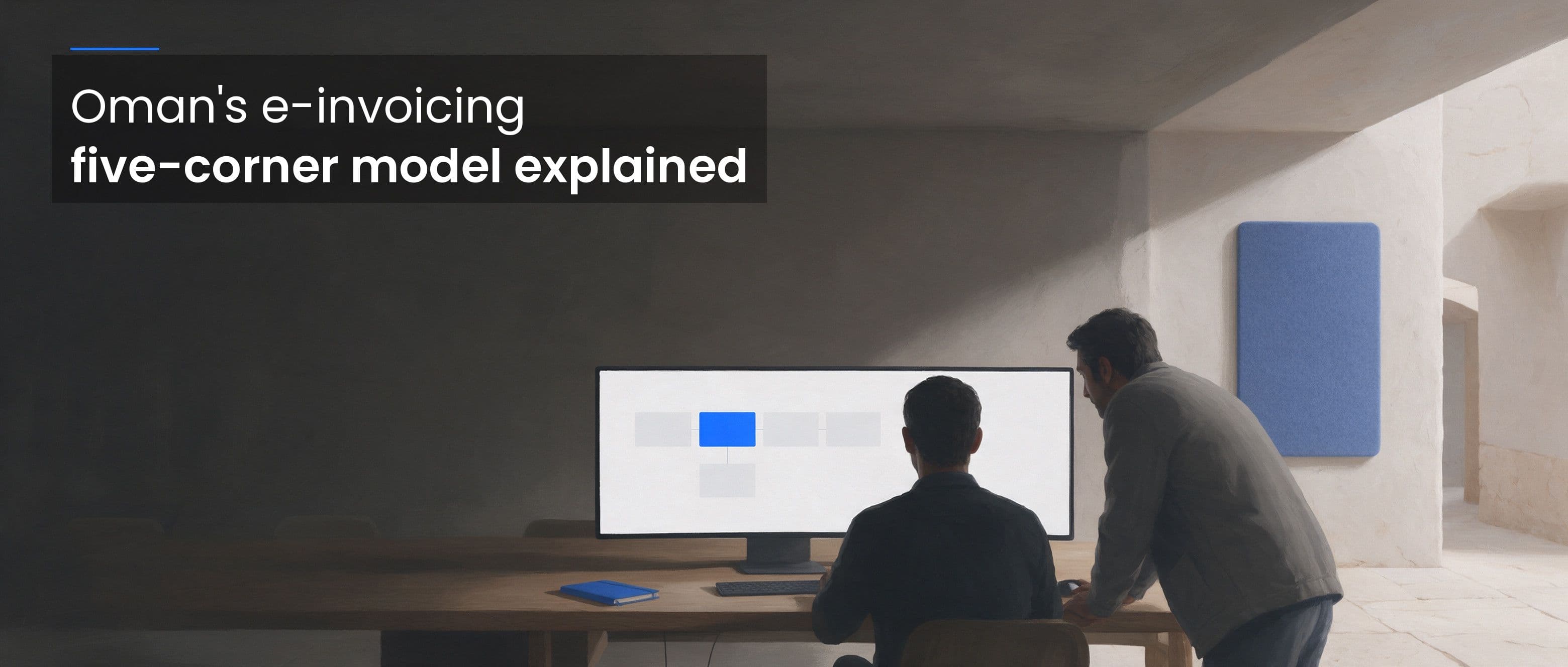
Oman uses a five-corner model built on the Peppol network. The model connects the supplier, the supplier’s service provider, the buyer’s service provider, the buyer and the OTA.
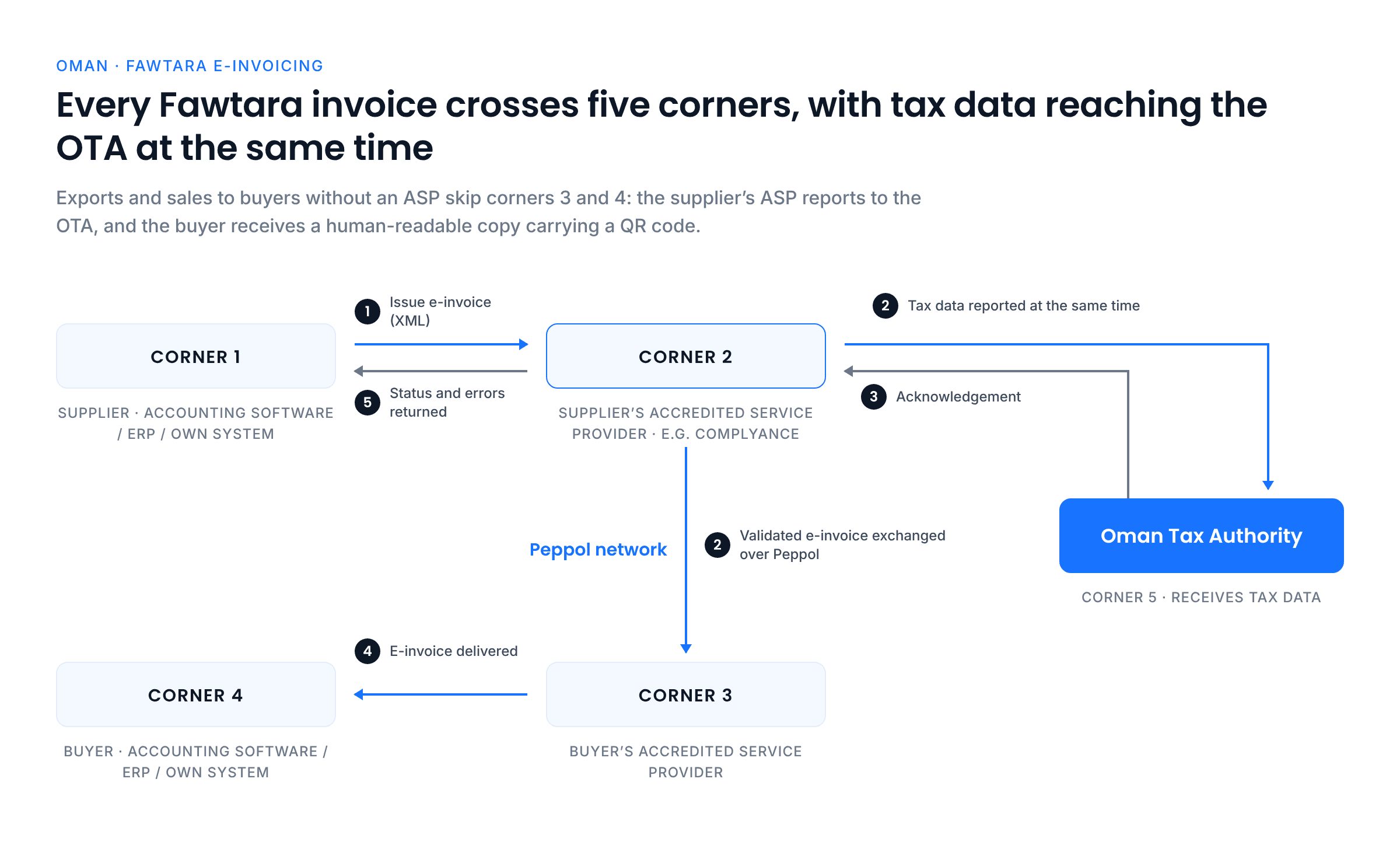
| Corner | Role in the process |
|---|---|
| 1. Supplier | Creates the invoice in its ERP, accounting or billing system. |
| 2. Supplier’s ASP | Validates the invoice against the applicable rules and sends it through the network. |
| 3. Buyer’s ASP | Receives and routes invoice data to the buyer’s connected system. |
| 4. Buyer | Receives the structured invoice and processes it in its business workflow. |
| 5. OTA | Receives the required tax data for reporting and compliance oversight. |
For a standard business-to-business (B2B) transaction, invoice data moves from the supplier through its ASP and the buyer’s ASP to the buyer, while the required tax data is reported to the OTA.
The flow is different for exports and for invoices to consumers or buyers who are not connected to the network. In those cases, the flow is supplier → supplier’s ASP → OTA. The supplier shares a human-readable copy with the customer through the existing channel. The OTA FAQ says this copy must follow its requirements and carry a QR code generated by the taxpayer.
What are Peppol and PINT-OM?
Peppol is a network and set of standards that allow organisations to exchange structured business documents. It is not a standalone invoicing application. In Oman, the e-invoicing framework uses Peppol and the PINT-OM invoice specification.
- XML format: Oman requires invoices to use a structured XML format. This allows software to read invoice fields consistently instead of relying on a PDF layout.
- PINT-OM: This defines the invoice structure and business rules for Oman. Businesses and providers use it to map ERP data into the required format.
- Peppol network: Accredited service providers use the network to exchange invoice documents between connected parties. This supports interoperability between different systems.
- Central OTA SMP: Oman uses a central Service Metadata Publisher (SMP) managed by the OTA. ASPs must use the OTA’s central SMP and are not allowed to operate their own.
The official technical reference is the Peppol PINT Oman specification. Businesses should ask their ERP vendor and ASP how their invoice fields will be mapped to the specification.
Key operational requirements businesses should know
The updated OTA FAQ also clarifies several practical requirements:
- Submission timing: B2B e-invoices must be submitted in real time. The updated FAQ specifies a 24-hour submission window for B2C invoices.
- B2C rollout: B2C e-invoicing is planned to start at the same time as B2B and B2G. Businesses should include consumer transactions in their implementation planning.
- Invoice records: Taxpayers are responsible for storing and archiving their e-invoices under VAT legislation. The OTA will not provide invoice records back to taxpayers or service providers, so businesses need their own reliable archive.
- Corrections: After an invoice has been issued, adjustments can be made through an electronic credit note or debit note, as applicable. Teams should define how they will manage these cases in their systems.
- Penalties: Penalties under VAT legislation apply after the mandate begins. Businesses should prepare before their applicable go-live date rather than waiting until the last moment.
- ERP systems: Businesses do not necessarily need to replace their ERP. The OTA says existing systems can be retained depending on the arrangement with the accredited service provider.
What should businesses do before connecting to Fawtara?
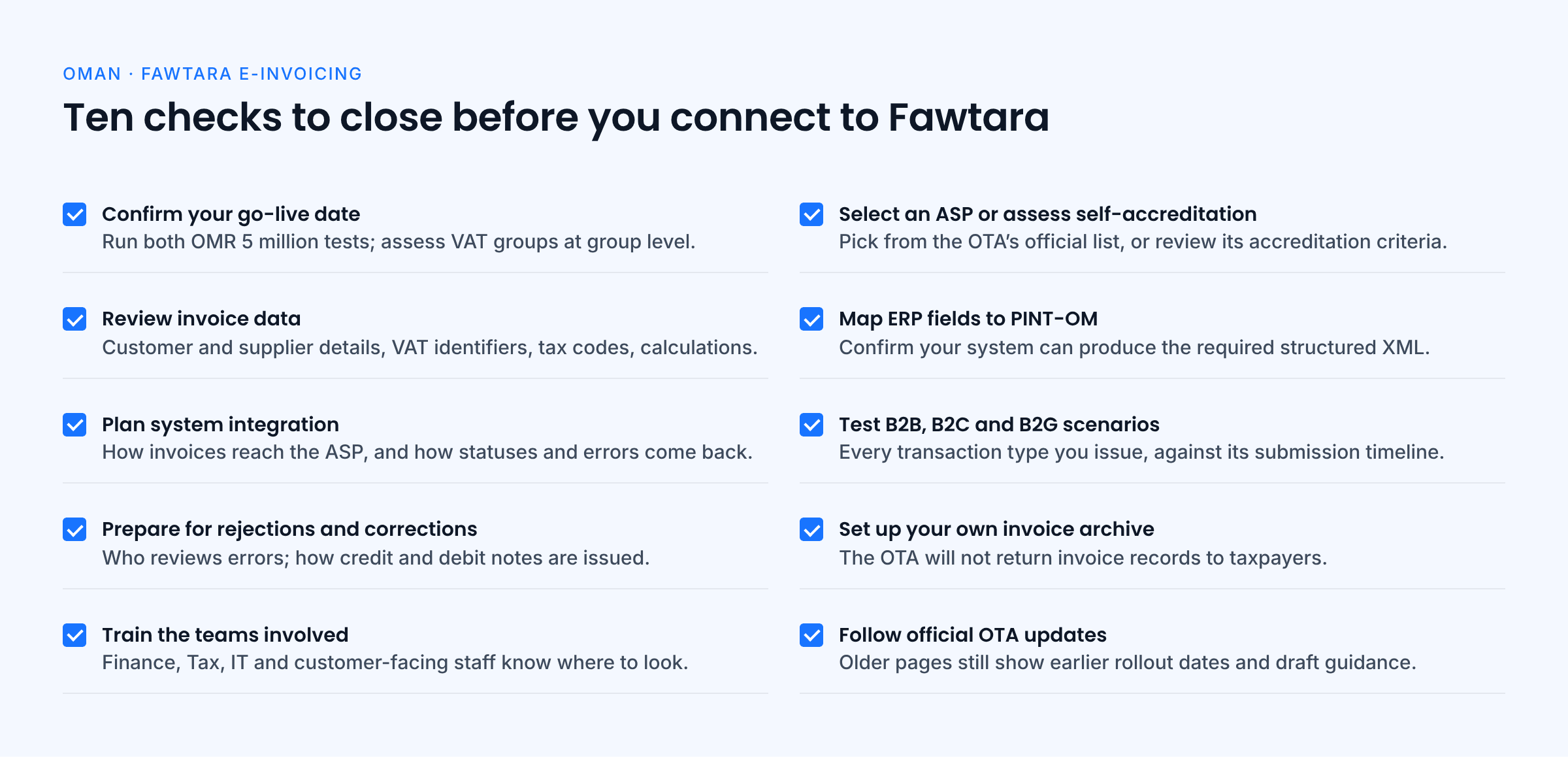
Use this checklist to organise preparation across Finance, Tax and IT.
- Confirm your go-live date: Compare your supplies for 1 April 2026 to 31 March 2027 and expected supplies for 1 April 2027 to 31 March 2028 against the OMR 5 million threshold. Assess VAT groups at group level and review the updated OTA FAQ PDF.
- Select an ASP or assess self-accreditation: Choose a provider from the OTA’s official list, or review the OTA’s accreditation criteria if your company intends to act as its own ASP. E-invoices must be validated by an accredited provider.
- Review invoice data: Check customer and supplier details, VAT identifiers, item descriptions, tax codes and calculations. Incomplete or inconsistent data can lead to validation failures.
- Map your ERP fields: Compare your current invoice fields with PINT-OM requirements. This helps ensure that your system can produce the required structured XML.
- Plan system integration: Confirm how invoices will move from your ERP to the ASP and how statuses and errors will return to your team. Agree responsibilities with your software vendor and provider.
- Test B2B, B2C and B2G scenarios: Include the transaction types relevant to your business and test their submission timelines. This reduces the risk of overlooking a required workflow.
- Prepare for rejections and corrections: Define who reviews validation errors and how credit or debit notes will be issued. A clear process helps prevent issues from remaining unresolved.
- Set up your own archive: Decide how invoice records will be stored, protected and retrieved. The OTA will not supply your invoice records on your behalf.
- Train the teams involved: Explain the new process to Finance, Tax, IT and customer-facing staff. Teams need to know where to check invoice status and how to escalate problems.
- Follow official updates: Use the updated OTA FAQ PDF and official technical specifications when planning. Older pages may still show earlier rollout dates or draft guidance.
Common misunderstandings about Fawtara
| Misunderstanding | What businesses need to know |
|---|---|
| “Fawtara is just a website for uploading invoices.” | Fawtara is the national framework, and invoice processing can take place through connected business systems and accredited service providers. |
| “We can use an ASP only if we want to.” | The OTA requires each e-invoice to be validated by the issuer’s ASP. A taxpayer must select an ASP or apply for accreditation itself. |
| “A PDF invoice meets the e-invoicing requirement.” | The OTA explicitly states that a PDF is not an e-invoice. The required structured format is XML based on Oman’s e-invoicing specifications. |
| “Our ASP is responsible for all compliance.” | The provider validates invoice data, but the taxpayer remains responsible for compliance and must retain its own records. |
| “We must replace our ERP.” | Not necessarily. Existing ERP systems can be retained if they can be mapped and integrated under the arrangement with the ASP. |
| “The OTA will keep our invoice records for us.” | The taxpayer is responsible for storing and archiving invoices. The OTA says it will not provide invoice records back to taxpayers or providers. |
| “We can wait until our deadline to start.” | Data cleanup, integration and testing take time. Starting early gives teams more time to resolve problems before the mandate applies. |
Final thoughts
Fawtara is more than a new way to send invoices. It changes how invoice data is structured, validated, exchanged and reported in Oman.
Businesses should start by confirming their mandatory date, selecting an accredited service provider or reviewing the self-accreditation route, and checking whether their invoice data and systems meet PINT-OM requirements. They also need to plan for submission timelines, error handling and their own invoice archive.
The most useful next step is to review the updated OTA FAQ and rollout checker, then agree on an implementation plan with your ERP vendor and ASP. Preparing early gives your team time to test the process before the mandate begins.
Official sources
- OTA: Fawtara FAQ PDF, updated 30 September 2026
- OTA: E-invoicing overview
- OTA: Service Provider FAQs
- OTA: Rollout checker
- OTA: Accredited service providers
- Peppol: PINT Oman specifications
This article provides general information and is not legal or tax advice. Refer to the latest applicable OTA guidance for your business’s implementation requirements.
Frequently Asked Questions
Fawtara (فوترة) is Arabic for “invoicing.” In Oman, Fawtara is the name of the national e-invoicing system led by the Oman Tax Authority.
The OTA’s FAQ PDF updated on 30 September 2026 sets 1 April 2027 for taxpayers whose supplies exceed OMR 5 million in either of the specified annual periods. Other taxpayers must implement e-invoicing from 1 October 2027. VAT groups are assessed at group level. Review the updated OTA FAQ PDF for the full calculation rules.
Yes. Every e-invoice must be validated by the issuer’s accredited service provider. A taxpayer must select an ASP through the Fawtara portal or apply for accreditation itself. A taxpayer can be linked to one ASP at a time.
In many cases, yes. The OTA says existing ERP systems can be retained depending on the arrangement with the ASP. Businesses should check whether their systems can provide the required data and map it to PINT-OM.
No. The OTA states that a PDF invoice is not an e-invoice. Oman’s mandatory structured format is XML, using the PINT-OM specifications. The human-readable invoice copy is separate from the structured e-invoice data.
The updated OTA FAQ specifies real-time submission for B2B e-invoices and a 24-hour window for B2C invoices. It also says B2C implementation will begin at the same time as B2B and B2G.
The taxpayer is responsible for storing and archiving e-invoices under VAT legislation. The OTA says it will not provide invoice-related records back to taxpayers or service providers, so businesses should plan their own retention and retrieval process.
Yes. A company that meets the OTA’s criteria and passes the required tests can apply for accreditation and serve as its own service provider. It should review the OTA’s official requirements before deciding whether to pursue this route.
About the Author

Swathy
Content Marketer
I’m a Content Marketer at Complyance, focused on e-invoicing. Over the years, I’ve created a wide range of content, including blog posts, whitepapers, and product guides, which have supported Complyance’s growth across markets such as the UAE and EU regions. My goal is to deliver content that is comprehensive, clear, accurate, and easy to understand, no matter how complex the topic.