Does Germany's E-Invoicing Mandate Apply to Foreign Businesses?

Find out when Germany's E-Invoicing mandate applies to foreign businesses, including establishment, VAT registration, cross-border transactions, receiving, B2G, and ViDA considerations.

Table of Contents
A foreign company selling to customers in Germany may hear about the German E-Rechnung rules and ask:
“Do I have to issue a German E-Rechnung too?”
The answer depends on the company's establishment, the customer's establishment, and the transaction.
Germany's mandatory E-Rechnung rules generally apply to covered transactions involving an entrepreneur established in Germany and another business established in Germany or in a relevant German VAT territory. A foreign business without a German seat, management, or establishment involved in the transaction may fall outside the German issuing requirement, depending on the transaction and applicable VAT rules.
A German VAT number alone does not determine the answer.
For foreign businesses, the key questions are:
- Where is the supplier established?
- Where is the customer established?
- Is there a German establishment involved in the transaction?
- Who is liable for German VAT?
- Does a special invoicing rule apply?
- Does the transaction fall within the German E-Rechnung requirement?
Scope: This article focuses on German VAT-law E-Rechnung rules for businesses dealing with Germany. B2G, B2C, cross-border, reverse-charge, and other special transactions can have different invoicing requirements.
Key Takeaways
- German E-Rechnung obligations depend on establishment and transaction facts, not simply on a German customer or German VAT number.
- A business with a German seat, management, or establishment involved in the transaction can qualify as an inländisches Unternehmen under § 14 UStG.
- A foreign business without a relevant German establishment may fall outside the German mandatory issuing requirement in the circumstances covered by the BMF guidance.
- For certain reverse-charge transactions, § 14(7) UStG allows a foreign supplier without a relevant German establishment to follow the invoicing rules of its establishment country.
- German VAT registration alone does not automatically create a German E-Rechnung issuing obligation.
- Foreign businesses with a relevant German establishment should assess both receiving and issuing requirements.
- B2G invoices require separate analysis because public-sector rules can apply alongside the VAT rules.
- Peppol is not a universal mandatory transmission method for German B2B invoices.
- The EU's ViDA Digital Reporting Requirements for relevant cross-border B2B transactions are scheduled to apply from July 1, 2030.
When Does Germany's E-Invoicing Rule Apply to a Foreign Business?
The first question is whether the business qualifies as an inländisches Unternehmen for the relevant transaction.
Under § 14 UStG, an entrepreneur can be treated as established in Germany for these purposes when it has its seat, management, or a permanent establishment involved in the turnover in Germany. Where there is no seat, residence or habitual abode can also be relevant.
This means a foreign company can fall within the German E-Rechnung framework if it has a relevant German establishment involved in the transaction.
By contrast, a foreign business with no German seat, management, or transaction-involved establishment may not be subject to the German mandatory issuing format merely because it sells to a German customer.
The establishment facts and the transaction therefore need to be assessed together.
Does a German VAT Number Make E-Invoicing Mandatory?
No, not by itself.
German VAT registration is a tax-registration status. It does not automatically create a German seat, management, or fixed establishment.
The BMF specifically addresses foreign entrepreneurs that are VAT-registered in Germany but do not have a fixed establishment there. Such a business can indicate this circumstance on its invoice to explain why it is not issuing a German E-Rechnung. A recipient acting with the care expected of a prudent businessman can rely on such an indication.
This does not mean that a German VAT number is irrelevant. It remains relevant to the overall VAT analysis. It simply should not be used as the sole test for whether the German E-Rechnung format is mandatory.
Keep these concepts separate:
- German VAT registration: a tax-registration status
- German seat or management: an establishment-status test
- German fixed establishment: a relevant permanent establishment under the VAT rules
- E-Rechnung obligation: a separate question determined by the transaction and applicable invoicing rules
When a German Business Invoices a Foreign Business
A German-established business invoicing a foreign business should not automatically treat the invoice as a German mandatory E-Rechnung.
The German B2B E-Rechnung requirement generally applies where the supplier and recipient are established in Germany or in a relevant German VAT territory. A foreign customer can therefore change the analysis.
The business should check:
- Where the customer is established
- Whether the customer has a German establishment involved in the transaction
- What type of transaction is being invoiced
- Whether a special invoicing rule applies
- Whether another framework, such as B2G, applies
For example, a foreign business may have a German fixed establishment involved in a particular transaction. In that case, the analysis can differ from a transaction carried out entirely by the foreign establishment.
The correct approach is to assess the actual transaction rather than assuming that the supplier's German establishment or the customer's foreign status automatically determines the result.
When a Foreign Business Invoices a German Business
A foreign company invoicing a German business should first determine whether it has a German seat, management, or relevant establishment involved in the transaction.
If it does not, German VAT registration alone does not automatically require the foreign supplier to issue a German E-Rechnung. The BMF specifically provides guidance for foreign entrepreneurs that are VAT-registered in Germany but have no fixed establishment there.
There is also an important rule for certain reverse-charge transactions.
Foreign Suppliers and Reverse-Charge Transactions
Under § 14(7) UStG, where a foreign supplier performs a transaction in Germany, the German recipient is liable for VAT under the reverse-charge rules, and the supplier has no German seat, management, or relevant German establishment, the supplier generally follows the invoicing rules of the Member State where it is established.
This does not apply to every cross-border transaction. The VAT treatment and establishment facts must be checked for the individual transaction.
Before deciding which invoicing rules apply, the supplier should determine:
- Whether the transaction is subject to German VAT
- Whether the recipient is liable for VAT under § 13b UStG
- Whether the supplier has a relevant German establishment
- Which invoicing rules apply under § 14 UStG
What If a Foreign Company Has a German Branch?
A German branch or other German location does not automatically determine the E-Rechnung result.
The key question is whether the location constitutes a relevant establishment and is involved in the specific transaction.
A company should distinguish between:
- A German location that exists but is not involved in the transaction
- A German establishment that is involved in the transaction
- A foreign establishment that carries out the transaction
The German rules focus on the establishment involved in the turnover, not simply on whether the company has a physical presence somewhere in Germany.
For international businesses, identifying which establishment makes or receives each supply is therefore an important part of the e-invoicing assessment.
Do Foreign Businesses Need to Receive E-Rechnungen?
Issuing and receiving are separate requirements.
A business that qualifies as an inländisches Unternehmen because it has a German seat, management, or establishment involved in the transaction generally must be able to receive E-Rechnungen from January 1, 2025. The BMF states that there is no general exception from this receiving requirement, and an email inbox is sufficient for the basic ability to receive an E-Rechnung.
A foreign business with no relevant German establishment is not automatically subject to the German receiving requirement merely because it has a German VAT number or German customers.
Once the business is within the German receiving framework, it should also have an appropriate process for accessing, recording, retaining, and processing the structured invoice data.
Which E-Invoice Formats Can Foreign Businesses Use?
A German E-Rechnung must use a structured electronic format that enables electronic processing.
Under § 14 UStG, the structured format can either comply with the European standard and the corresponding syntax list or be agreed between the supplier and recipient if the format allows the legally required invoice data to be extracted correctly and completely into an EN 16931-compliant or interoperable format.
The BMF identifies XRechnung and qualifying ZUGFeRD profiles among the formats that can meet the German VAT requirements.
Foreign businesses should therefore confirm the format accepted by the specific German customer or public authority instead of assuming that one format applies to every transaction.
Is Peppol Mandatory for Foreign Businesses?
No.
Peppol is not a universal German B2B transmission requirement.
Germany does not prescribe one single transmission channel for ordinary B2B E-Rechnungen. Depending on the arrangement, invoices can be exchanged through email, electronic interfaces, portals, Peppol, or other agreed methods.
Peppol can be useful where the customer or public-sector workflow supports or requires it, but a foreign business should first determine the applicable invoice requirements and then choose an appropriate transmission method.
The invoice format and the transmission channel are separate questions.
What About B2G Invoices?
B2G invoices require separate analysis.
Public-sector invoicing can be subject to the German E-Rechnungsverordnung and related public-procurement requirements in addition to the VAT rules. Federal public-sector workflows can involve specific submission platforms, transmission methods, and identifiers such as the Leitweg-ID.
A foreign supplier should therefore not assume that the B2B treatment applies unchanged to an invoice issued to a German public authority.
The applicable federal, state, or municipal requirements should be checked for the specific recipient.
Germany E-Invoicing and ViDA
Germany's current E-Rechnung rules should not be confused with the EU's VAT in the Digital Age (ViDA) package.
ViDA was adopted on March 11, 2025 and is being rolled out progressively through January 2035. The European Commission states that its Digital Reporting Requirements for relevant cross-border B2B transactions will apply from July 1, 2030. The new reporting system is based on electronic invoicing and digital reporting.
This is a separate EU framework from Germany's current domestic E-Rechnung transition.
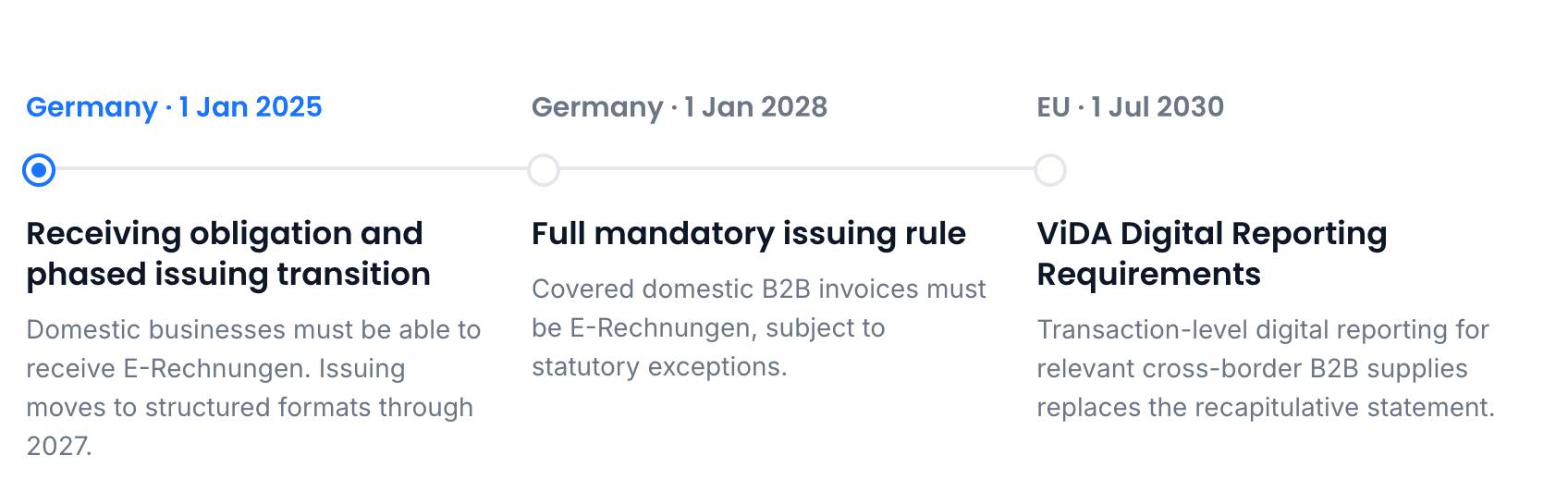
Germany from January 1, 2025: Receiving obligation and phased issuing transition
Germany from January 1, 2028: Full mandatory issuing rule for covered transactions, subject to exceptions
EU from July 1, 2030: ViDA Digital Reporting Requirements for relevant cross-border B2B transactions
Businesses operating across Europe should consider both the current German requirements and the future EU reporting framework when designing their e-invoicing architecture.
How Should Foreign Businesses Prepare?
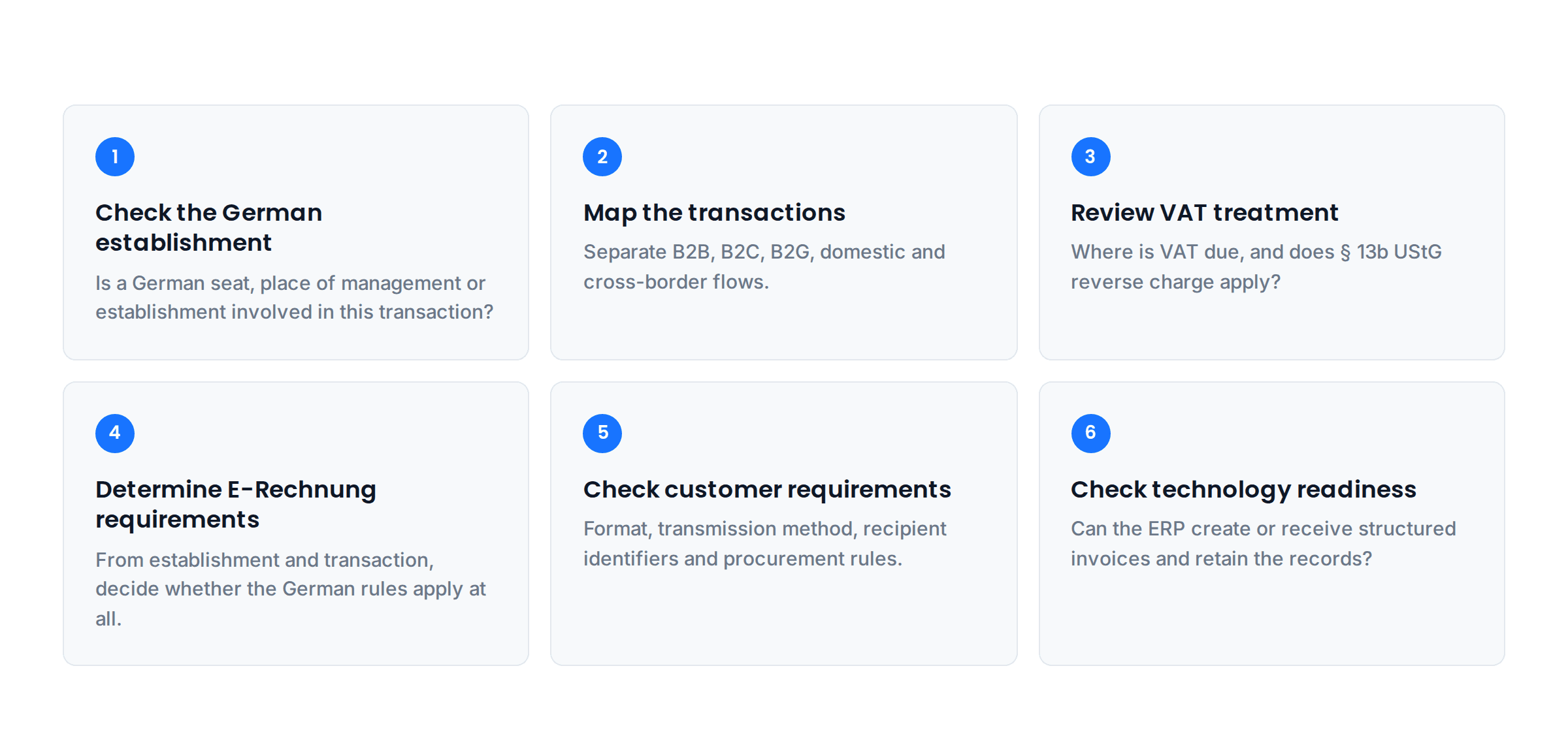
A foreign business should begin with a transaction-level scope assessment.
1. Check the German Establishment
Determine whether the business has a German seat, management, or establishment involved in the relevant transaction.
2. Map the Transactions
Separate B2B, B2C, B2G, domestic, and cross-border transactions.
3. Review VAT Treatment
Determine where VAT is due and whether reverse charge under § 13b UStG applies.
4. Determine the E-Rechnung Requirement
Based on the establishment and transaction, determine whether the German E-Rechnung rules apply.
5. Check the Customer's Requirements
Confirm the invoice format, transmission method, recipient identifiers, and any procurement requirements.
6. Check the Technology
Make sure the ERP and e-invoicing setup can create or receive the required structured invoice data and retain the necessary records.
This approach prevents an international business from treating every German customer and every invoice in the same way.
How Complyance Can Support International Businesses
For an international business, Germany is one part of a wider e-invoicing environment.
Depending on the accounting system and integration setup, Complyance can provide an e-invoicing and compliance layer between the ERP and the relevant customer or transmission channel.
A typical setup can connect the ERP with Complyance, apply the relevant country-specific rules, process the required e-invoice data, and support the applicable transmission method.
The exact workflow depends on the transaction, required invoice format, transmission method, and product configuration.
For international businesses, the important first step is still to determine which German rules apply to the actual transaction.
Conclusion
Germany's E-Rechnung rules do not apply to every invoice simply because one party is German.
For foreign businesses, the analysis starts with the company's establishment and the transaction. A German VAT number alone does not automatically create a German E-Rechnung obligation.
A German establishment involved in the transaction can change the result, while certain reverse-charge transactions can allow a foreign supplier without a relevant German establishment to follow the invoicing rules of its establishment country under § 14(7) UStG.
The practical approach is to:
- Check the establishment
- Identify the transaction
- Review the VAT treatment
- Determine the E-Rechnung scope
- Confirm the required format and transmission method
B2G transactions require separate consideration, and ViDA introduces an additional EU framework for relevant cross-border B2B digital reporting from July 1, 2030.
Frequently Asked Questions
It depends on the company's establishment and the transaction. A business with a German seat, management, or establishment involved in the transaction can qualify as an inländisches Unternehmen. A foreign entrepreneur without such a German establishment may fall outside the German issuing requirement in the circumstances covered by the BMF guidance. Reverse-charge transactions can also be subject to the special invoicing rule in § 14(7) UStG.
No. German VAT registration alone does not create a German seat, management, or fixed establishment. The BMF specifically addresses foreign entrepreneurs that are VAT-registered in Germany but have no fixed establishment there. They can indicate this circumstance on the invoice to explain why they are not issuing a German E-Rechnung. Other transaction and reverse-charge rules must still be checked.
Not automatically. The business should determine whether the German location constitutes a relevant establishment and whether it is involved in the specific transaction.
A foreign business that qualifies as an inländisches Unternehmen because it has a German seat, management, or relevant establishment generally must be able to receive E-Rechnungen from January 1, 2025. A foreign business with no relevant German establishment is not automatically subject to the German receiving obligation merely because it has a German VAT number or German customers. An email inbox is sufficient for the basic receiving capability.
No. It applies to specific transactions where the German recipient is liable for VAT under the reverse-charge rules and the foreign supplier does not have the relevant German establishment described in § 14(7). The VAT treatment and establishment facts must be checked for the individual transaction.
No. ViDA is a separate EU framework. Its Digital Reporting Requirements for relevant cross-border B2B transactions are scheduled to apply from July 1, 2030, while Germany's current E-Rechnung rules operate under German VAT law and their own transition timetable.
No. Peppol is not a universal German B2B transmission requirement. It is one possible transmission method where appropriate for the customer and transaction.
About the Author

Swathy
Content Marketer
I’m a Content Marketer at Complyance, focused on e-invoicing. Over the years, I’ve created a wide range of content, including blog posts, whitepapers, and product guides, which have supported Complyance’s growth across markets such as the UAE and EU regions. My goal is to deliver content that is comprehensive, clear, accurate, and easy to understand, no matter how complex the topic.