France E-Invoicing: Key Dates and Deadlines

France’s e-invoicing reform is now moving into its implementation phase. The most important dates are 1 September 2026 and 1 September 2027.
Table of Contents
France’s e-invoicing reform is now moving into its implementation phase. The most important dates are 1 September 2026 and 1 September 2027.
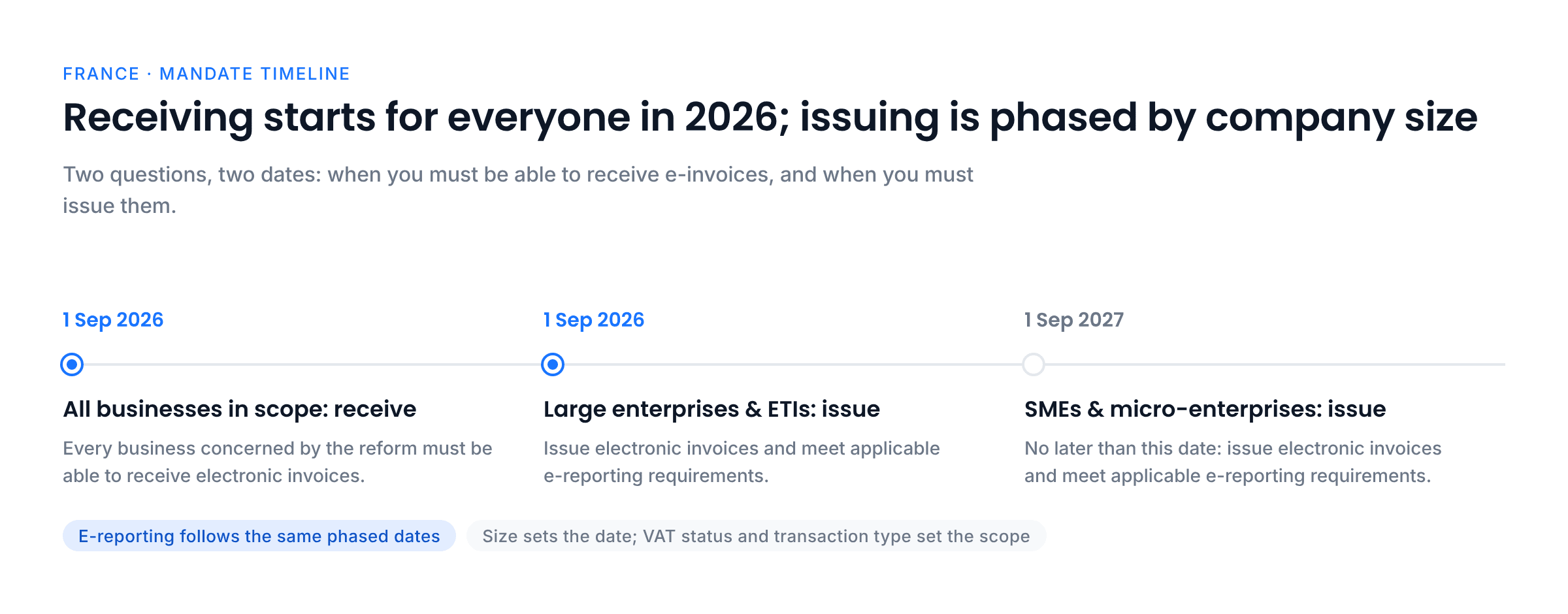
From 1 September 2026, all businesses concerned by the reform must be able to receive electronic invoices. Large enterprises and ETIs must also issue electronic invoices from that date. SMEs and micro-enterprises must be able to issue electronic invoices no later than 1 September 2027.
These dates are central to searches such as facturation électronique 2026, facturation électronique obligatoire, réforme facturation électronique, and France e-invoicing deadline.
The important point is that France has two different questions: when a business must be ready to receive electronic invoices, and when it must be ready to issue them.
Key Takeaways
- 1 September 2026 is the main starting date for the French e-invoicing reform.
- All businesses concerned by the reform must be able to receive electronic invoices from 1 September 2026.
- Large enterprises and ETIs must issue electronic invoices from 1 September 2026.
- SMEs and micro-enterprises must be able to issue electronic invoices no later than 1 September 2027.
- E-reporting follows the phased timetable for businesses concerned by those reporting obligations.
- For regulated e-invoicing and e-reporting flows, businesses must use a PA directly or use a compatible solution connected to a PA.
- Company size affects the implementation date, while VAT status and transaction type determine whether a particular flow is in scope.
What Happens on 1 September 2026?
1 September 2026 is the first major milestone.
From this date, all businesses concerned by the reform must be able to receive electronic invoices from suppliers that are required to issue them electronically.
At the same time, large enterprises and ETIs must be ready to issue electronic invoices for the relevant transactions covered by the reform.
The date therefore affects more businesses than the first issuing deadline might suggest. An SME may not need to issue electronic invoices until 2027, but it still needs to prepare for receiving them in 2026.
What Happens on 1 September 2027?
SMEs and micro-enterprises must be able to issue electronic invoices no later than 1 September 2027.
This is the second major implementation milestone.
The phrase “no later than” matters. It reflects the official timetable and avoids treating the date as though every business must begin every electronic invoicing process on exactly the same operational day.
By this point, a smaller business within the reform should have its issuing processes, system connections, customer data, and applicable reporting processes ready.
France E-Invoicing Timeline
| Date | Businesses concerned | Main requirement |
|---|---|---|
| 1 September 2026 | All businesses concerned by the reform, including businesses that only need to receive supplier e-invoices | Be able to receive electronic invoices |
| 1 September 2026 | Large enterprises and ETIs | Issue electronic invoices and meet applicable e-reporting requirements |
| No later than 1 September 2027 | SMEs and micro-enterprises | Issue electronic invoices and meet applicable e-reporting requirements |
The receiving requirement is therefore earlier for everyone concerned, while the issuing requirement depends on business size.
Why Are There Two Dates?
The French government designed the rollout so that the receiving capability is established across the business population before the smaller businesses reach their issuing deadline.
This creates a practical transition period for many SMEs and micro-enterprises.
For example, consider an SME that buys telecommunications services from a large French supplier. The supplier may be required to issue an electronic invoice from 1 September 2026. The SME must therefore be ready to receive that invoice even though its own issuing deadline is no later than 1 September 2027.
The same SME may also receive invoices from several suppliers with different internal systems. Its finance team therefore needs to prepare for incoming electronic invoices before it reaches its own issuing deadline.
Does E-Reporting Follow the Same Dates?
Yes, for businesses concerned by the relevant e-reporting obligations, the reporting timetable follows the phased implementation.
E-reporting is relevant to transactions that do not use the domestic B2B e-invoicing flow, such as certain B2C and cross-border transactions.
The data required depends on the transaction and, where relevant, on when VAT becomes chargeable. For example, payment data can be relevant where services are subject to VAT on receipt.
This means a business should not prepare only for electronic invoice exchange. It should also identify which transaction and payment information may need to be reported electronically.
When Must a Business Choose a Plateforme Agréée?
The French framework relies on Plateformes Agréées, or PAs, for regulated electronic invoicing and e-reporting flows.
For electronic invoicing and e-reporting flows within the reform, businesses must use a PA directly or use a compatible solution that is connected to a PA.
A business does not have to build its own connection to the French tax administration. Instead, it needs an appropriate technology setup that supports the regulated exchange and reporting model.
The PA should also not be confused with ordinary invoicing or accounting software. A business can keep its existing ERP or accounting system while using a PA or a compatible technology layer connected to a PA.
What Should Businesses Prepare Before 2026?
The first step is to understand the business’s scope.
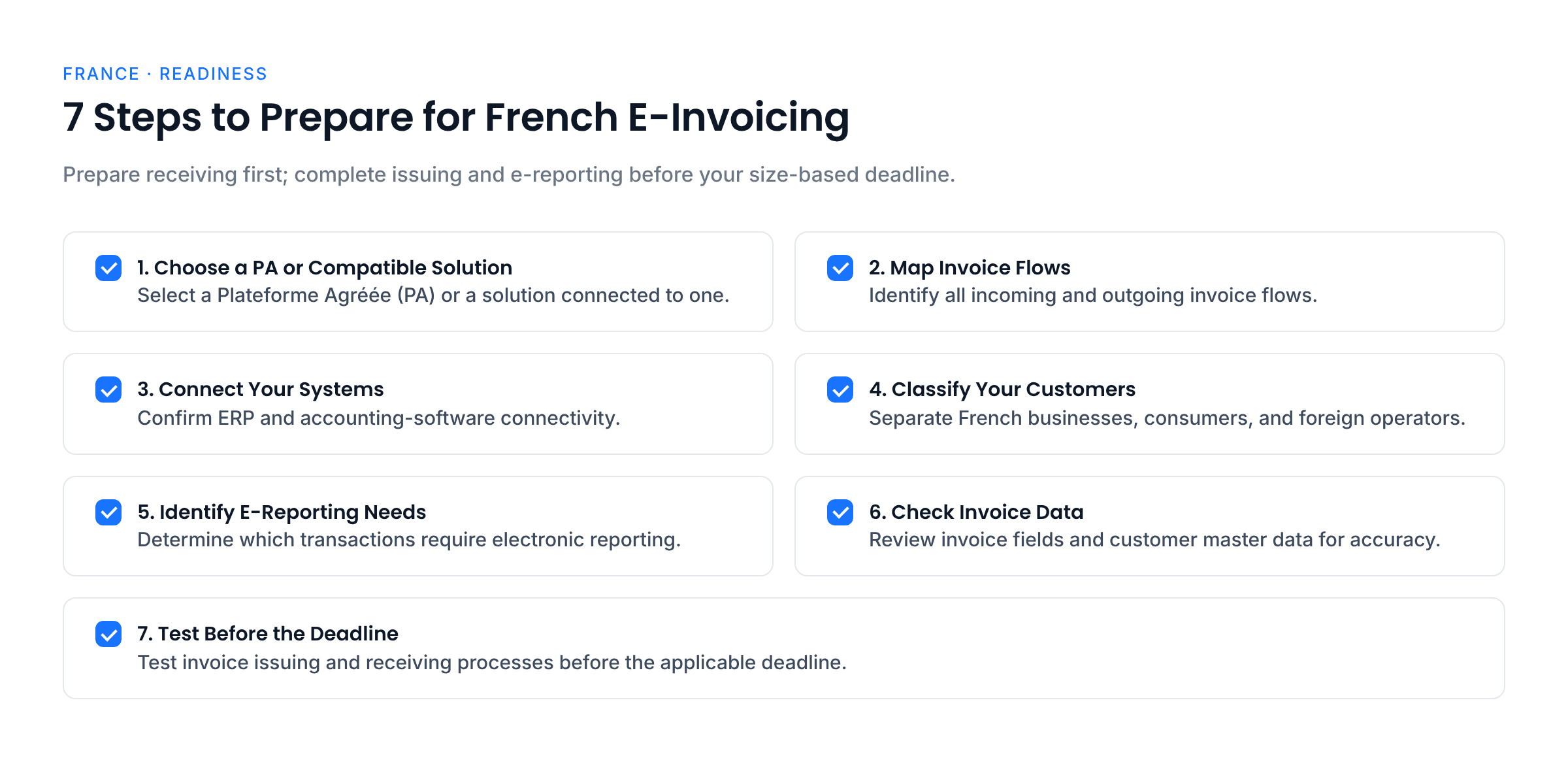
A useful preparation checklist includes:
- Choose a PA or compatible solution connected to a PA.
- Map incoming and outgoing invoice flows.
- Confirm ERP or accounting-software connectivity.
- Classify customers as French businesses, consumers, or foreign operators.
- Identify e-reporting requirements for relevant transactions.
- Check invoice data and customer master data.
- Test receiving and issuing processes before the applicable deadline.
Businesses should also confirm their official size classification. The applicable category should be assessed using the relevant legal-entity and SIREN-level information where required, rather than relying only on an internal description such as “small company.”
What Does the 2026 Deadline Mean for an SME?
It does not mean that every SME must start issuing electronic invoices in September 2026.
It means the SME must be ready to receive electronic invoices from 1 September 2026 if it is concerned by the reform.
The issuing obligation comes no later than 1 September 2027.
This distinction is useful for project planning. A finance team can separate the work into two stages: prepare the receiving process for 2026, then complete the issuing and reporting setup ahead of the 2027 deadline.
What Does the 2026 Deadline Mean for Large Enterprises?
Large enterprises and ETIs face a more immediate operational requirement.
From 1 September 2026, they must issue electronic invoices for relevant in-scope transactions as well as receive electronic invoices.
Their preparation therefore needs to cover both sides of the invoice process.
They also need to review applicable e-reporting obligations, customer and supplier data, integration points, and the way invoice statuses and information move back into their finance systems.
Does Company Size Determine Whether a Transaction Is In Scope?
No.
Company size mainly affects the implementation date for issuing electronic invoices.
Whether a transaction is subject to domestic B2B e-invoicing depends on factors such as VAT status, establishment, transaction type, and French VAT and invoicing rules.
A small business can therefore have an in-scope transaction even though its issuance deadline is later than that of a large enterprise.
This is an important distinction when reviewing France e-invoicing requirements.
How Complyance Can Support Readiness
Meeting the deadline is not only about selecting a technology provider. Businesses also need to connect the solution to their existing systems and understand the transaction flows that apply.
Complyance is an e-invoicing platform designed to help businesses manage electronic invoicing requirements across markets. Businesses can use an e-invoicing platform such as Complyance to connect existing ERP or accounting systems with the required electronic invoicing infrastructure.
The implementation approach depends on the business’s systems, transaction types, and applicable French requirements. The goal should be to make the technology fit the finance process rather than create a separate manual process.
Conclusion
The France e-invoicing timetable is easier to understand when the receiving and issuing obligations are kept separate.
1 September 2026 is the key date for receiving electronic invoices across the businesses concerned by the reform, and for issuing by large enterprises and ETIs.
No later than 1 September 2027 is the issuing deadline for SMEs and micro-enterprises.
Businesses that prepare early can use the time between these milestones to choose their PA or connected solution, map invoice flows, connect finance systems, and prepare e-reporting requirements.
For teams tracking facturation électronique 2026 and the wider France e-invoicing mandate, the practical priority is simple: know what must be received in 2026, what must be issued by the applicable deadline, and which reporting obligations apply to the business’s transactions.
Frequently Asked Questions
The reform starts on 1 September 2026. All businesses concerned by the reform must be able to receive electronic invoices from that date. Issuing obligations are phased by business size.
SMEs and micro-enterprises must be able to issue electronic invoices no later than 1 September 2027.
All businesses concerned by the reform must be able to receive electronic invoices from 1 September 2026, including businesses whose own issuing obligation comes later.
Yes. E-reporting is a separate part of the reform for relevant transactions and can include transaction and, where applicable, payment data.
For regulated electronic invoicing and e-reporting flows, businesses must use a PA directly or a compatible solution connected to a PA.
About the Author

Swathy
Content Marketer
I’m a Content Marketer at Complyance, focused on e-invoicing. Over the years, I’ve created a wide range of content, including blog posts, whitepapers, and product guides, which have supported Complyance’s growth across markets such as the UAE and EU regions. My goal is to deliver content that is comprehensive, clear, accurate, and easy to understand, no matter how complex the topic.