What Is a Plateforme Agréée in France?

A Plateforme Agréée (PA) is a central part of France’s electronic invoicing reform. It is a dematerialisation operator immatriculated by the French tax administration and given a defined role in the regulated electronic invoicing and reporting framework.
Table of Contents
A Plateforme Agréée (PA) is a central part of France’s electronic invoicing reform. It is a dematerialisation operator immatriculated by the French tax administration and given a defined role in the regulated electronic invoicing and reporting framework.
Older French materials often use the term PDP, or plateforme de dématérialisation partenaire. The current term is Plateforme Agréée, or PA. This article uses PA throughout.
Key Takeaways
- A PA is a dematerialisation operator immatriculated by the French tax administration.
- A PA enables the regulated issuance, transmission, and receipt of electronic invoices on behalf of businesses.
- PAs also handle applicable transaction and payment information within the reporting framework.
- A PA is different from ordinary accounting or invoicing software.
- A compatible solution is not automatically a PA. It must connect to a PA for regulated flows.
- Supplier and customer businesses can use different PAs.
- PA immatriculation is valid for three years and can be renewed.
- A normal PDF sent by email is not the target compliant channel for regulated e-invoicing, although temporary continuity arrangements may apply during implementation incidents.
What Is a Plateforme Agréée?
A Plateforme Agréée is a dematerialisation operator that has been immatriculated by the French tax administration for the electronic invoicing reform.
The PA has a defined intermediary role in regulated invoice exchange and reporting. For a supplier, it supports transmission. For a customer, it supports receipt.
The PA also has responsibilities connected with transmitting relevant invoice, transaction, and payment information to the French tax administration where the reform requires it.
What Does a PA Do?
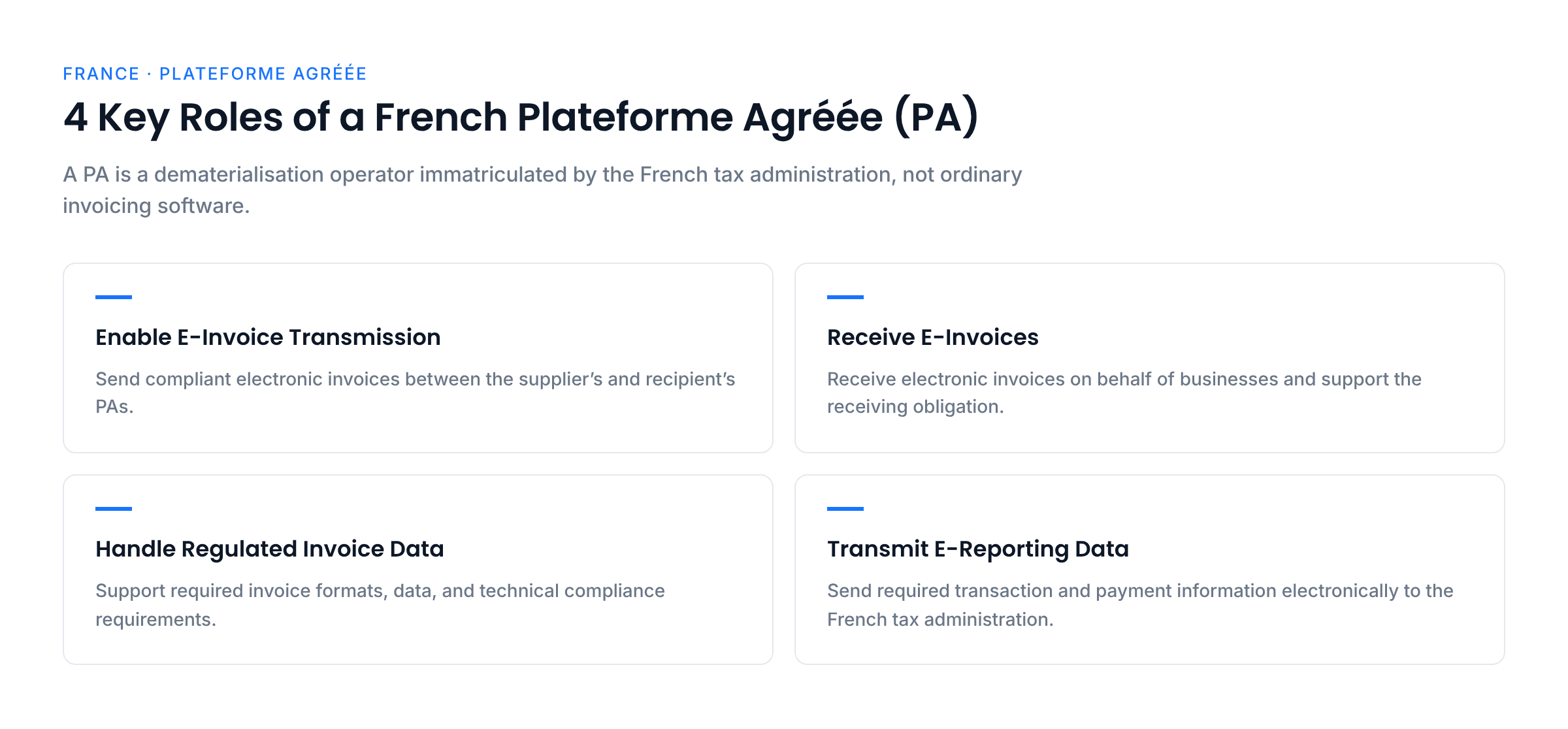
The French reform gives PAs several important functions.
Enable Electronic Invoice Transmission
A business can use the PA framework to send electronic invoices covered by the French rules.
The supplier’s ERP or invoicing system can provide the invoice data to its PA. The PA then handles the regulated electronic exchange with the recipient’s PA.
The supplier remains responsible for issuing the invoice. The PA provides the infrastructure and regulated transmission functions required by the framework.
Receive Electronic Invoices
A PA also receives electronic invoices on behalf of businesses.
This matters because all businesses concerned by the reform must be able to receive electronic invoices from 1 September 2026, even when their own obligation to issue invoices begins later.
A smaller business therefore needs a receiving setup before it reaches its own issuing deadline.
Support Regulated Invoice Data
Electronic invoices must meet the applicable French technical requirements.
The PA can support the handling and exchange of required invoice data and formats. A normal PDF, spreadsheet, or other document should not be confused with a compliant electronic invoice.
Transmit Reporting Information
The reform also covers information beyond the invoice exchange itself.
Depending on the transaction, relevant transaction and payment information may need to be transmitted electronically to the French tax administration.
The PA has a central role in these regulated reporting flows.
Is a PA the Same as Invoicing Software?
No.
An accounting or invoicing application may help a business:
- Create invoices
- Manage customer records
- Calculate invoice amounts
- Record sales
- Manage accounting information
- Prepare invoice documents
A PA has a different role. It is an immatriculated operator within the French electronic invoicing framework.
A business can therefore use its existing ERP or accounting software for invoice creation and finance management while relying on a PA for regulated electronic exchange and reporting.
A product may provide an invoice workflow without itself holding PA status.
What Is the Difference Between a PA and a Compatible Solution?
A compatible solution is a technology product that can support a business’s invoicing processes and connect to a PA.
It is not automatically a PA.
This means a technology provider can offer invoice automation, integration, validation, data management, or other business functions while using a separate PA for the regulated exchange.
For regulated transmission, the compatible solution must connect to a PA.
Businesses should therefore ask a provider a simple question: Which legal entity holds the PA immatriculation, and how does your product connect to that PA?
The software seller, PA holder, and entity responsible for regulated exchange may not always be the same legal entity.
Is a PA Mandatory for France E-Invoicing?
For electronic invoicing and e-reporting flows within the French reform, businesses must use a PA directly or use a compatible solution that is connected to a PA.
From 1 September 2026, all businesses concerned by the reform must be able to receive electronic invoices. Large enterprises and ETIs must also issue electronic invoices from that date.
SMEs and micro-enterprises must be able to issue electronic invoices no later than 1 September 2027.
The PA requirement therefore needs to be planned before the relevant operational deadline, not after it.
Can a Supplier and Customer Use Different PAs?
Yes.
The supplier and customer do not have to select the same PA.
The French system allows electronic invoices to move between different platforms, so the receiving PA can receive an invoice from the supplier’s PA.
The French electronic invoicing directory supports this process by providing information used for addressing and routing the invoice to the recipient’s receiving platform.
Choosing one PA does not require all customers and suppliers to use the same provider. A company may also work with more than one PA where its operating model requires it.
How Does the PA Work With the French Directory?
The French electronic invoicing system includes a directory that supports addressing and routing.
The directory contains information that helps platforms identify the appropriate receiving platform for a business.
For example, the supplier’s PA needs to know where the customer should receive the invoice. The relevant directory information helps identify the recipient and the platform responsible for receiving the electronic invoice.
How Long Is PA Immatriculation Valid?
PA immatriculation is valid for three years and can be renewed.
A company should check the current PA status and identify the legal entity that holds the immatriculation. It should also confirm whether that entity is the same company that signs the commercial contract.
If a technology provider uses another PA for regulated flows, the relationship should be clear. Businesses should know which provider holds the legal status and which provider supplies the technology layer.
Is a PDF Sent by Email a French E-Invoice?
A simple PDF sent by email is not the target compliant channel for regulated French e-invoicing.
The reform is based on structured electronic exchange through the regulated platform framework. A PDF document attached to an email should therefore not simply be treated as equivalent to the regulated e-invoice.
There is an important implementation caveat. During the reform’s startup phase, DGFiP guidance allows businesses to continue processing genuine invoices received through ordinary channels where necessary for business continuity. This does not replace the obligation to use the regulated electronic channel for in-scope flows.
Businesses should therefore distinguish temporary operational continuity from the long-term compliance model.
What Should Businesses Check When Choosing a PA?
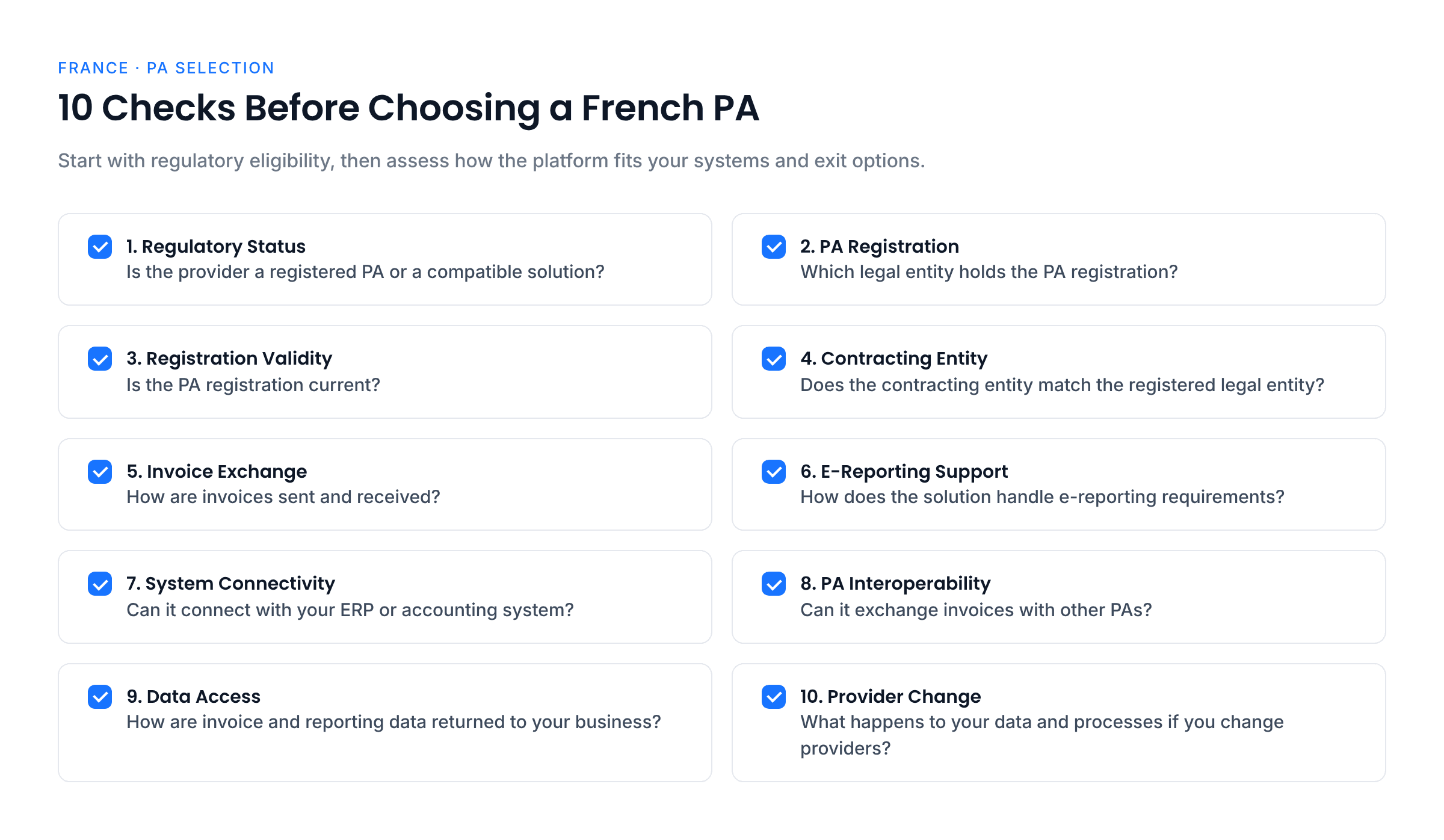
A provider review should begin with regulatory eligibility.
Businesses should check:
- Whether the provider is currently a PA or a compatible solution
- Which legal entity holds the PA immatriculation
- Whether the registration is current
- Whether the contracting entity is the same legal entity
- How invoices are sent and received
- How e-reporting is supported
- How the solution connects with ERP or accounting systems
- How it interoperates with other PAs
- How invoice and reporting information is returned to the business
- What happens if the business changes provider
How Complyance Fits Into the PA Model
Complyance provides an e-invoicing technology layer for businesses managing electronic invoicing across markets.
For France, businesses can use an e-invoicing platform such as Complyance to connect their existing systems with the French electronic invoicing infrastructure. Complyance can connect to the French PA ecosystem, with the exact architecture depending on the provider model, business systems, and regulated flows involved.
This distinction is important. Complyance should not be presented as a PA or as directly performing the PA’s official transmission and reception functions unless the relevant PA status has been verified.
Conclusion
The Plateforme Agréée is a central part of France’s electronic invoicing architecture.
It is not simply another invoicing application. A PA is an immatriculated operator that enables regulated electronic invoice exchange and relevant reporting flows.
Businesses should also understand the difference between a PA and a compatible technology solution. A compatible solution can manage business processes and connect to a PA without being the PA itself.
As the French reform moves through its 2026 and 2027 milestones, this distinction will help finance and IT teams evaluate providers, design integrations, and build an e-invoicing setup that matches the regulatory framework.
Frequently Asked Questions
PA means Plateforme Agréée, the current term for the immatriculated dematerialisation platform used within the French electronic invoicing reform.
No. Accounting or invoicing software can create and manage invoices. A PA has an official role in the regulated French electronic invoicing and reporting framework.
Yes. A compatible solution can support business processes and must connect to a PA for regulated electronic invoicing and reporting flows.
PA immatriculation is valid for three years and can be renewed.
No. They can use different PAs, with the French directory supporting the addressing and routing process.
About the Author

Swathy
Content Marketer
I’m a Content Marketer at Complyance, focused on e-invoicing. Over the years, I’ve created a wide range of content, including blog posts, whitepapers, and product guides, which have supported Complyance’s growth across markets such as the UAE and EU regions. My goal is to deliver content that is comprehensive, clear, accurate, and easy to understand, no matter how complex the topic.