France E-Invoicing: Who Must Comply and Who Is Exempt?

France’s electronic invoicing reform is being introduced in stages. From 1 September 2026, all businesses concerned by the reform must be able to receive electronic invoices. Large enterprises and entreprises de taille intermédiaire (ETIs) must also issue electronic invoices from 1 September 2026. SMEs and micro-enterprises must be able to issue electronic invoices no later than 1 September 2027.
Table of Contents
France’s electronic invoicing reform is being introduced in stages. From 1 September 2026, all businesses concerned by the reform must be able to receive electronic invoices. Large enterprises and entreprises de taille intermédiaire (ETIs) must also issue electronic invoices from 1 September 2026. SMEs and micro-enterprises must be able to issue electronic invoices no later than 1 September 2027.
The starting point is not simply company size. The first question is whether the business is a VAT taxable person, known in French tax terminology as an assujetti à la TVA. The transaction type then determines whether electronic invoicing or e-reporting applies.
Key Takeaways
- The reform is based on VAT taxable status and the type of transaction, not turnover or legal form alone.
- Businesses under the franchise en base de TVA, including relevant micro-entrepreneurs and auto-entrepreneurs, are not automatically excluded.
- All businesses concerned by the reform must be able to receive electronic invoices from 1 September 2026.
- Large enterprises and ETIs must issue electronic invoices from 1 September 2026.
- SMEs and micro-enterprises must be able to issue electronic invoices no later than 1 September 2027.
- Domestic B2B transactions meeting the French VAT and invoicing conditions are covered by e-invoicing.
- Relevant B2C and cross-border transactions generally fall under e-reporting rather than domestic B2B e-invoicing.
- Some operations exempt under Articles 261 to 261 E of the French General Tax Code and also dispensed from invoicing are excluded for those operations.
- A business can still have a receiving obligation even when some of its own operations are outside e-invoicing.
Who Is Concerned by E-Invoicing in France?
The French reform uses the concept of a VAT taxable person, or assujetti à la TVA.
It is useful to separate this from the question of whether the business is actually liable to charge VAT on a particular invoice. A business can be subject to VAT rules without being liable to collect VAT under its current regime. The franchise en base de TVA is a common example.
The reform can therefore concern:
- Companies
- Independent professionals
- Liberal professions
- Micro-enterprises
- Auto-entrepreneurs
- Businesses benefiting from the franchise en base de TVA
The legal form, turnover, or company size does not by itself remove a business from the reform. Size mainly determines when the business must start issuing electronic invoices.
Does Company Size Affect France E-Invoicing Requirements?
Yes, but mainly when the issuing obligation starts.
| Business category | Receive electronic invoices | Issue electronic invoices |
|---|---|---|
| Large enterprises | 1 September 2026 | 1 September 2026 |
| ETIs | 1 September 2026 | 1 September 2026 |
| SMEs | 1 September 2026 | No later than 1 September 2027 |
| Micro-enterprises | 1 September 2026 | No later than 1 September 2027 |
Every business concerned by the reform must be able to receive electronic invoices from 1 September 2026 when its supplier is required to issue them electronically.
So an SME can have a 2027 issuance deadline while still needing to prepare its systems for receiving invoices in 2026.
Are Micro-Enterprises and Auto-Entrepreneurs Covered?
Yes.
A common misunderstanding is that a micro-enterprise or auto-entrepreneur is outside the reform because it uses the franchise en base de TVA. Being under this regime does not by itself remove the business from the reform.
For a micro-enterprise, the practical timeline is:
- 1 September 2026: it must be able to receive electronic invoices.
- No later than 1 September 2027: it must be able to issue electronic invoices and meet applicable e-reporting obligations for its relevant transactions.
The issuance obligation should still be assessed against the transaction. For example, a micro-enterprise serving French business customers can have a domestic B2B e-invoicing obligation for relevant French transactions.
Which B2B Transactions Are Covered?
Mandatory domestic B2B e-invoicing applies where the key conditions are met:
- The supplier and customer are VAT taxable persons established in France.
- The transaction falls within the scope of French VAT.
- French invoicing rules apply.
The business relationship alone is not enough. The transaction must also meet the French VAT and invoicing conditions.
For example, a French consulting company selling services to another French business can fall within domestic B2B e-invoicing. The same company may have different obligations for a sale to a consumer or a customer established outside France.
What About B2C and Cross-Border Transactions?
Not every transaction becomes a domestic B2B e-invoice.
Sales to consumers are generally handled through e-reporting rather than domestic B2B e-invoicing. Relevant transactions involving operators established outside France can also fall under e-reporting where domestic e-invoicing does not apply.
Depending on the transaction and VAT collection rules, e-reporting can include transaction data and, in applicable cases, payment data.
Consider a French freelance consultant who has three types of customers:
- French companies
- French consumers
- Companies established outside France
The French B2B invoices can fall within e-invoicing when the applicable issuance obligation starts. Consumer sales can be subject to e-reporting. Cross-border business transactions can also create e-reporting obligations rather than the domestic B2B e-invoice flow.
The same business can therefore have several obligations at the same time, depending on the transaction.
Which Operations Are Outside the Reform?
This is where businesses need to be careful with the word “exempt.”
The exclusion applies to operations exempt from VAT under Articles 261 to 261 E of the French General Tax Code that are also dispensed from invoicing. The exclusion applies to those operations, rather than automatically to the business as a whole.
French tax guidance gives examples that can include:
- Healthcare
- Education and training
- Banking and financial activities
- Insurance and reinsurance
- Certain non-profit activities
- Certain real-estate activities, including many residential rental activities
“Real estate” should not be treated as a blanket exemption. The exact activity and its VAT and invoicing treatment matter.
A mixed-activity example makes the distinction clearer. Imagine a medical professional whose healthcare activity qualifies for the relevant exemption, but who also provides separate taxable consulting services. The qualifying exempt healthcare operations can be outside the e-invoicing and relevant e-reporting obligations for those operations. The taxable consulting activity can still be subject to the applicable electronic invoicing or reporting rules.
Can an Exempt Business Still Receive E-Invoices?
Yes.
Being outside the issuing requirement for a qualifying exempt operation does not necessarily remove the business from the electronic invoicing ecosystem.
A business can have exempt operations and still buy goods or services from suppliers whose invoices fall within the French B2B e-invoicing framework. It must therefore be able to receive electronic invoices where the reform requires it.
This is why businesses should assess their obligations at both the business level and the transaction level.
How Should a Business Check Its Scope?
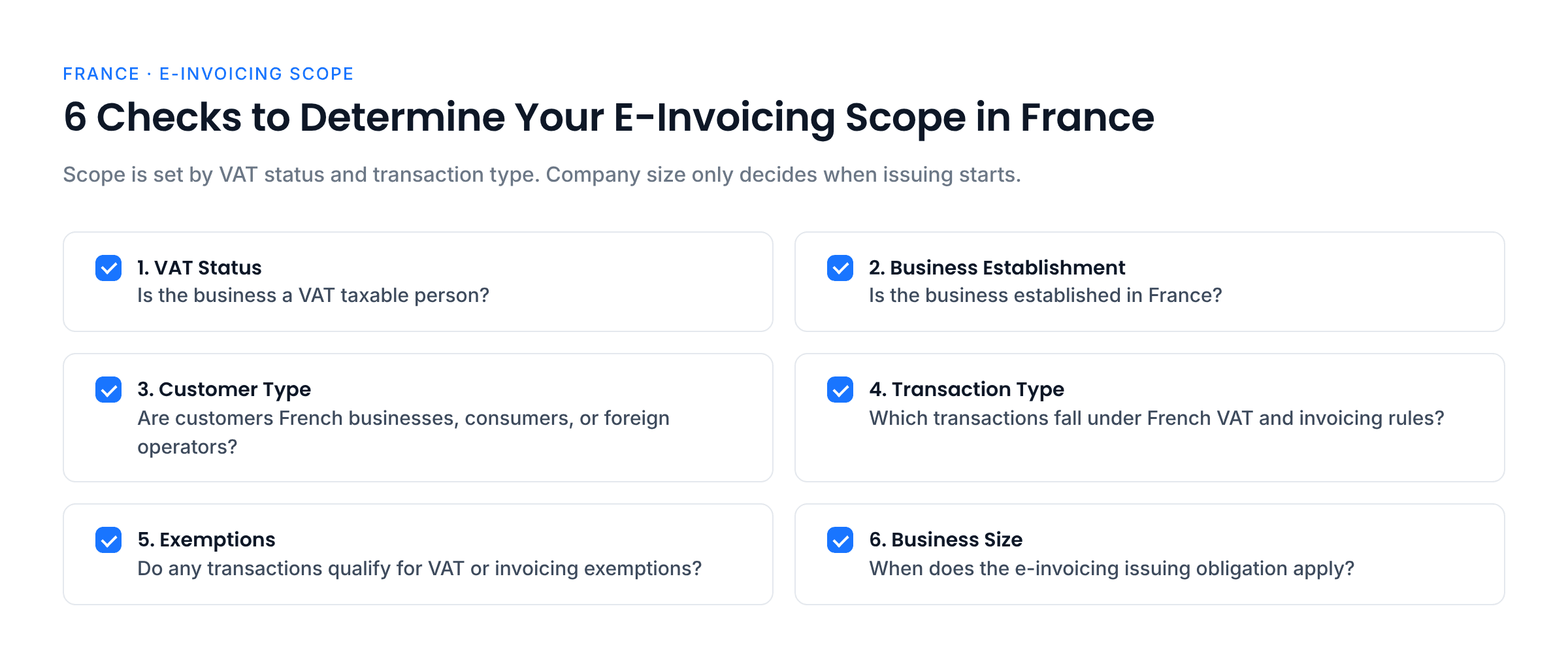
A practical scope review should look at six points:
- VAT status: Is the business a VAT taxable person?
- Establishment: Is the business established in France?
- Customers: Are customers French businesses, consumers, or foreign operators?
- Transactions: Which transactions fall within French VAT and invoicing rules?
- Exemptions: Do any operations qualify for the specific VAT and invoicing exemptions?
- Business size: When does the issuing obligation begin?
This approach is more reliable than asking only whether the company is an SME, micro-enterprise, or large enterprise.
It also helps finance teams separate three questions that are often mixed together: whether the business must receive e-invoices, whether it must issue e-invoices, and whether certain data must be reported electronically.
How Complyance Fits Into France E-Invoicing
Understanding scope is the first step. Businesses then need technology that can support the electronic invoicing and reporting processes that apply to their transactions.
Complyance is an e-invoicing platform designed to help businesses manage electronic invoicing requirements across markets. For France, businesses can use an e-invoicing platform such as Complyance to connect existing business systems with the required electronic invoicing infrastructure.
The exact architecture depends on the business, its transaction flows, and the French requirements that apply. Product architecture should not assume that every transaction follows the same route.
Conclusion
The French e-invoicing reform is broader than a simple company-size rule.
The key questions are whether the business is a VAT taxable person, which transactions it carries out, whether specific exemptions apply, and when its receiving and issuing obligations begin.
For businesses preparing for facturation électronique obligatoire, the safest approach is to assess the business and its transactions separately. This makes it easier to understand what must be received, what must be issued, and what information may need to be reported electronically.
Frequently Asked Questions
Yes. The French reform introduces mandatory electronic invoicing for businesses concerned by the reform. All such businesses must be able to receive electronic invoices from 1 September 2026, while issuance is phased according to company size.
Yes, where the micro-enterprise is concerned by the reform. It must be able to receive electronic invoices from 1 September 2026 and be able to issue them no later than 1 September 2027 for relevant transactions.
No. The franchise en base de TVA does not by itself remove a business from the reform. Relevant French B2B transactions can still be subject to electronic invoicing.
B2C transactions are generally not domestic B2B e-invoices. Relevant transaction and, where applicable, payment data can instead fall under e-reporting.
Yes. A business may have qualifying exempt operations while still needing to receive electronic invoices from suppliers for transactions covered by the reform.
About the Author

Swathy
Content Marketer
I’m a Content Marketer at Complyance, focused on e-invoicing. Over the years, I’ve created a wide range of content, including blog posts, whitepapers, and product guides, which have supported Complyance’s growth across markets such as the UAE and EU regions. My goal is to deliver content that is comprehensive, clear, accurate, and easy to understand, no matter how complex the topic.