UAE E-Invoicing for SaaS: Use Cases, Risks, and Strategic Implementation

UAE e-invoicing is transforming SaaS billing with new VAT rules and subscription use cases under the UAE e-invoicing mandate. Learn how to prepare today.
Table of Contents
What is E-Invoicing in the UAE?
E-invoicing, also known as electronic invoicing, is the process of creating and exchanging invoices in a structured digital format that systems can automatically read and validate. Instead of sending a PDF invoice by email, businesses transmit structured invoice data through Accredited Service Providers. These providers validate the data against regulatory rules and transmit it within the UAE’s official framework aligned with PINT-AE standards. The key difference is structure. Every invoice must follow predefined data fields, tax classifications, validation rules, and formatting standards, often defined within the uae e-invoicing data dictionary and technical schema documentation. This means:
- VAT is calculated consistently.
- Mandatory data, such as TRNs and tax codes, must be present.
- Errors are detected before acceptance.
- Audit records are automatically preserved.
E-invoicing is therefore not just digitisation. It is a structured compliance infrastructure built on schema validation and regulated transmission protocols.
How E-Invoicing Transforms SaaS Business Operations
When implemented properly, e-invoicing strengthens operational control and reduces risk. In subscription-driven environments, this impact is closely tied to billing accuracy, predictable cash flow, and revenue stability under the evolving e-invoicing in uae framework.
image insertion: for ex 
Cost Savings
Subscription billing often requires fixing recurring errors, reconciling ERP data, and correcting VAT mismatches. Even PDF invoices demand manual review and reissuance. Structured e-invoicing reduces these inefficiencies through automated validation, preventing rejection cycles and lowering operational costs at scale.
Boosted Team Productivity
Finance teams handling renewals, upgrades, and usage-based billing spend significant time verifying VAT timing and compliance. Structured validation improves invoice accuracy before submission, allowing teams to focus on forecasting, pricing strategy, and financial planning instead of fixing errors.
Prevention of Lost Documents
Invoices stored across billing systems, ERPs, and emails increase the risk of data fragmentation. Structured e-invoicing centralises records with digital audit logs, making retrieval fast and reliable during disputes or audits.
Increased Efficiency and Fewer Errors
Automated validation detects VAT rate errors, missing TRNs, and formatting issues before submission. This prevents large-scale billing mistakes in recurring cycles and ensures smoother, faster invoice processing.
Audit Readiness
Structured, searchable invoice records simplify audit preparation. Validation logs and submission confirmations are easily accessible, reducing regulatory exposure and reconciliation effort.
Stronger Security
Encrypted transmission, digital authentication, and secure storage protect sensitive billing and tax data. This strengthens compliance and builds trust with enterprise customers.
Support for Global Expansion
Because the UAE framework aligns with Peppol standards, structured e-invoicing creates a scalable foundation for international growth. Instead of rebuilding systems for each country, compliance becomes an integrated infrastructure layer.
Why SaaS Is Structurally Different Under the UAE E-Invoicing Mandate
SaaS revenue models introduce VAT timing complexity because services are delivered over time rather than at a single transaction moment. SaaS revenue is:
- Recurring rather than one-time.
- Time-based, often spanning months or years.
- Frequently prepaid.
- Sometimes usage-based.
- Dependent on automated billing engines.
This creates VAT timing obligations that differ from those of industries selling physical goods. Under UAE VAT time-of-supply principles, continuous supplies cannot remain uninvoiced indefinitely. In practice, long-term subscription contracts must generate periodic invoices so VAT is recognised in the correct tax period. For example:
- A 24-month contract cannot remain uninvoiced for 24 months.
- An advance annual subscription payment triggers VAT at receipt.
- Foreign cloud services may require reverse charge documentation.
Generic ERP invoice modules operate on event-based logic. SaaS requires subscription-aware logic aligned with VAT time-of-supply rules. Failure to align with these rules may expose businesses to uae e-invoicing penalties and VAT reporting adjustments.
UAE E-Invoicing Penalties and Compliance Risks for SaaS Platforms
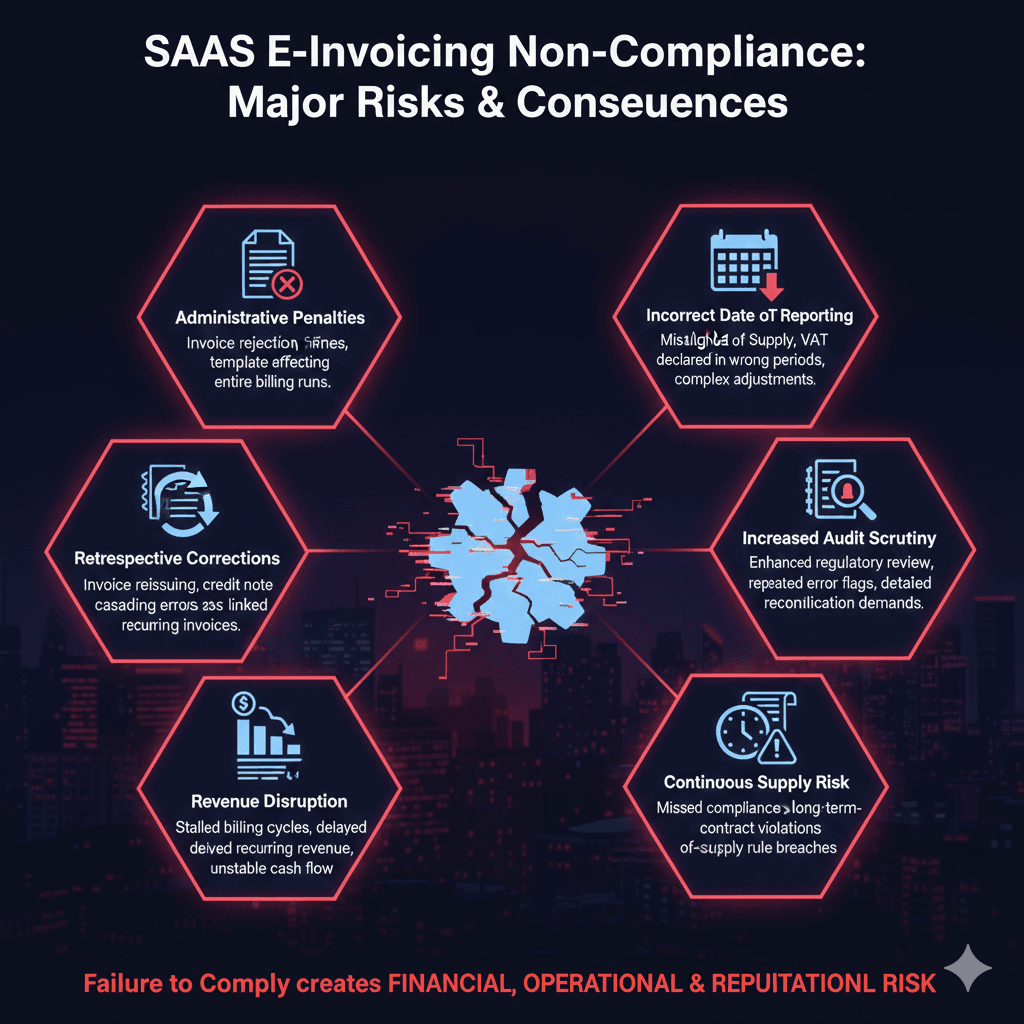
Failure to comply with structured e-invoicing requirements creates operational, financial, regulatory, and reputational risk at the same time. In subscription businesses running automated billing at scale, even small compliance errors can multiply quickly.
👉 Administrative Penalties
Invoice validation failures due to missing fields, incorrect tax classifications, or formatting errors can lead to repeated rejections. If one billing template is wrong, an entire cycle may be impacted.
👉 Incorrect VAT Reporting
Misaligned Date of Supply calculations for subscriptions or advance payments can result in VAT being declared in the wrong tax period, requiring corrections and adjustments.
👉 Retrospective Corrections
Non-compliant invoices may need to be reissued, credit notes amended, and VAT returns revised. In recurring billing chains, one error can affect multiple linked invoices.
👉 Increased Audit Scrutiny
Structured submissions increase transaction visibility. Repeated errors or timing inconsistencies may trigger deeper regulatory review and reconciliation demands.
👉 Revenue Disruption
If invoices fail validation, billing cycles can stall. For SaaS businesses dependent on recurring revenue, this directly affects cash flow stability.
👉 Continuous Supply Risk
Long-term subscriptions must be invoiced periodically under time-of-supply rules. Without automated monitoring, enterprise contracts may fall outside compliance windows.
Key SaaS Use Cases Under E-Invoicing in the UAE
Continuous Supply of Subscriptions
Under UAE VAT principles aligned with e-invoicing in uae, the date of supply is triggered by payment receipt or invoice issuance, whichever occurs first. Invoices must be issued periodically to comply with time-of-supply rules under the broader uae e-invoicing timeline. Most SaaS subscriptions qualify as continuous supplies because services are delivered over time. Under UAE VAT principles:
- The date of supply is triggered by either payment receipt or invoice issuance, whichever occurs first.
- An invoice must be issued at least once every 12 months, even if the contract duration is longer.
This requires systems to:
- Monitor contract timelines.
- Detect billing intervals.
- Prevent extended uninvoiced service periods.
- Align invoice issuance with regulatory timing rules.
Without automation, long-term enterprise contracts can unintentionally fall outside compliance windows.
Advance Payments
When customers prepay for subscriptions, VAT liability arises at payment receipt. This means:
- An invoice must be generated at the time payment is received.
- VAT must be calculated based on the advance.
- The invoice cannot wait until service delivery is complete.
Systems must therefore connect billing confirmations with invoice triggers in real time. Manual detection introduces a delay risk.
Reverse Charge for Imported Services
SaaS businesses frequently purchase services from foreign vendors, such as:
- Cloud hosting providers.
- Infrastructure platforms.
- Global SaaS tools.
- API services.
Under reverse charge principles, the UAE entity must self-account for VAT when applicable. This requires:
- Proper classification of the transaction.
- Internal documentation of the reverse charge.
- Accurate reporting in VAT returns.
- Audit trail preservation.
Structured systems must support internal invoice generation for these transactions.
Governance Before Integration
Before implementation begins, SaaS businesses should:
- Assign a VAT and compliance owner.
- Conduct a structured data gap analysis.
- Review subscription billing logic against time-of-supply rules.
- Align ERP master data with structured schema requirements.
- Evaluate reverse charge treatment consistency.
Strategic governance reduces implementation risk significantly.
Building an In-House E-Invoicing Solution vs Buying an E-Invoicing Solution for SaaS Industries
While building in-house may appear to offer control, many SaaS companies evaluate vendor-based solutions to reduce risk, accelerate compliance, and protect engineering bandwidth. E-invoicing is not just a technical integration. It is an evolving regulatory layer that requires continuous monitoring, structured validation, and scalable infrastructure.
Buying a specialised solution shifts compliance complexity to a provider that already manages schema updates, mandate changes, and multi-country requirements. Instead of building and maintaining a parallel compliance engine internally, SaaS platforms can integrate once and scale confidently.
The comparison below outlines the strategic advantages of adopting a vendor-based e-invoicing solution for SaaS industries.
Building an In-House E-Invoicing Solution for SaaS Industries
| Area | What It Means for SaaS | Practical Impact |
|---|---|---|
| The Expertise Gap | Building internally requires more than developers. You need backend engineers for API and XML generation, ERP specialists for schema mapping, tax experts for UAE VAT time-of-supply rules, QA teams for sandbox validation, and project managers for coordination. | Hiring or reallocating 6–9 resources for even one country. Risk of VAT misinterpretation leading to invoice rejection or exposure to uae e-invoicing penalties. |
| Maintenance Burden | E-invoicing mandates evolve with new schema versions, validation rules, Peppol updates, and technical transmission changes. Internal teams must continuously track and implement these changes. | Developers are pulled away from core product features. Compliance updates interrupt product roadmaps. Ongoing testing cycles increase operational overhead. |
| ERP and Billing Complexity | SaaS companies operate subscription billing engines, ERPs, CRMs, payment gateways, and revenue recognition tools. Each system stores invoice data differently. | Complex field mapping to structured XML. Continuous supply and reverse charge logic must align with UAE VAT and the uae e-invoicing data dictionary. Multi-country expansion multiplies mapping complexity. |
| Scalability Challenges | Each country introduces different frameworks, APIs, validation logic, and transmission rules, even within Peppol-based systems like uae peppol. | Compliance architecture grows into a parallel product. Expansion to 5 countries means maintaining 5 compliance frameworks internally. Engineering effort scales exponentially. |
| Accreditation & Infrastructure Costs | Some jurisdictions require official accreditation, specific hosting standards, and technical certifications for invoice transmission. | Legal processes, insurance, local infrastructure setup, and ongoing regulatory audits create hidden costs unrelated to core SaaS innovation. |
| Long-Term Cost Escalation | Initial build costs may seem lower than vendor subscriptions. However, salaries, infrastructure, updates, and expansion add recurring expenses. | The more global the SaaS platform becomes, the more expensive internal compliance becomes. Costs grow with success rather than remaining predictable. |
Buying an E-Invoicing Solution for SaaS Industries
| Area | What It Means for SaaS | Strategic Advantage |
|---|---|---|
| Reduced Internal Resource Burden | Integration typically requires one developer or ERP specialist. Tax interpretation, validation updates, and schema changes are handled by the vendor. | Engineering teams stay focused on product innovation instead of compliance maintenance. Lower hiring and payroll requirements. |
| Accelerated Go-Live | Vendor-based implementation can take weeks instead of months. API-first platforms enable faster sandbox testing and production rollout. | Faster compliance with the uae e-invoicing timeline. Reduced exposure to operational delays and penalties. |
| Simplified ERP Integration | Pre-built connectors, SDKs, and auto-mapping engines reduce the need for custom XML development. | Faster deployment across business units. Reduced risk of schema mismatch or formatting errors under e-invoicing in uae requirements. |
| Multi-Country Scalability | Unified API models support multiple countries through a single integration layer. | Linear scalability instead of exponential engineering effort. Easier adaptation to new mandates under evolving global e-invoicing frameworks. |
| Predictable Cost Structure | Subscription-based pricing replaces variable payroll and infrastructure expenses. | Budget certainty. Vendor absorbs accreditation, hosting, and regulatory update costs. |
| Continuous Regulatory Monitoring | Vendors continuously track mandate updates, schema changes, Peppol specifications, and validation rule adjustments. | Compliance stays aligned without internal redevelopment. Reduced risk of uae e-invoicing penalties due to missed regulatory updates. |
What to Look for in a SaaS-Friendly E-invoicing Tool
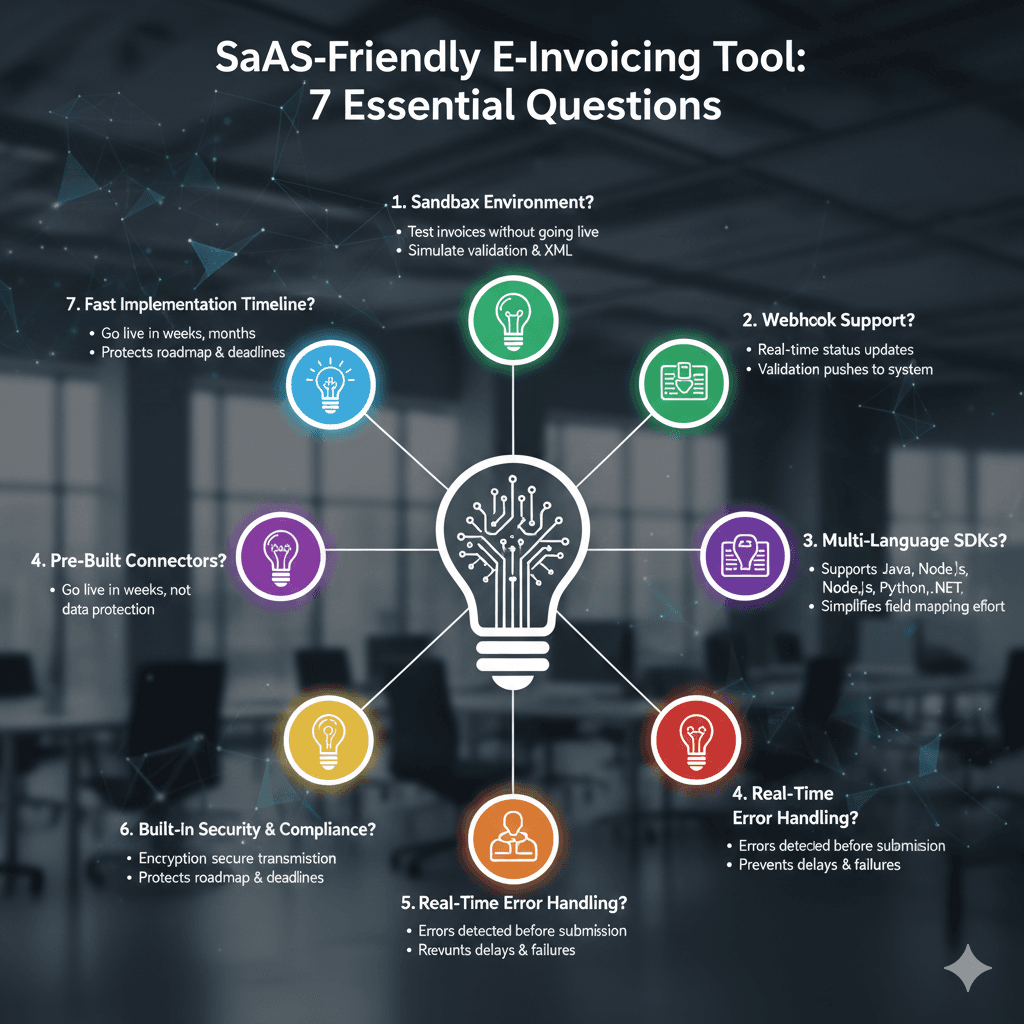
Sandbox Environment
Does it offer a real production-like sandbox? A proper sandbox should let you test invoices, simulate validation, and verify XML outputs without affecting live compliance. This ensures billing logic works correctly before going live.
Webhook Support
Does it support real-time status updates? Webhooks should automatically push validation results into your system. This keeps your billing engine aligned with compliance without manual tracking.
Multi-Language SDKs
Does it support your tech stack? The tool should provide SDKs in languages like Java, Node.js, Python, or .NET. This reduces development time and simplifies integration.
Pre-Built Connectors
Are ERP and billing connectors available? Ready-made connectors reduce field mapping effort and speed up deployment across different systems and regions.
Real-Time Error Handling
Are errors detected before submission? Validation should happen before sending invoices to authorities. Clear error messages prevent delays and repeated failures.
Built-In Security & Compliance
Is security built into the platform? Strong encryption, secure transmission, and audit logs must be standard. Compliance and data protection should be embedded, not optional.
Fast Implementation Timeline
Can you go live quickly? The solution should allow implementation in weeks, not months. Fast deployment protects your roadmap and regulatory deadlines.
Why Complyance Is the Best UAE E-Invoicing Solution for SaaS
Complyance is an accredited service provider and API-first compliance infrastructure designed for subscription-driven and multi-tenant SaaS environments.
It supports:
- A unified API architecture across 100+ countries.
- Dedicated sandbox aligned with government test environments.
- Structured transformation through GETS.
- Multi-tenant architecture.
- Automated compliance updates.
- Intelligent queuing during government downtime.
Compliance becomes invisible infrastructure operating behind your product.
Single API for 100+ Countries
Most vendors claim to support multiple countries but require separate APIs, separate payload formats, or country-specific implementations. Complyance provides a unified API architecture.
This means:
- One integration into your billing or ERP system
- One payload structure
- One authentication flow
- Multi-country compatibility
As new mandates are introduced, the transformation happens within the Complyance layer, not inside your codebase. For SaaS companies expanding internationally, this eliminates repetitive schema redevelopment and prevents country-specific logic from polluting core product architecture.
Dedicated Sandbox
Compliance cannot be tested in production. Complyance provides a fully functional sandbox environment connected to government test frameworks.
This allows developers to:
- Simulate invoice submissions
- Validate continuous supply scenarios
- Test advance payment triggers
- Verify reverse charge handling
- Review structured XML output
Because SaaS billing is automated, even a small misconfiguration can scale across thousands of invoices. The sandbox ensures stability before live submission. This reduces launch risk significantly.
Pre-Built ERP & Billing Connectors
SaaS companies often operate complex data ecosystems.
You may have:
- Subscription billing engines
- Custom ERP systems
- Revenue recognition tools
- Multiple entity structures
Complyance provides connectors and SDK support that simplify integration with both enterprise ERPs and custom billing platforms. Instead of manually building XML transformations and validation layers, the platform handles structured conversion automatically. This reduces engineering effort and accelerates deployment timelines.
Developer-Centric Documentation
Integration quality depends heavily on documentation clarity.
Complyance provides:
- Structured API documentation
- SDK guides
- Sample payloads
- Error response examples
- Schema references
- Migration documentation
This reduces onboarding friction and shortens development cycles. For SaaS companies where developer velocity directly impacts product roadmap execution, documentation quality is not a secondary feature. It is a critical infrastructure.
Multi-Tenant Architecture
SaaS platforms typically manage e-invoicing for multiple end customers within a single product instance. Complyance supports multi-tenant environments natively.
This means:
- Separate company profiles
- Separate tax identifiers
- Separate country configurations
- Centralized monitoring
SaaS platforms can serve multiple clients across different jurisdictions without duplicating infrastructure.
Seamless UX Integration
Compliance should not disrupt your product experience. Complyance operates entirely behind your interface through APIs and webhooks.
Your customers:
- Continue using your platform normally
- Do not need to access external dashboards
- Experience no workflow disruption
This preserves brand consistency and strengthens product stickiness. Compliance becomes invisible infrastructure.
Automated Compliance Updates
E-invoicing mandates evolve frequently. Schema updates, validation rule changes, and transmission protocol adjustments happen without warning. Complyance continuously monitors regulatory updates and deploys platform updates automatically. Your integration does not need to be rebuilt every time a mandate changes. This removes ongoing compliance maintenance from your engineering roadmap.
Smart Queue During Downtime
Government systems occasionally experience downtime. Without proper handling, this can interrupt billing cycles. Complyance includes an intelligent queuing mechanism.
Invoices are:
- Securely stored
- Automatically retried
- Submitted once systems resume
Recurring revenue operations continue without manual intervention.
How to Implement UAE E-Invoicing with Complyance
After understanding the strategic advantage, the next step is implementation. Below is a structured walkthrough.
Before You Start: Setting Up Your Complyance Account
Before integration begins, your workspace must be configured properly.
Step 1: Sign Up for an Account
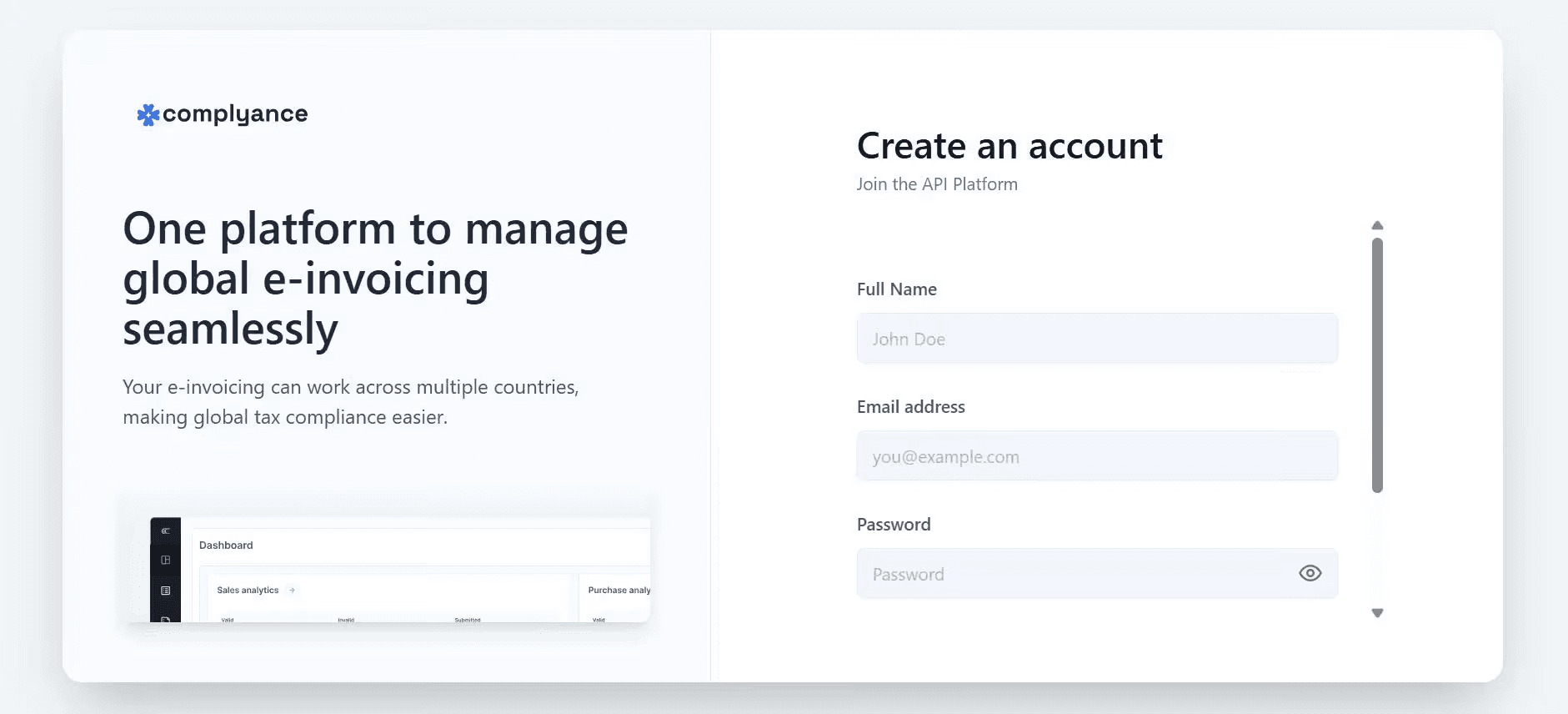
Visit: one.complyance.io Enter your:
- Name
- Work email
- Password
Click Create Account. This creates your base access credentials.
Step 2: Select Your Use Case
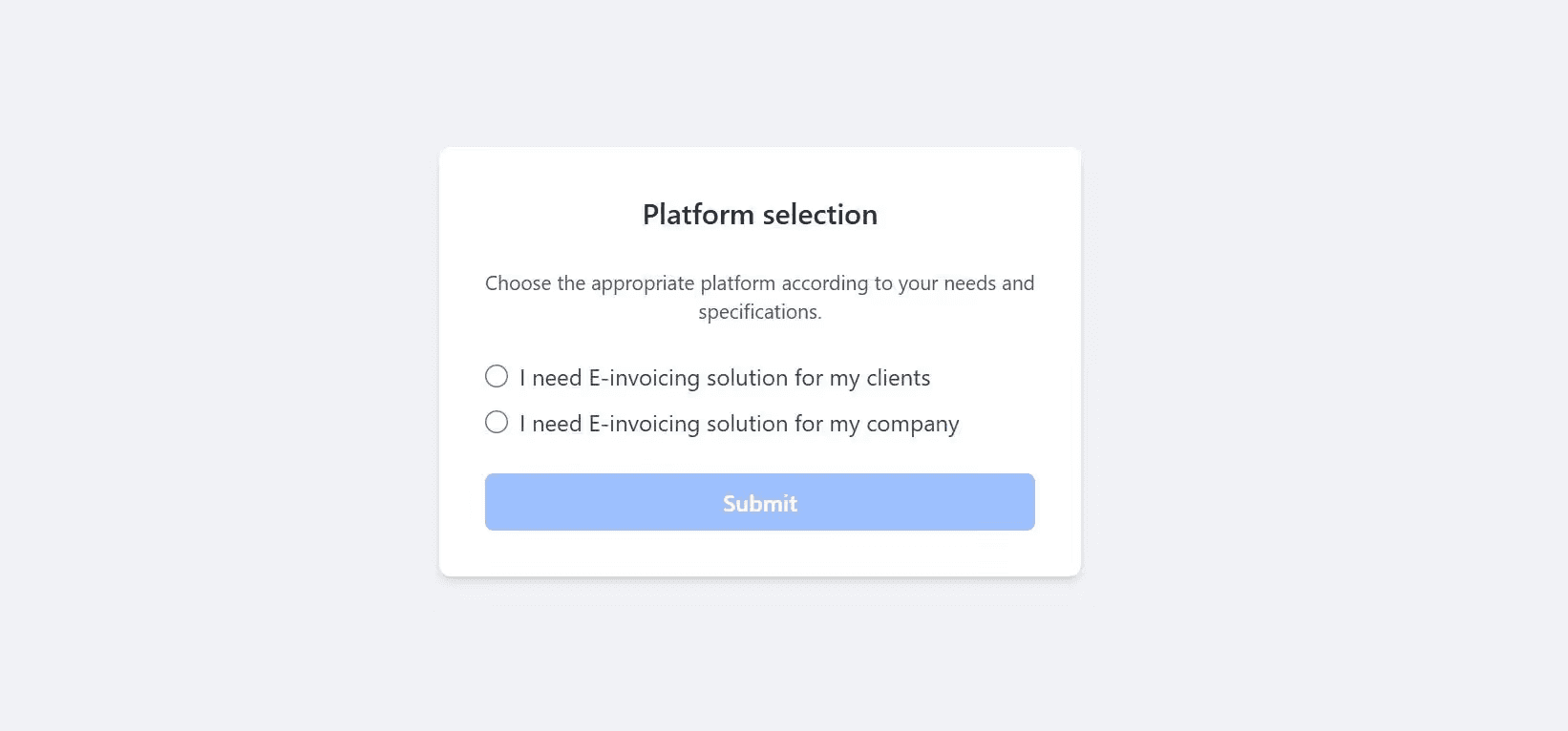
You will be asked how you intend to use the platform:
- “I need an E-invoicing solution for my company.”
- “I need an E-invoicing solution for my clients.”
This selection determines your workspace configuration. Multi-tenant SaaS platforms typically select the second option.
Step 3: Create Your Workspace
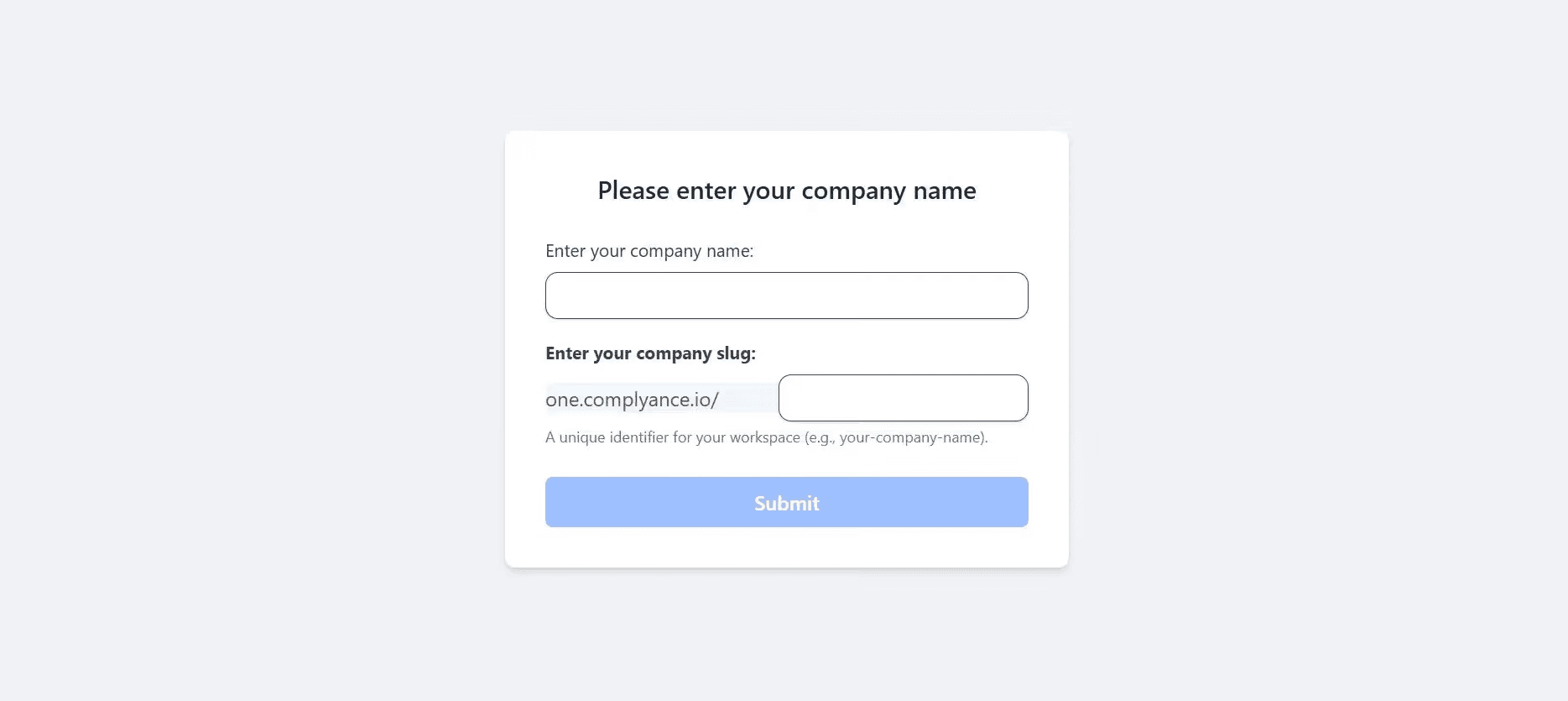
Enter:
- Company Name
- Unique URL slug
Example: one.complyance.io/technova This workspace becomes your central compliance environment.
Step 4: Add Company Details
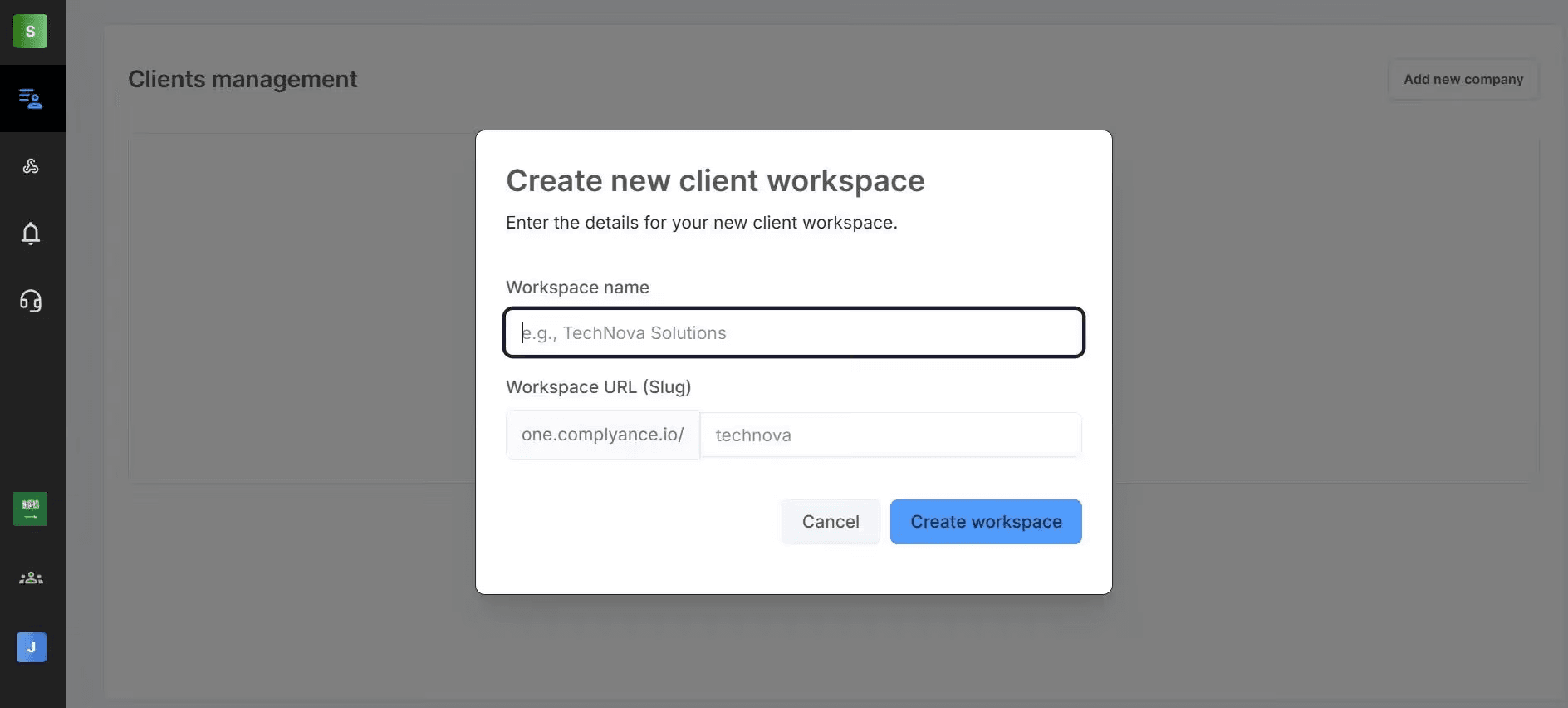
Enter:
- Legal entity name
- Tax Registration Number
- Registered address
- Contact details
If you manage multiple clients, you can configure multiple entities within the same workspace.
Step 5: Access Your Dashboard
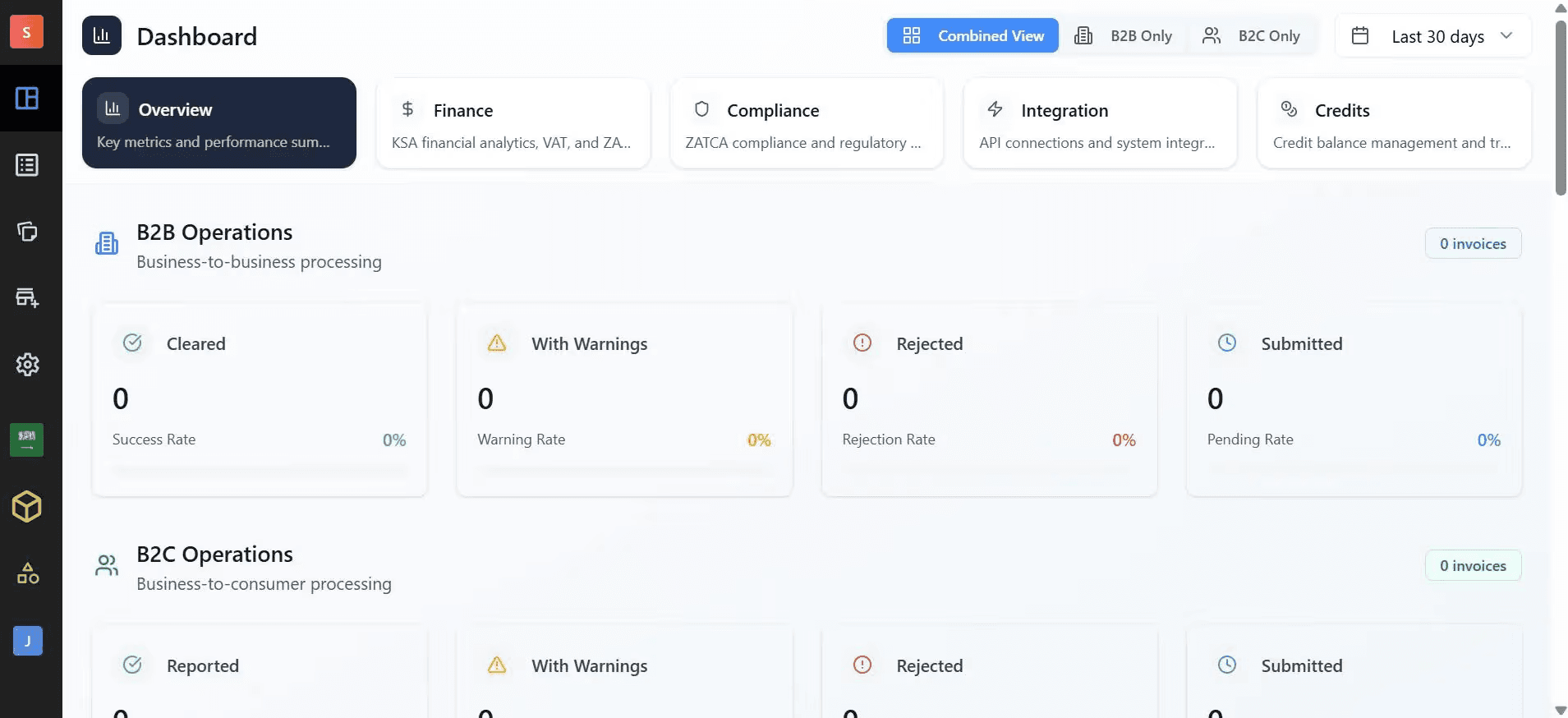
Once configured, your dashboard becomes your compliance control center. You can:
- Monitor invoice status
- View validation results
- Manage API keys
- Access sandbox and production environments
- Download signed XML and PDFs
This dashboard provides full visibility across transactions.
Getting Ready for Implementation
Before integration, ensure your billing or ERP system can provide structured data. You will need:
| Category | Details |
|---|---|
| Invoice Details | Invoice number, issue date, type |
| Buyer Details | Legal name, TRN, address |
| Seller Details | Legal name, TRN |
| Document Totals | Total amount, discount, payable amount |
| Tax Breakdown | VAT per rate category |
| Line Items | Description, quantity, unit price, tax |
Complete Integration Breakdown
Step 1: Access Developer Portal
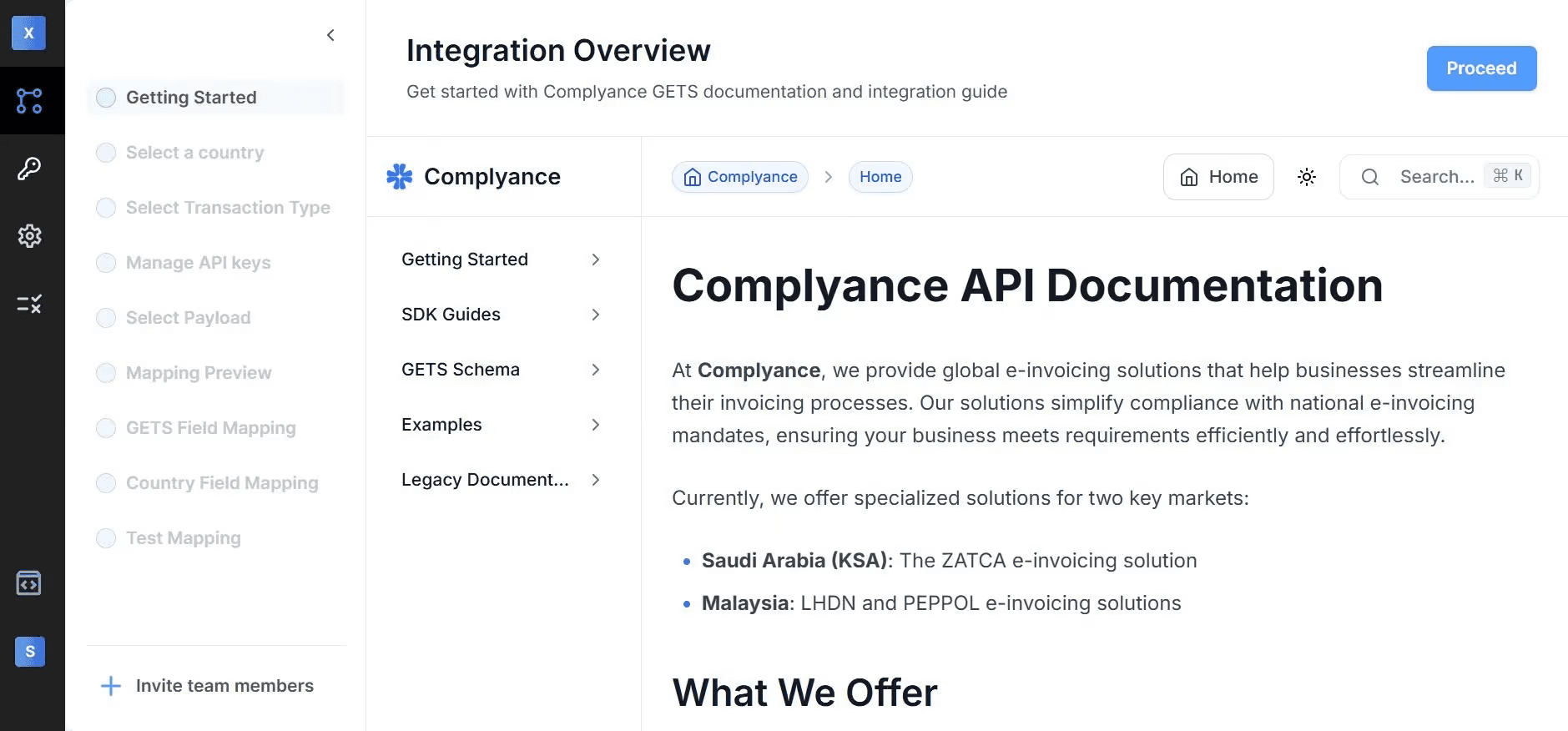
From your dashboard: Navigate to Developer Portal.
Here you will find:
- SDK Guides
- GETS Schema Documentation
- Example Payloads
- Legacy migration docs
This is your starting point for technical integration. This section gives your developers everything they need to get started: from understanding GETS to pushing validated data using SDKs. On the left sidebar, you'll see a progress-driven checklist, starting from country selection and ending with test mapping.
Java SDK Setup (Recommended Path for Developers)
We currently support the Java SDK for production-grade integration with your ERP or billing systems. In upcoming updates, we’ll add official SDK support for C++, JavaScript (Node.js), and Python to suit broader tech stacks. For now, if you're using Java, follow the setup below.
Installation: Java SDK Setup
We recommend using the automated setup, which detects your operating system and generates the correct configuration path for you.
macOS & Linux Setup
Install Java (JDK 11 or higher) JAVA Copy
brew install openjdk@11Set the JAVA\_HOME environment variable JAVA Copy
export JAVA_HOME=$(/usr/libexec/java_home -v 11)Verify Java Installation JAVA Copy
java -versionWindows
- Download and install OpenJDK 11+
- Set the JAVA\_HOME environment variable
- Add Java to PATH
After setting up the Installation, go to the Developer portal and start implementing it
Step 2: Select Country
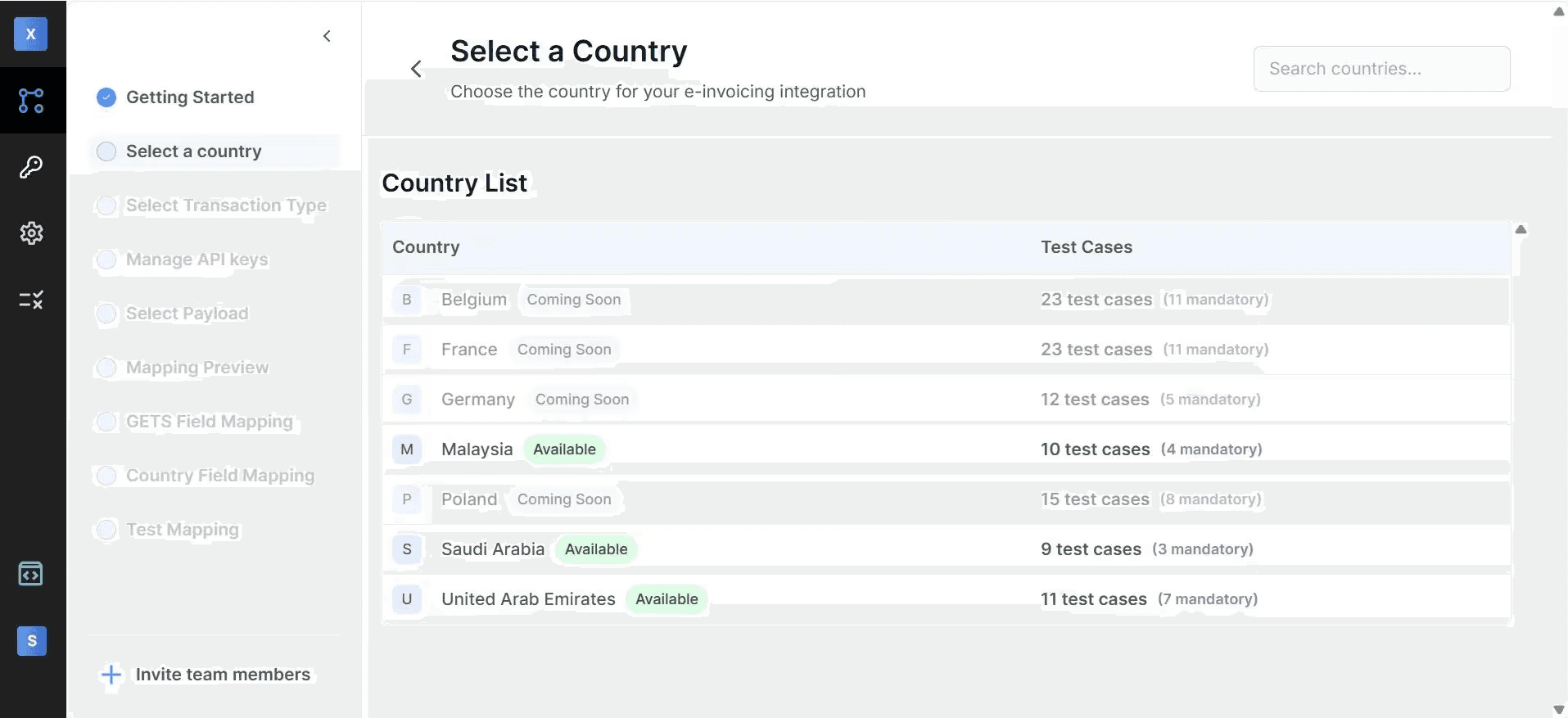
Choose United Arab Emirates (AE). This loads UAE-specific:
- PINT-AE schema
- Validation rules
- Formatting standards
Country selection configures compliance logic automatically.
Step 3: Choose Transaction Type
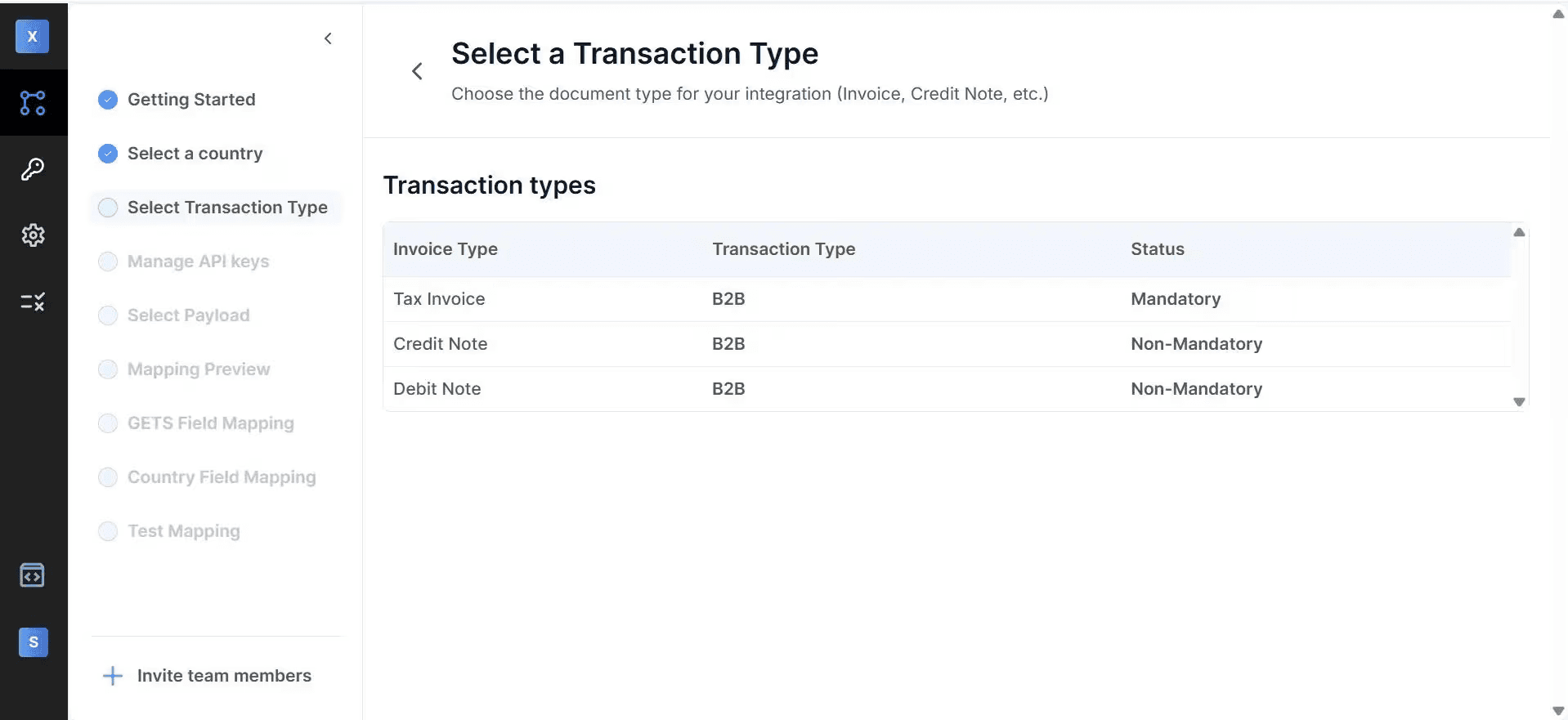
In the next step, “Select Transaction Type”, you’ll choose the type of invoice you want to send. Options include:
| Invoice Type | Transaction Type | Status |
|---|---|---|
| Tax Invoice | B2B | Mandatory |
| Credit Note | B2B | Non-Mandatory |
| Debit Note | B2B | Non-Mandatory |
You can select one or multiple types based on your use case.
Step 4: Generate Sandbox API Key
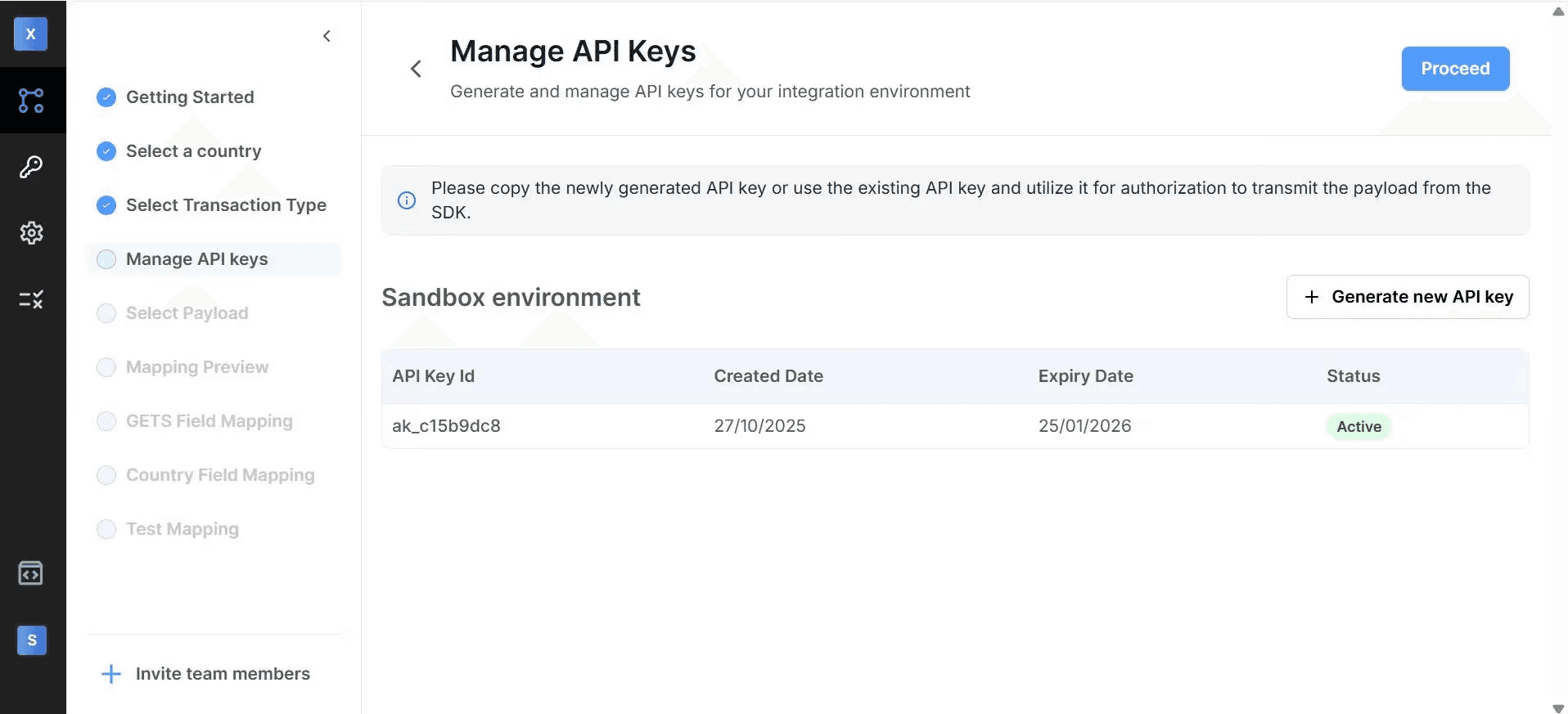
Now head to “Manage API Keys” and click Generate new API key under the Sandbox Environment. A secure key will be created and shown in a pop-up.
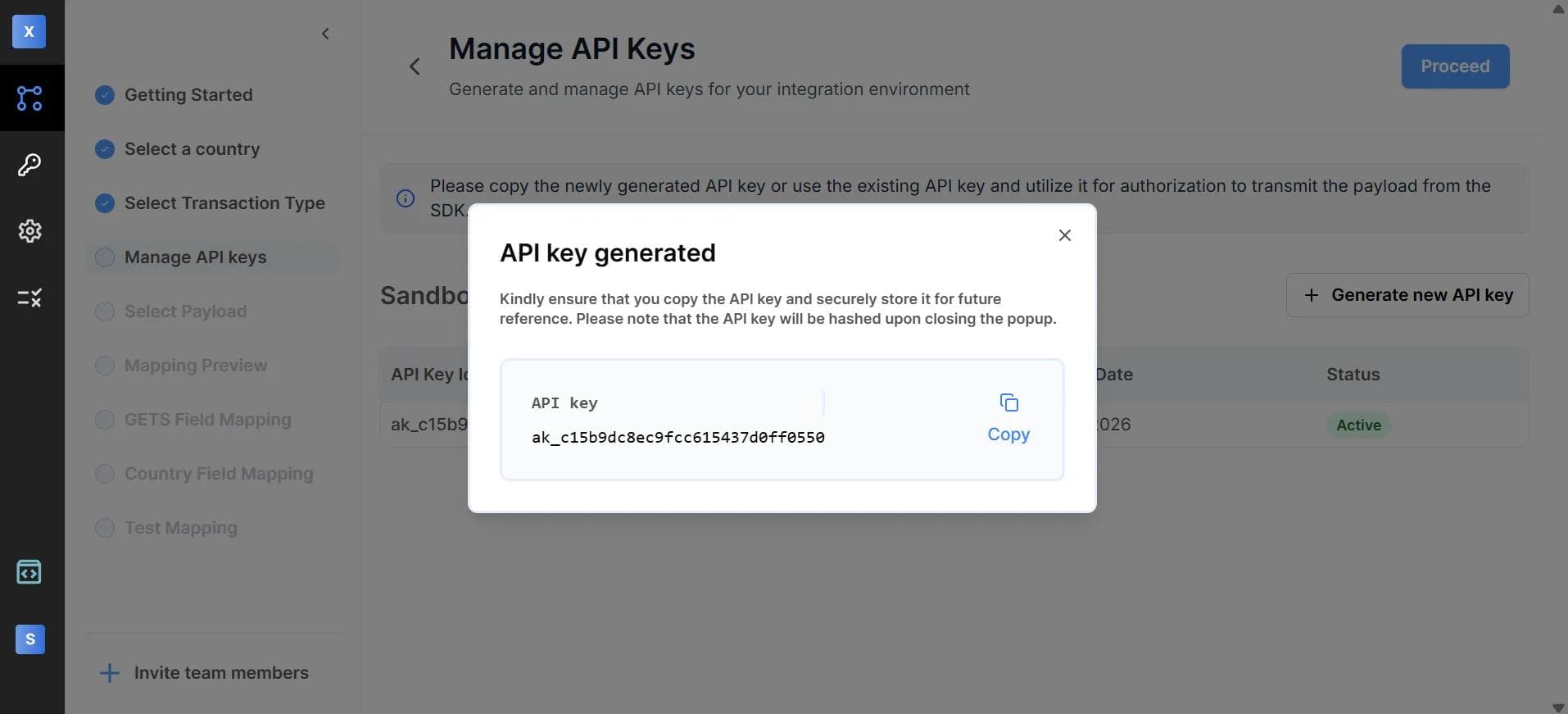
Important: Copy this key immediately, as it won’t be shown again. You’ll use this key to authenticate all API calls from your ERP or backend system during testing.
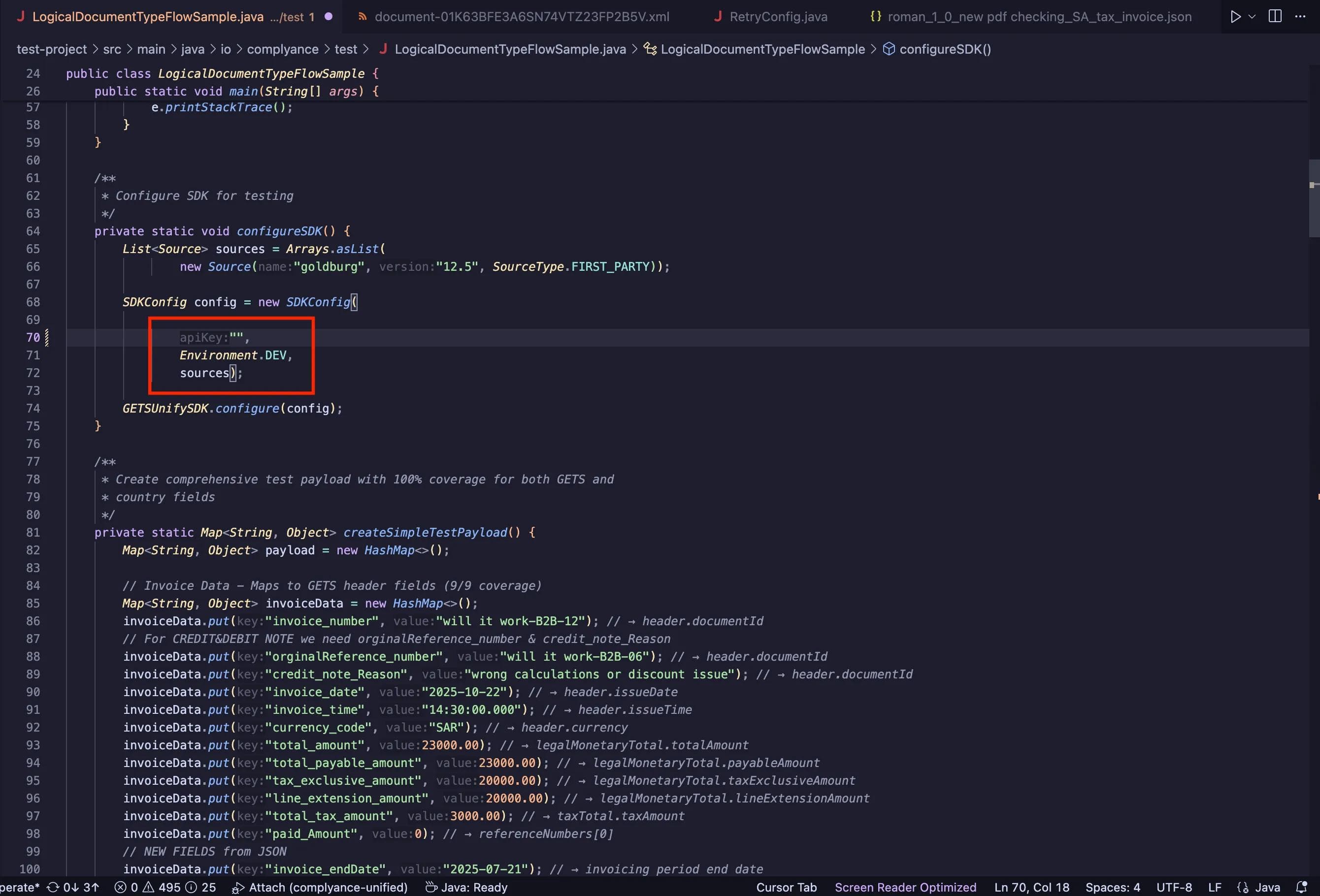
Once you generate your sandbox API key from the Complyance dashboard: Paste the API key here and then run it. After that, you can see the payload in the “Select Payload” screen.
Step 5: Upload or Select Payload
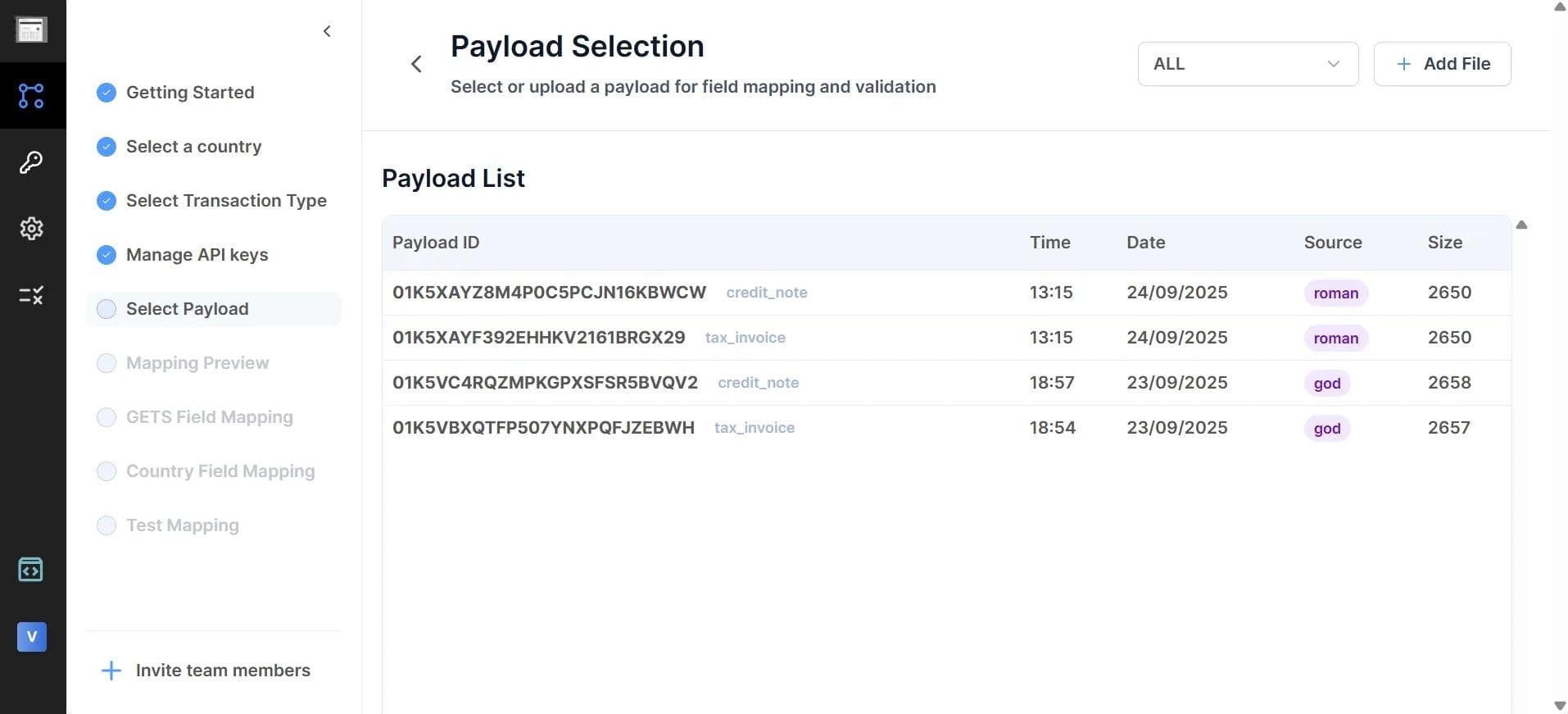
In the Payload Selection screen:
- Choose an existing test payload or upload your own
.json - Each payload is tied to a document type like
tax_invoiceorcredit_note - Payloads are used to map fields during GETS integration
Step 6: Preview Mapping
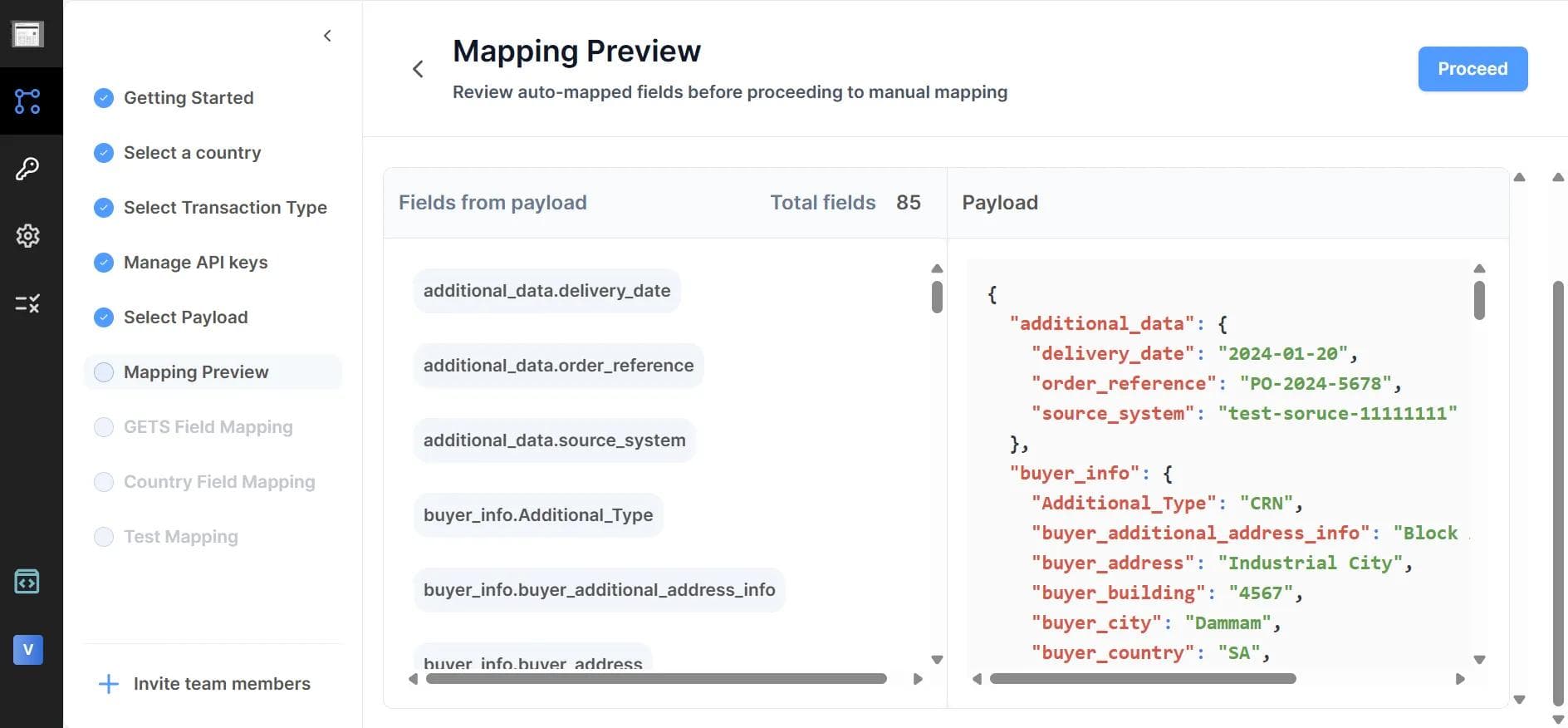
The Mapping Preview screen auto-detects the structure of your uploaded payload.
- On the left: Field names from your JSON
- On the right: Raw payload content for verification
This allows you to verify that your ERP export is structured correctly before proceeding.
Step 7: GETS Field Mapping
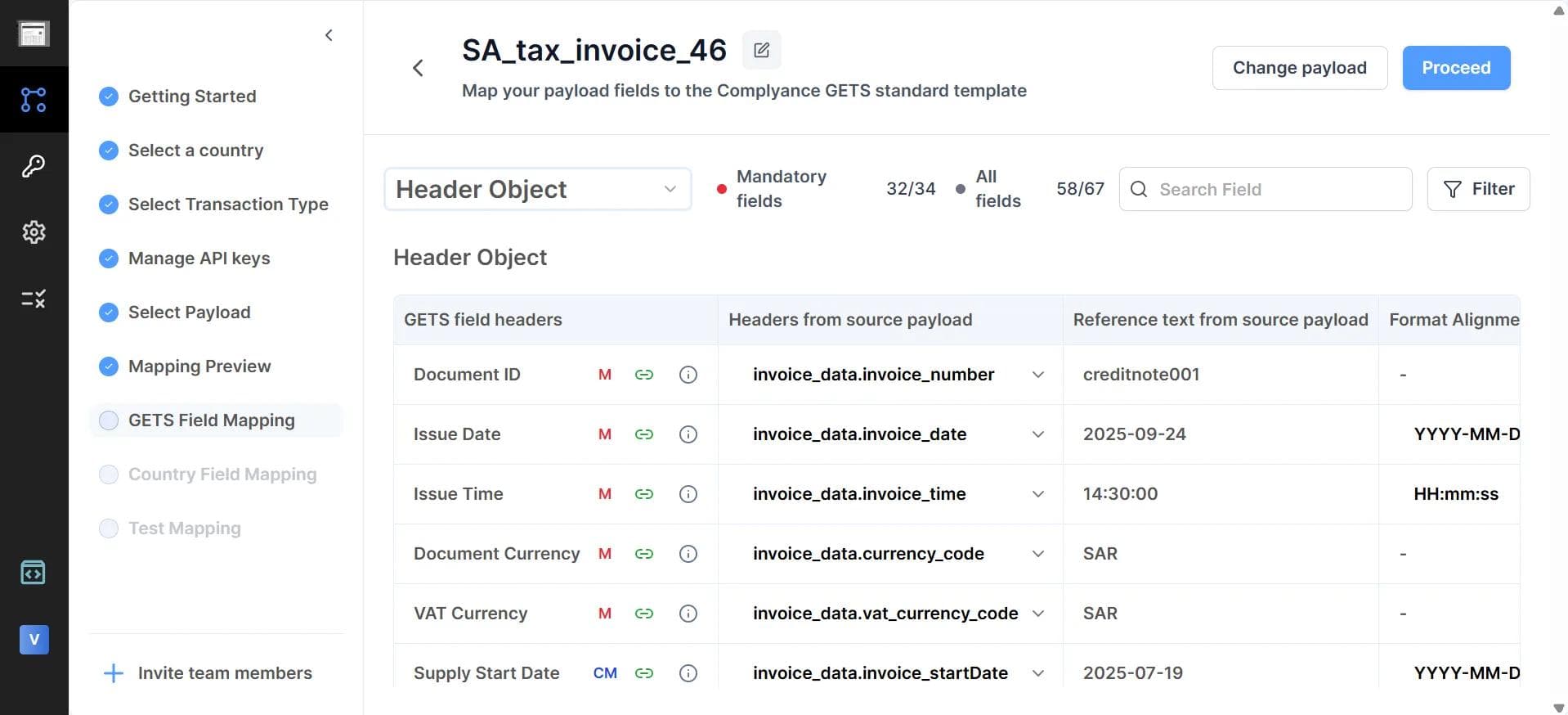
GETS (Global E-Invoicing Transformation Standard) will auto-map your payload fields to the UAE's PINT-AE schema. Here, you can:
- Review each source field (like
buyerTRN,invoiceAmount, etc.) - Confirm how it maps to the FTA-required XML structure
- Use auto suggestions to auto-correct mismatches
This step ensures your data is always formatted correctly for validation.
Step 8: Country-Specific Field Mapping
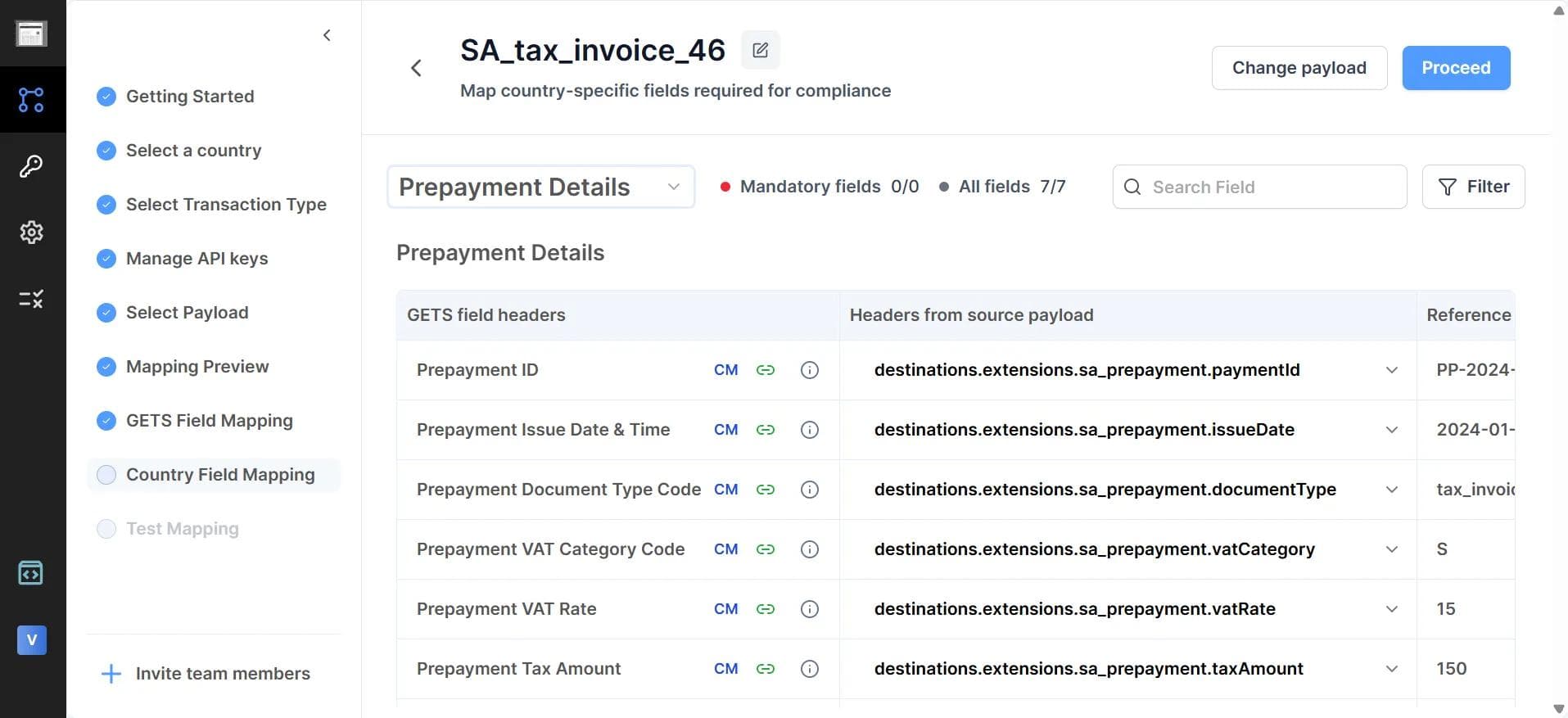
In Country Field Mapping, you’ll handle additional UAE-specific rules, such as:
- Mandatory tax classifications
- Required string formats (e.g., 15-digit TRNs)
- Field validations (e.g., decimal formats, VAT code matching)
Complyance ensures your invoice meets PINT-AE specs automatically.
Step 9: Test Your Mapping
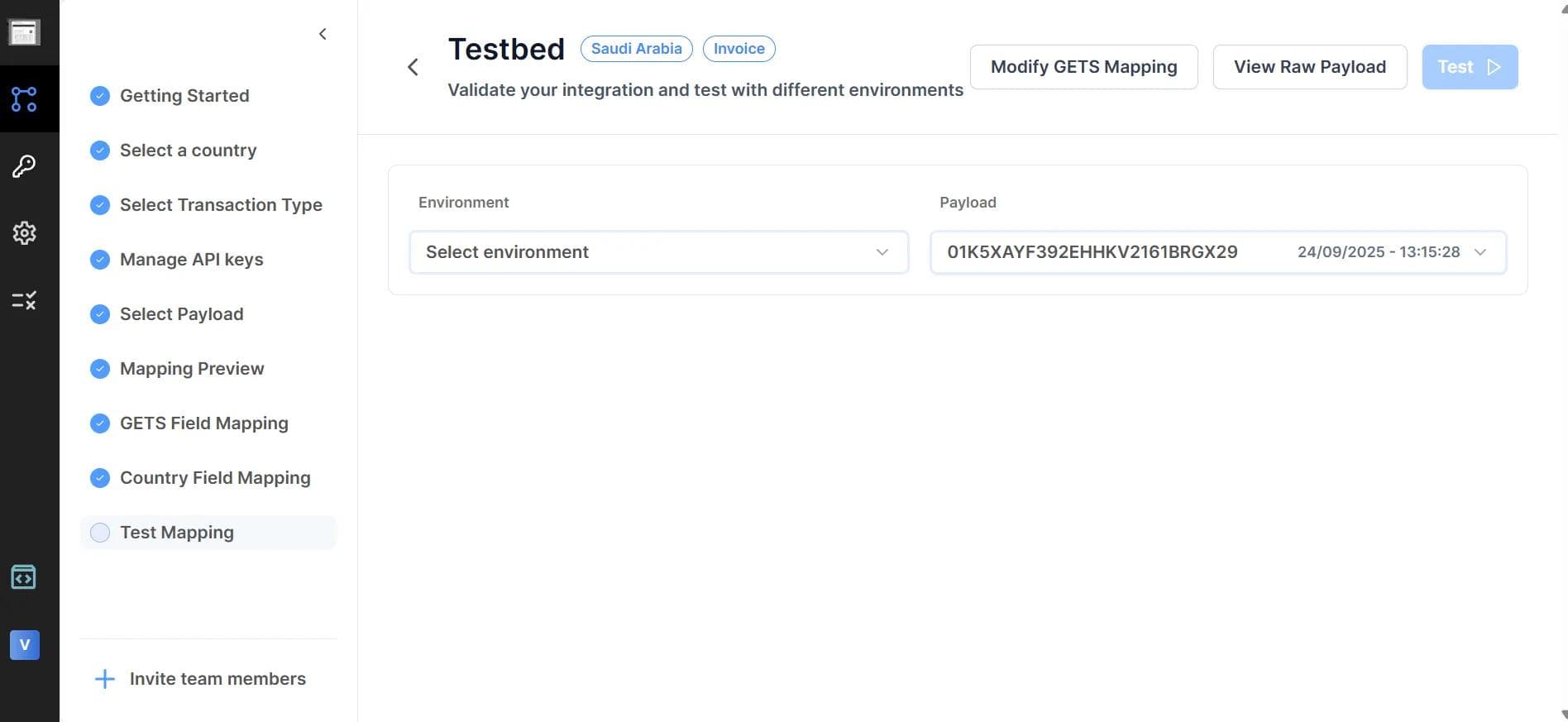
This is your final stop before production.
- Choose your payload
- Select the environment (e.g., UAE Sandbox)
- Click Test to run validation
The system will check:
- If all required fields are mapped
- If the data matches the correct formats
- If the output structure matches the UAE PINT-AE specification
You’ll get real-time feedback to fix any last-mile issues.
Step 10: Go Live in Production
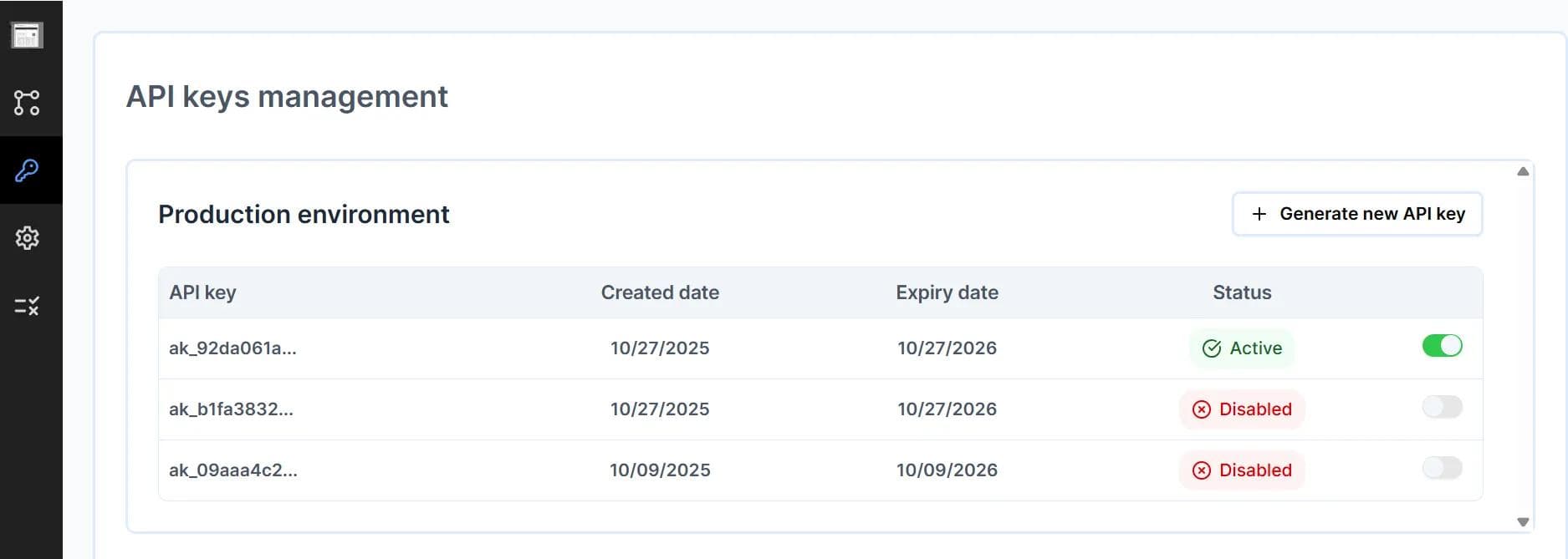
Once testing is successful:
- Switch your environment from Sandbox to Production
- Generate a new Production API Key
- Start submitting real, compliant invoices directly to the UAE tax authority
Your invoices are now digitally signed, validated, and submitted in real-time.
Real-Time Monitoring
Dashboard statuses include: 🟡 Pending ✅ Validated 🟢 Cleared ❌ Rejected Full audit logs are accessible.
Alternative Methods
While API integration is recommended for SaaS environments, alternative methods are available.
Option A: Manual Input (Best for Small Businesses)
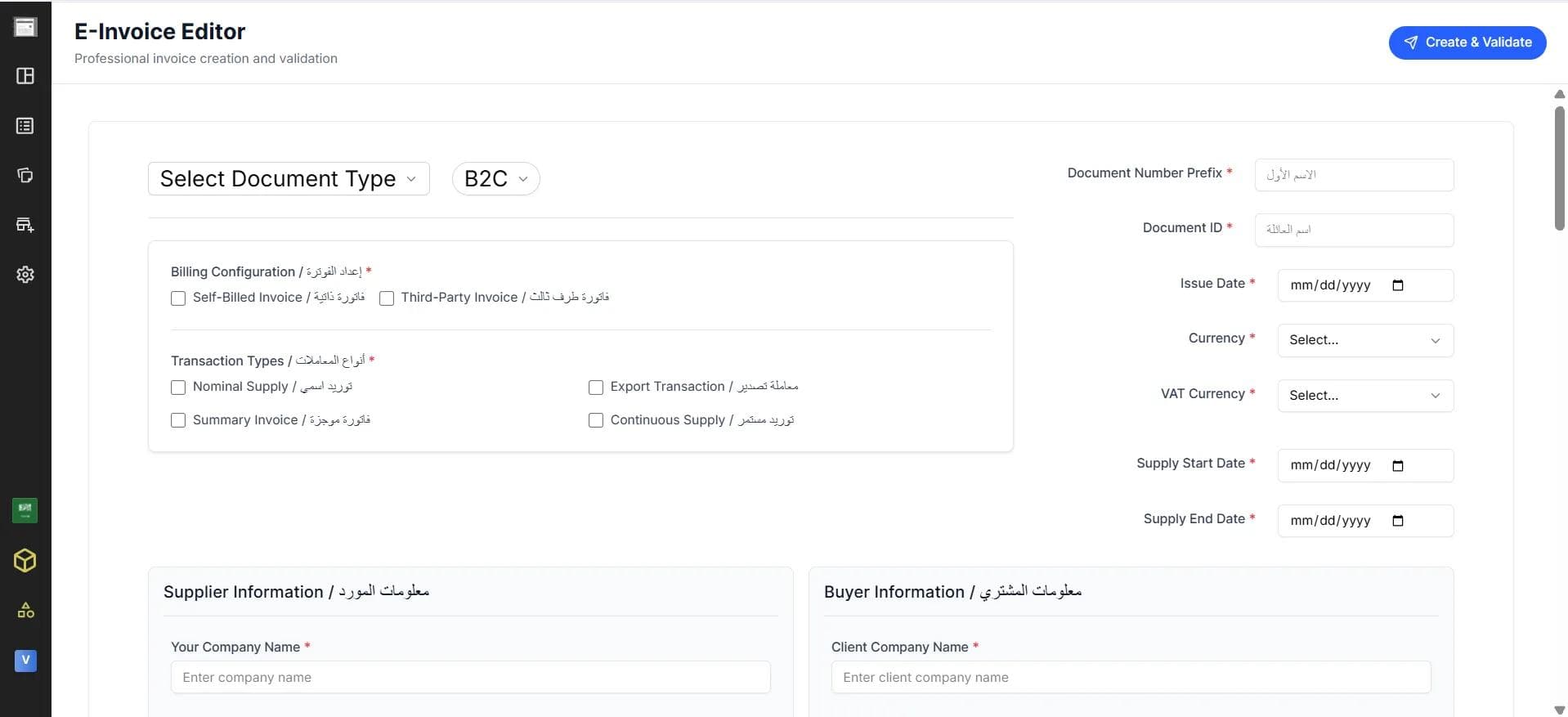
If you're a small business issuing only a few invoices each week, you can create invoices directly in the Complyance platform without any technical setup. Here’s how it works:
- Log in to your Complyance workspace
- Click the "Create Invoice" button
- Fill in key fields such as TRN, customer name, item details, VAT, and total amount
- Click "Validate" to check for errors, then hit "Submit" to send
This method is ideal for testing or businesses without any ERP systems in place.
Option B: Excel Upload (Best for Growing Teams)
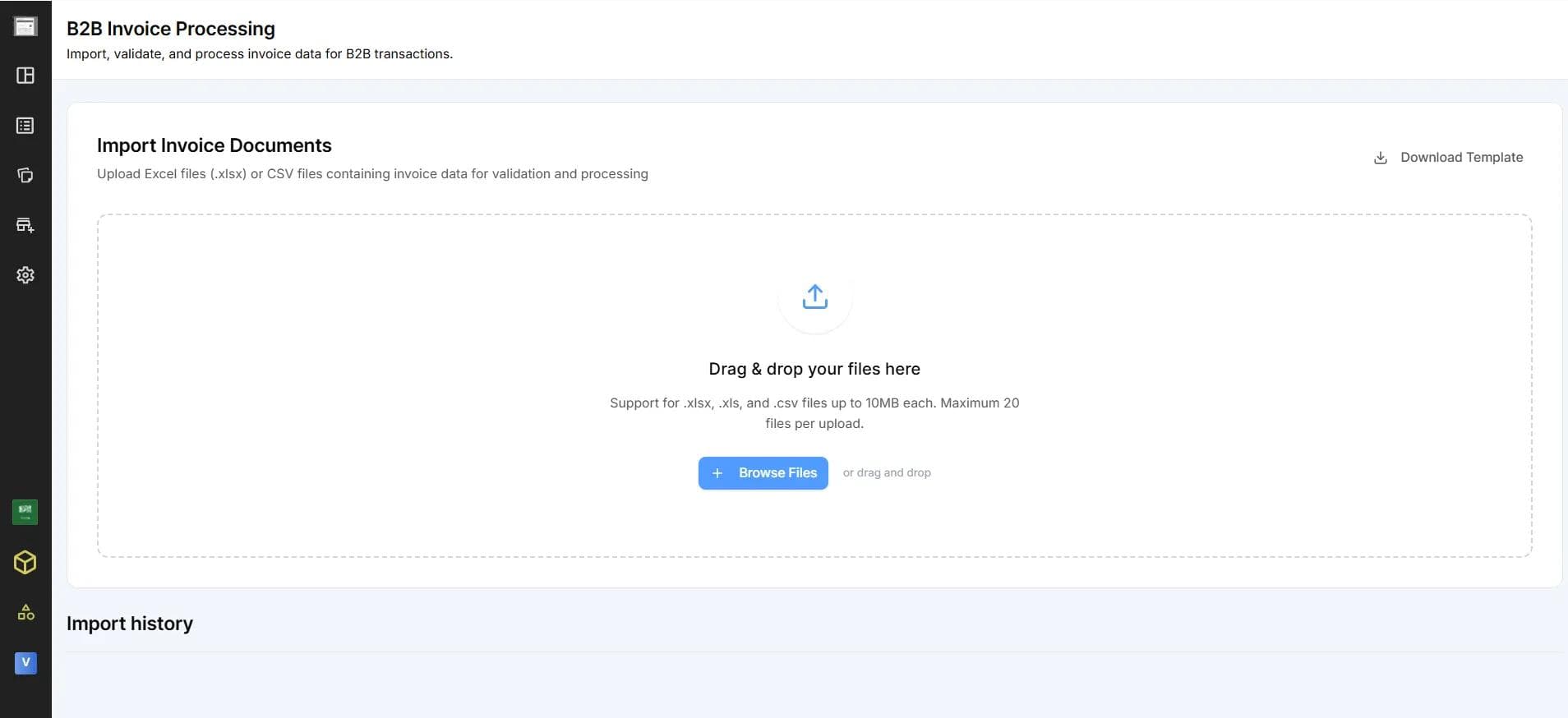
For the teams that already manage invoices in spreadsheets, the Excel Upload option offers a convenient way to process many invoices at once. Here’s the process:
- Download the pre-formatted Excel template from your Complyance dashboard
- Fill in all invoice rows with the required details
- Upload the completed sheet back to the platform
- Complyance auto-validates each entry, showing clear errors (like missing TRNs or VAT mismatches)
Bonus: Smart dropdowns and data validation in the template help reduce manual mistakes while preparing the sheet.
Conclusion
UAE e-invoicing is not merely a formatting requirement. For SaaS companies, it directly affects subscription billing logic, VAT timing, reverse charge documentation, record retention, and audit readiness. Handled manually, it creates risk and operational drag. Handled strategically, it becomes a structured infrastructure that strengthens revenue operations. For SaaS businesses preparing for the UAE rollout, the priority is automation, validation, and scalability. Complyance provides the structured foundation to move forward confidently while preserving developer focus and product growth.
Frequently Asked Questions
It directly impacts customer retention. Enterprise clients will churn if your platform generates non-compliant invoices that cause them penalties and payment delays. Compliance is no longer optional; it's a core feature.
- Increase Stickiness: Clients rely on your platform to solve a complex regulatory problem.
- Automate Operations: Eliminate manual billing processes for consistent cash flow.
- Accelerate Global Expansion: Use the system as a compliance engine for entering new markets faster.
Complyance is built API-first for developers, offering a sandbox, clear documentation, and a single API for global compliance, enabling integration in days, not months.
- API-First Architecture: For seamless integration into your product.
- Sandbox Environment: For safe testing without affecting live data.
- Global Compliance Coverage: A single solution for multiple countries.
- Pre-built Connectors: For popular billing systems and ERPs.
- Comprehensive Documentation: For a fast, smooth developer experience.
Key requirements include using the Peppol-based 5-corner model, where invoices must be exchanged through Accredited Service Providers (ASPs) accredited by the Federal Tax Authority (FTA). Invoices must be generated in specific digital formats like XML or JSON using structured standards such as PINT AE (Peppol International Invoice for UAE). Real-time reporting to the FTA is mandatory, and invoices must include mandatory fields like supplier/buyer Tax Identification Numbers (TRNs), VAT breakdowns, and invoice types as per the UAE Data Dictionary.
- Complyance: Best for Global E-Invoicing with a Developer-Friendly One API
- Avalara: Best for global tax compliance and extensive ERP integrations
- Pagero: Best for network-based automation and seamless partner connectivit
- EDICOM: Best for EDI and E-Invoicing Expertise
- Comarch: Best for Regulatory-Focused E-Invoicing
About the Author

Swathy
Content Marketer
I’m a Content Marketer at Complyance, focused on e-invoicing. Over the years, I’ve created a wide range of content, including blog posts, whitepapers, and product guides, which have supported Complyance’s growth across markets such as the UAE and EU regions. My goal is to deliver content that is comprehensive, clear, accurate, and easy to understand, no matter how complex the topic.