E-Invoice Archiving in Germany: Retention, GoBD and Compliance Requirements

Learn Germany e-invoice archiving requirements, including eight-year retention, structured invoice data, GoBD, invoice integrity, access, ERP migration, and preservation controls.
Table of Contents
Sending or receiving an E-Rechnung is not the end of the process. German businesses must also retain invoices and related business records in accordance with applicable VAT and tax-record requirements.
For VAT purposes, invoices generally must be retained for eight years. Under § 14b UStG, the period begins at the end of the calendar year in which the invoice was issued. The rule covers both invoices received by the business and copies of invoices issued by the business.
E-Rechnungen add an important requirement because the structured invoice data is part of the legally relevant record. Retaining only a PDF rendering may therefore be insufficient.
Key Takeaways
- German VAT invoice retention is generally eight years, starting at the end of the calendar year in which the invoice was issued.
- For an E-Rechnung, the structured part must be retained in accordance with § 14b UStG and the applicable GoBD requirements.
- For a hybrid invoice such as ZUGFeRD, the structured XML must be retained, while the PDF/A-3 component must also be retained when it contains additional or different tax-relevant information.
- GoBD provides broader guidance for the proper management, recording, retention, and access of electronic books, records, and documents.
- An archive should protect integrity, support traceability and retrieval, and keep records available throughout the required retention period.
How Long Must German Invoices Be Retained?
Under § 14b UStG, invoices generally must be retained for eight years. The period begins at the end of the calendar year in which the invoice was issued.
The requirement applies to both incoming invoices and copies of invoices issued by the business.
Businesses should therefore configure their archiving processes so the required records remain available, readable, retrievable, and protected throughout the retention period.
Cloud storage outside Germany is not automatically prohibited. A business must ensure that the statutory requirements for storage location, online access, downloading, use of the data, and access by the German tax authorities are satisfied. Storage outside the EU or designated territories can trigger additional requirements under § 14b UStG and the German Fiscal Code.
What Must Be Retained for an E-Rechnung?
For an E-Rechnung, the structured part of the invoice is particularly important.
An incoming E-Rechnung should generally be retained in the structured format in which it was received, subject to the applicable GoBD conditions. An accounting entry, OCR output, or PDF rendering does not replace the structured invoice data.
For a hybrid E-Rechnung such as ZUGFeRD, the structured XML must be retained in accordance with the applicable retention and GoBD requirements.
The PDF/A-3 component must also be retained where it contains additional or different tax-relevant information, such as booking notes or a qualified electronic signature. Retaining the complete original hybrid file may be a prudent operational practice, but it is not automatically required in every case.
What Is GoBD?
GoBD is German tax-administration guidance on the proper management, recording, retention, and data access of books, records, and documents in electronic form.
The guidance is broader than E-Rechnung requirements and covers principles such as:
- Traceability and verifiability should allow records and their processing to be followed and checked.
- Completeness should ensure that relevant records are captured and retained.
- Accuracy should ensure that recorded information reflects the underlying business transactions.
- Timely recording should ensure that business events are recorded without inappropriate delay.
- Orderliness should support systematic and understandable record management.
- Immutability should make unauthorized or unnoticed alteration detectable.
- Availability and machine evaluability should be supported where applicable.
The BMF's July 14, 2025 GoBD amendment specifically addressed changes resulting from the introduction of mandatory E-Rechnung rules.
How Should Businesses Protect Invoice Integrity?
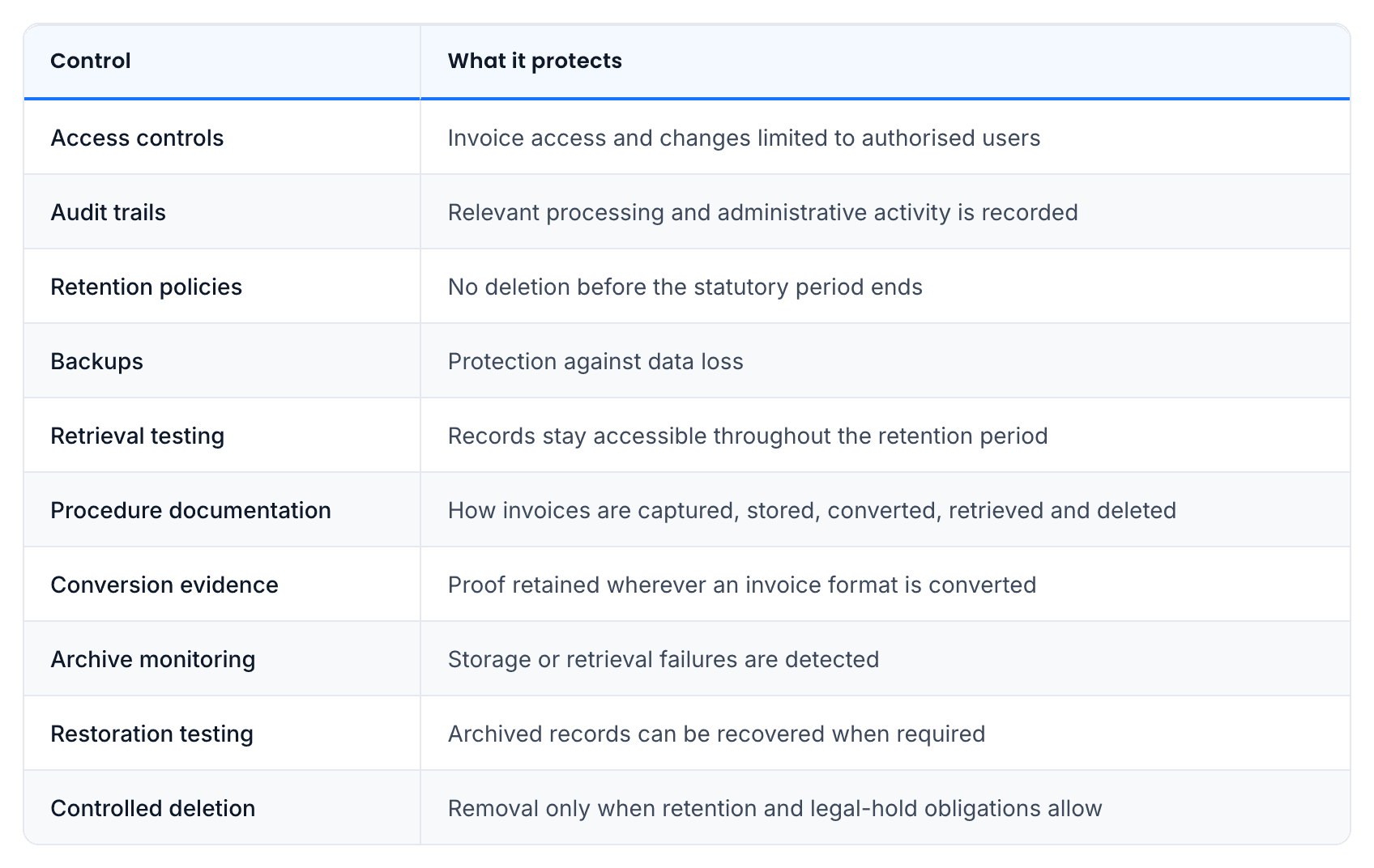
An archive should preserve the integrity of invoices and make subsequent changes detectable.
Suitable controls can include:
- Access controls should limit invoice access and changes to authorized users.
- Audit trails should record relevant processing and administrative activities.
- Retention policies should prevent premature deletion.
- Backups should protect against data loss.
- Retrieval testing should confirm that records remain accessible throughout the retention period.
- Procedure documentation should explain how invoices are captured, stored, converted, retrieved, and deleted.
- Conversion evidence should be retained where invoice formats are converted.
- Archive monitoring should identify storage or retrieval failures.
- Restoration testing should confirm that archived records can be recovered when required.
- Controlled deletion should ensure that records are removed only when the applicable retention and preservation obligations allow it.
GoBD does not prescribe one specific storage technology. Immutable storage can be one implementation approach, but businesses can use other suitable technical and organisational measures to meet the applicable requirements.
Archiving Incoming E-Rechnungen
Incoming electronic invoices require particular attention because the received structured data forms an important part of the original record.
The process should allow the business to receive the invoice, process and check the structured data, retain it in the required form, and connect it with the relevant accounting record and processing history.
Receipt or validation does not eliminate the need to retain the original invoice data.
Archiving Outgoing E-Rechnungen
Outgoing invoices must also be retained in accordance with the applicable rules.
For an outgoing invoice created by a billing system, a separate PDF image does not necessarily need to be stored from the moment of creation if an identical copy can be reproduced on demand and the applicable GoBD conditions are satisfied.
The archive should nevertheless preserve the invoice and relevant evidence of its processing and transmission where required by the business's controls.
Hybrid Invoice Archiving
A hybrid invoice such as ZUGFeRD contains structured XML and a human-readable PDF/A-3 component.
The structured XML is the legally relevant structured part of the E-Rechnung and must be retained in accordance with the applicable retention and GoBD requirements.
The PDF/A-3 component must also be retained where it contains additional or different tax-relevant information that is not represented in the structured data, such as booking notes or a qualified electronic signature.
A complete original-file archive may still be a sensible operational policy because it can simplify retrieval, dispute handling, and audit support. However, retaining the PDF component is not automatically required in every case if it contains no additional tax-relevant information.
How to Design an E-Invoice Archive
A practical archive should make it possible to identify the invoice, determine who sent or received it, confirm when it was issued, locate the relevant original structured data, understand its processing history, and retrieve it when required.
Useful search fields can include invoice number, supplier or customer, issue date, amount, tax information, and other relevant identifiers.
The archive should connect the accounting record with the original structured invoice and relevant processing history. It should also support human-readable review and machine-readable access where required.
For incoming E-Rechnungen, the structured data should generally remain available in the format received, subject to applicable GoBD conditions.
Retention, Access and ERP Migration
Businesses should define who can access archived invoices and how access is controlled and recorded. Finance teams may need full access, while other employees and external auditors may require limited or controlled access.
ERP migration creates an additional risk because historical invoices may need to remain accessible after the original system has been replaced.
Before decommissioning an old ERP, businesses should export and test the original structured invoices, related attachments where required, metadata, audit history, and retrieval indexes.
Migration should preserve important relationships and information, including invoice identity, issue date, supplier or customer relationship, tax information, links to accounting entries, and relevant conversion or correction history.
A dedicated archive or document repository can provide continuity when systems change, but the business remains responsible for meeting its retention obligations.
Legal Holds and Preservation
Statutory retention should not be treated as a simple automatic deletion timer.
In addition to statutory retention requirements, businesses should maintain an operational legal-hold process for disputes, audits, investigations, or other preservation obligations. A legal hold may prevent deletion after the ordinary retention period would otherwise end.
How Complyance Can Support E-Invoice Archiving
Complyance can help businesses keep structured invoice data as part of the e-invoicing workflow.
Depending on the actual product configuration and storage architecture, Complyance may support invoice processing, structured-data retention, retrieval, and related compliance workflows.
Whether a particular configuration satisfies the business's retention obligations depends on the actual storage architecture, access controls, retention settings, audit trail, data-export capability, and applicable legal requirements.
Businesses should therefore assess the complete operating model rather than treating a platform as automatically "GoBD-compliant." Where appropriate, it is safer to describe a solution as GoBD-supporting or designed to support GoBD-relevant controls unless the precise product and operating model have been assessed.
Conclusion
German E-Rechnung archiving is not simply about keeping a copy of an invoice.
It is about preserving the legally relevant structured data, protecting its integrity, maintaining traceability, and keeping the required records accessible for the applicable retention period.
For hybrid invoices such as ZUGFeRD, the structured XML must be retained, while the PDF/A-3 component must also be retained when it contains additional or different tax-relevant information.
Businesses should build these requirements into their invoicing, accounting, archive, ERP migration, and document-management processes from the beginning.
Frequently Asked Questions
Under § 14b UStG, invoices generally must be retained for eight years. The period begins at the end of the calendar year in which the invoice was issued. The rule covers both incoming invoices and copies of invoices issued by the business, subject to specific statutory provisions.
Yes. For an E-Rechnung, the structured part must be retained in accordance with § 14b UStG and the applicable GoBD requirements. For a hybrid invoice such as ZUGFeRD, the structured XML is essential. The PDF/image component must also be retained where it contains additional or different tax-relevant information.
For an incoming E-Rechnung, retaining only a PDF is generally insufficient because the structured invoice data must be preserved. For a hybrid invoice, the structured XML is the key required component. The PDF part is additionally required where it contains tax-relevant information that is not represented in the structured data.
GoBD is German tax-administration guidance on the proper management, recording, retention, and access of electronic books, records, and documents. It covers principles such as completeness, accuracy, traceability, timely recording, orderliness, immutability, and auditability.
Yes. Section 14b UStG generally requires businesses to retain incoming invoices and copies of invoices they issue for eight years. For incoming E-Rechnungen, the structured data should be retained in the required form. For outgoing invoices, applicable GoBD rules may allow an identical invoice copy to be reproduced from the billing system instead of storing a separate PDF image, provided the conditions are met.
About the Author

Swathy
Content Marketer
I’m a Content Marketer at Complyance, focused on e-invoicing. Over the years, I’ve created a wide range of content, including blog posts, whitepapers, and product guides, which have supported Complyance’s growth across markets such as the UAE and EU regions. My goal is to deliver content that is comprehensive, clear, accurate, and easy to understand, no matter how complex the topic.