How to Validate an E-Invoice in Germany: EN 16931, XRechnung and ZUGFeRD

Learn how to validate E-Rechnungen in Germany, including EN 16931, XRechnung, ZUGFeRD, syntax and business checks, common errors, severity levels, and validation controls.
Table of Contents
Creating a structured E-Rechnung is only the first step. The invoice can still contain missing information, invalid codes, calculation errors, or profile-specific rule violations.
That is why Germany e-invoice validation matters. Validation helps businesses identify technical and rule-based problems before an invoice is transmitted or processed.
The BMF recommends validation as a practical control, but it does not prescribe or endorse one particular validation application.
Key Takeaways
- Validation checks whether an invoice meets its applicable technical and business rules.
- EN 16931-based validation is important for invoices using the European standard and related specifications.
- XRechnung requires validation against its applicable syntax and XRechnung business rules.
- ZUGFeRD validation should check the structured XML and, for hybrid invoices, its consistency with the visual representation.
- Passing technical validation does not guarantee commercial acceptance or payment.
What Is E-Invoice Validation?
E-invoice validation is the process of checking an electronic invoice against the requirements that apply to its format, profile, and business context.
A validation process can check:
- File and XML structure to confirm that the document is technically well formed.
- Syntax to confirm that the selected UBL or UN/CEFACT CII syntax is used correctly.
- EN 16931 rules where the invoice uses an EN 16931-based specification.
- Profile-specific rules for specifications such as XRechnung or ZUGFeRD.
- Business data such as customer references, tax information, purchase orders, and duplicate invoices.
A technical validator cannot always determine whether the commercial facts are true. For example, it may not know whether goods were actually delivered or whether a price matches the underlying contract.
EN 16931 Validation
EN 16931 defines the semantic model and business rules for electronic invoices.
For invoices based on EN 16931, validation helps check whether the required information is structured and represented correctly. Other agreed structured formats must also be checked against their applicable syntax, mapping, and business rules.
This distinction matters because an invoice can be technically valid while still containing incorrect or incomplete business information.
How to Validate XRechnung
XRechnung is Germany's Core Invoice Usage Specification, or CIUS, based on EN 16931. It is implemented using supported structured XML syntaxes, including UBL and UN/CEFACT CII.
XRechnung is widely used for public-sector invoicing, but it is not mandatory for ordinary B2B transactions.
A useful XRechnung validation process checks:
- XML syntax to confirm that the invoice is technically valid.
- EN 16931 rules to check the applicable European business requirements.
- XRechnung rules to check Germany-specific requirements, including relevant buyer and public-sector information.
KoSIT provides technical resources for XRechnung validation.
How to Validate ZUGFeRD
ZUGFeRD is a hybrid invoice containing structured XML and a human-readable PDF/A-3 representation.
Validation should check the embedded XML against the applicable ZUGFeRD profile and relevant rules. For a hybrid invoice, the visual representation should also be consistent with the structured data.
If the structured and visual parts differ, the structured data is the authoritative invoice component under the applicable German rules.
The exact profile matters, so businesses should validate against the ZUGFeRD profile used for their transaction.
Syntax Validation vs Business Validation
These checks answer different questions.
- Syntax validation checks whether the file is technically structured according to the applicable syntax.
- Business-rule validation checks whether required fields, codes, calculations, and other rules are satisfied.
- Business-data review checks information that a technical validator may not be able to verify, such as commercial agreements or whether a delivery actually occurred.
A robust process therefore combines automated validation with the appropriate finance or ERP checks.
Common E-Invoice Validation Errors
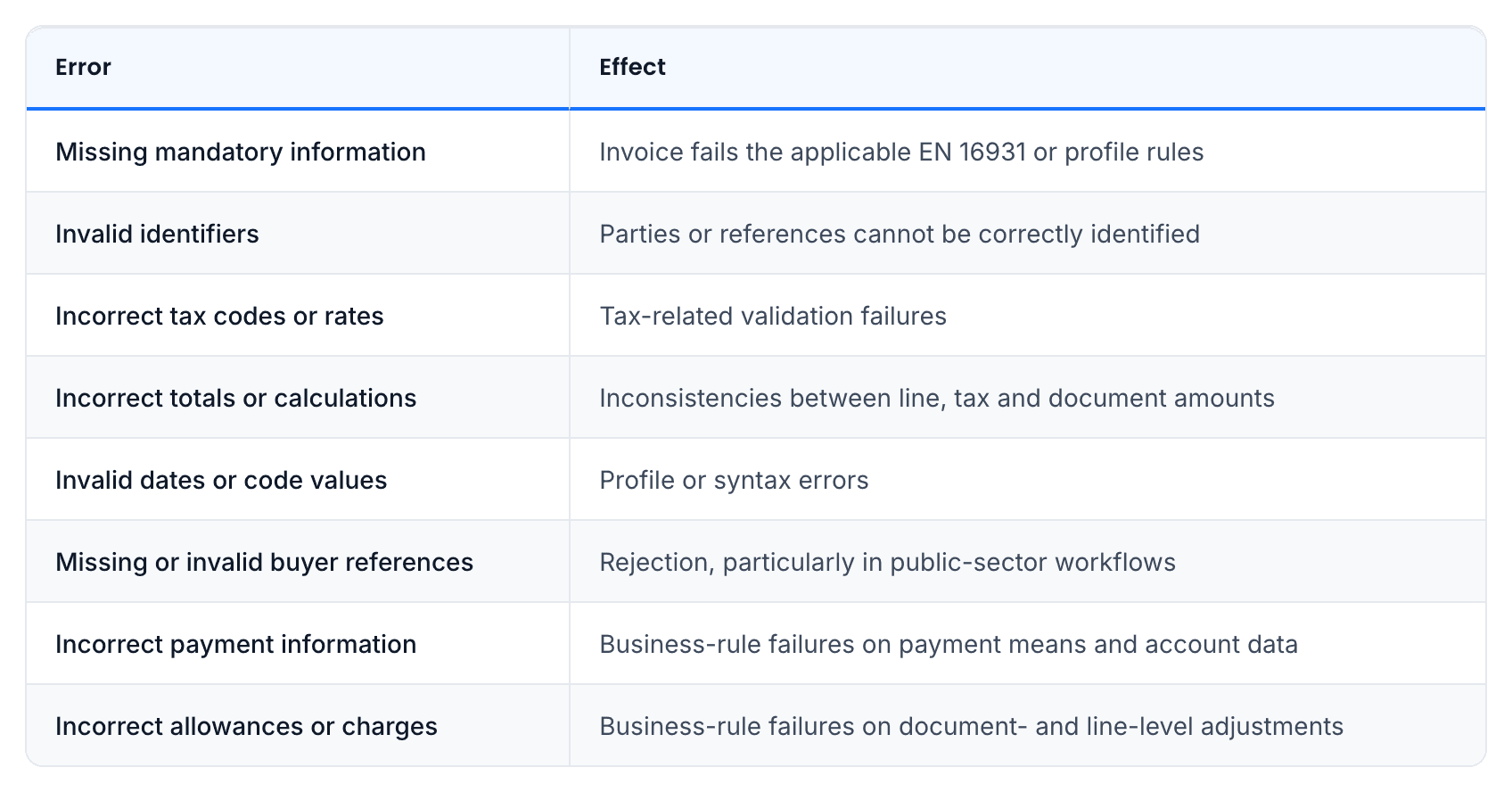
Common validation problems include:
- Missing mandatory information can cause an invoice to fail applicable rules.
- Invalid identifiers can prevent correct identification of parties or references.
- Incorrect tax codes or rates can cause tax-related validation failures.
- Incorrect totals or line calculations can create inconsistencies between invoice amounts.
- Invalid dates or code values can cause profile or syntax errors.
- Missing or invalid buyer references can create problems, particularly in public-sector workflows.
- Incorrect payment information or allowances and charges can cause business-rule failures.
A useful validator should identify the affected field and explain the problem clearly enough for the business to correct it.
Validate Before Sending
Validation is most useful when it happens before transmission.
A practical process is:
The invoice should be created, validated, corrected where necessary, validated again, and then sent.
For incoming invoices, businesses can also validate received documents before they enter the normal accounting or payment workflow.
Validation should not automatically be treated as a legal prerequisite for processing. Businesses should define which validation results block transmission or processing and which require review.
Validation Severity
A validator should distinguish between:
- Errors, which may prevent the document from being accepted by the target process.
- Warnings, which may require review but do not necessarily prevent processing.
- Informational messages, which report a condition without requiring rejection.
This helps finance and IT teams focus on the issues that actually need action.
Does Validation Guarantee Customer Acceptance?
No.
Pre-validation can reduce technical and rule-based rejections, but an invoice can still be rejected for commercial or customer-specific reasons.
For example, the customer may identify an incorrect purchase-order number, customer reference, contract detail, duplicate invoice, or delivery information.
Validation therefore reduces avoidable errors, but it does not guarantee acceptance or payment.
Keeping Validation Up to Date
E-invoice specifications, validation artefacts, code lists, and business rules can change.
A validation service should therefore use the applicable current specifications and identify the version or configuration used for a validation result. This makes it easier to investigate why an invoice passed or failed under a particular validation setup.
How Complyance Can Support Validation
Depending on the product configuration, Complyance can place validation within the e-invoicing workflow so invoices can be checked before transmission and relevant validation results can be handled within the process.
Businesses should verify the specific formats, profiles, validation rules, incoming-invoice capabilities, error handling, ERP feedback, and rule-update capabilities available in their configuration.
Conclusion
Germany e-invoice validation is about more than checking whether an XML file opens correctly.
Businesses should validate the applicable syntax, EN 16931 rules, profile-specific requirements, and relevant invoice data before transmission. For XRechnung and ZUGFeRD, the applicable specification and profile must be taken into account.
The practical goal is simple: identify avoidable problems before they reach the customer or downstream accounting process.
Frequently Asked Questions
It is the process of checking a structured invoice against its applicable syntax, EN 16931 rules, profile-specific requirements, and relevant business rules.
Use a validator that supports the current XRechnung specification, applicable UBL or UN/CEFACT CII syntax, EN 16931 validation artefacts, and XRechnung business rules. KoSIT provides technical resources for XRechnung validation.
Validate the embedded XML against the applicable ZUGFeRD profile and relevant rules. For a hybrid invoice, also check that the visual PDF/A-3 representation is consistent with the structured data.
The invoice must meet the applicable legal and format requirements, but using a particular validation tool is not itself mandatory. The BMF recommends validation as a practical control.
No. Validation can reduce technical and rule-based errors, but it cannot guarantee commercial acceptance or payment.
About the Author

Swathy
Content Marketer
I’m a Content Marketer at Complyance, focused on e-invoicing. Over the years, I’ve created a wide range of content, including blog posts, whitepapers, and product guides, which have supported Complyance’s growth across markets such as the UAE and EU regions. My goal is to deliver content that is comprehensive, clear, accurate, and easy to understand, no matter how complex the topic.