Germany E-Invoicing Requirements: What Businesses Need to Know

Germany E-Invoicing Requirements: A practical guide to formats, receiving and issuing rules, exemptions, transmission, retention, and what businesses need to do.
Table of Contents
Germany is changing the way businesses handle invoices.
Since January 1, 2025, businesses covered by the German rules have needed to be able to receive E-Rechnungen. At the same time, the requirement to issue E-Rechnungen is being introduced in stages, with transition rules running through 2026 and, for certain businesses, 2027.
This can make the German rules look more complicated than they really are.
A business may already be receiving structured invoices while still being allowed to issue a PDF. Another business may have to start issuing E-Rechnungen earlier because it does not qualify for the extended transition period.
And there is another important point.
A PDF sent by email is not automatically an E-Rechnung under the German definition. A German E-Rechnung needs to use a structured electronic format that allows electronic processing.
So, what exactly are the Germany e-invoicing requirements?
In this guide, we will explain the main requirements in simple terms, including who is affected, what format an E-Rechnung needs, how businesses receive and issue invoices, which invoices are exempt, how invoices are transmitted, and how they need to be archived.
Key Takeaways
- Germany's E-Rechnung rules mainly apply to relevant transactions between domestic businesses.
- Businesses covered by the rules have needed to be able to receive E-Rechnungen since January 1, 2025.
- A simple PDF is not an E-Rechnung under the German definition.
- The invoice must use a structured electronic format that allows electronic processing.
- The structured invoice needs to contain the required invoice information.
- The German framework is based on EN 16931, the European standard for electronic invoicing.
- XRechnung and qualifying ZUGFeRD formats are among the formats that can meet the German requirements.
- The general transition for issuing E-Rechnungen runs until December 31, 2026. Businesses with previous-year turnover of no more than €800,000 can use an extended transition through December 31, 2027.
- Certain transactions are exempt from the mandatory E-Rechnung requirement.
- Businesses must retain invoices for eight years for VAT purposes, with the structured part of an E-Rechnung preserved in its original, unaltered form.
What Are the Germany E-Invoicing Requirements?
Let's start with the most important question.
What does Germany actually mean by an E-Rechnung?
Under Section 14 of the German VAT Act, an E-Rechnung is an invoice that is issued, transmitted, and received in a structured electronic format that allows electronic processing. An invoice that does not meet this definition is treated as a "sonstige Rechnung", or other invoice.
This creates an important difference between an electronic invoice and a German E-Rechnung.
Imagine that your company sends a customer a PDF.
The PDF might contain:
Invoice number: 2026-1001
Invoice date: August 19, 2026
Net amount: €10,000
VAT: €1,900
Total: €11,900
A person can open the PDF and read it.
But the customer's accounting system cannot necessarily take those values and process them automatically.
A structured E-Rechnung works differently.
The invoice information is provided as structured data. The receiving system can identify the invoice number, date, amounts, tax information, supplier, customer, and other fields.
That is the basic idea behind Germany's new e-invoicing framework.
Who Is Affected by the Germany E-Invoice Requirements?
The German rules mainly concern transactions between domestic businesses.
The BMF defines a domestic business based on factors such as its registered office, management, or business establishment involved in the transaction being located in Germany.
This means businesses should first look at who is involved in the transaction before deciding whether the German E-Rechnung rules apply.
For example:
- German business to German business: A covered domestic B2B transaction can fall under the E-Rechnung rules.
- German business to private consumer: The mandatory B2B E-Rechnung rules do not apply to invoices issued to private end consumers in the same way.
There are also specific rules for businesses without a German establishment and for transactions that fall under an exemption.
So, simply having a German VAT registration does not tell you the whole story.
Germany E-Invoice Requirements
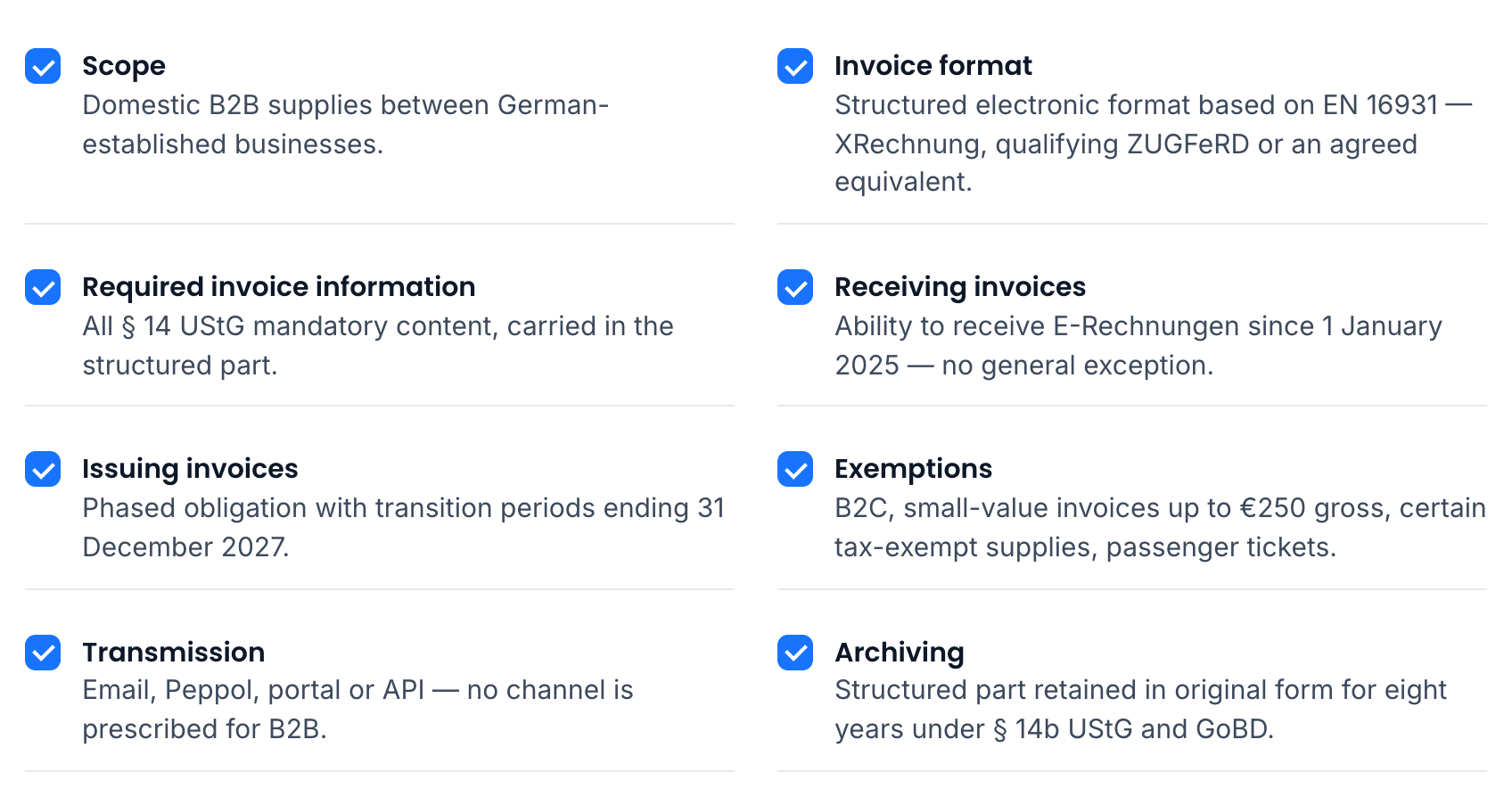
The German requirements cover several parts of the invoice process.
A business needs to think about:
- The invoice format
- Required invoice information
- Receiving invoices
- Issuing invoices
- Exemptions
- Transmission
- Archiving
Let's look at each one.
What Format Must a German E-Invoice Use?
A German E-Rechnung must use a structured electronic format that allows electronic processing.
The German framework is based on the European EN 16931 standard. The format needs to meet the applicable requirements of the standard and German VAT rules.
You can think of EN 16931 as a common language for invoice data.
Different accounting systems may store invoice information differently.
One system might call a field "Invoice Number".
Another might call it "Document ID".
A common data model helps both systems understand what the information represents.
XRechnung
XRechnung is a structured XML-based standard used widely for electronic invoicing in Germany, particularly in the public sector.
The official federal e-invoicing portal states that XRechnung is maintained by KoSIT on behalf of the IT Planning Council. For invoices to the German federal administration, XRechnung in the current applicable version is generally used.
ZUGFeRD
ZUGFeRD is a hybrid invoice format.
It combines a visual PDF/A-3 document with structured XML invoice data. This allows the invoice to be read by a person while the structured data can be processed by software.
The BMF recognises qualifying ZUGFeRD formats for German VAT purposes.
The important point is not simply choosing "XML" or "PDF".
The chosen format and profile need to meet the applicable German requirements.
Receiving E-Invoices in Germany
Receiving is one requirement businesses cannot postpone.
Businesses covered by the German rules have needed to be able to receive E-Rechnungen since January 1, 2025. The BMF states that there is no general exception from this receiving requirement.
The basic technical requirement is relatively simple.
An email inbox can be enough to receive an E-Rechnung.
But receiving the file is only the first step.
Imagine your business receives 2,000 invoices every month.
Someone still needs to:
- Receive the invoice
- Check the invoice
- Process the data
- Approve the invoice
- Record it in accounting
- Archive it
This creates a simple workflow:
After receiving an invoice, the business checks it, processes and approves it, records it in accounting, and archives the required records.
This is where businesses should look at their complete receiving process.
The receiving system should be able to handle the structured data and move it into the appropriate accounting workflow.
Issuing E-Invoices in Germany
The requirement to issue E-Rechnungen is being introduced gradually.
From January 1, 2025 through December 31, 2026, businesses can generally continue issuing a "sonstige Rechnung" under the transition rules. A paper invoice can still be used. A different electronic format, such as a PDF, can be used during this period if the recipient agrees to receive it.
There is an extended transition for businesses whose previous-year turnover does not exceed €800,000.
These businesses can continue using other invoice types through December 31, 2027, subject to the applicable rules.
After the relevant transition period ends, covered domestic B2B transactions must generally be invoiced using an E-Rechnung.
This is why businesses should not assume that there is one deadline for everyone.
Your applicable deadline depends on your circumstances.
Which Invoices Are Exempt?
Not every invoice needs to be issued as an E-Rechnung.
The German rules provide several exceptions.
These include certain:
- B2C invoices
- Small-value invoices
- VAT-exempt transactions
- Passenger transport tickets
- Invoices issued by Kleinunternehmer
- Transactions involving legal entities that are not entrepreneurs
- Certain property-related services to consumers
What About Kleinunternehmer?
This is particularly important for small businesses.
A Kleinunternehmer can fall under an exception from the requirement to issue an E-Rechnung.
However, this does not mean that the business can ignore E-Rechnungen completely.
The receiving requirement still applies.
So a small business may not have to issue a structured E-Rechnung for its own invoices while still needing to receive structured E-Rechnungen from its suppliers.
This is why businesses should check the issuing and receiving requirements separately.
How Are E-Invoices Transmitted?
Germany does not require every E-Rechnung to be transmitted through one specific channel.
The BMF describes several possible methods, including:
- Email
- Electronic interfaces
- Internet portals
- Other suitable transmission methods in the circumstances described by the rules
For example, a business could connect its ERP system to an e-invoicing platform through an API.
The workflow could look like:
The ERP sends the invoice data to Complyance, where it is validated and prepared for transmission to the customer.
The important thing to understand is that format and transmission are different things.
The format answers:
What structured data does the invoice contain?
The transmission method answers:
How does that invoice reach the customer?
A business needs to consider both when designing its e-invoicing process.
How Long Must E-Invoices Be Archived?
The requirements do not stop once an invoice has been sent or received.
For VAT purposes, German businesses must retain incoming and outgoing invoices for eight years.
For an E-Rechnung, at least the structured part needs to be retained in its original, unaltered form.
This is particularly important for hybrid formats such as ZUGFeRD.
A ZUGFeRD invoice contains:
Visual document + Structured XML
The structured data should therefore not be removed after the PDF has been stored.
Businesses need to make sure the structured invoice remains available in the required form throughout the retention period.
The BMF also refers businesses to the GoBD rules for the broader requirements around the proper electronic retention of business records.
What Does This Mean for Your Business?
Germany's e-invoicing requirements may look like a technical change, but they affect several parts of a business.
Your finance team needs to know which invoices are covered.
Your IT team needs to check whether the ERP can provide the required structured data.
Your accounting system needs to receive and process structured invoices.
Your e-invoicing solution needs to support the required formats and transmission methods.
And your records need to be stored correctly.
You can think of the complete process like this:
The ERP provides the invoice data, which is validated, converted into the required E-Rechnung format, transmitted to the customer, recorded in accounting, and archived.
This means preparing for German e-invoicing is not simply a matter of adding an XML export to your existing invoice system.
The complete process needs to work.
How Complyance Helps With Germany E-Invoicing Requirements
At Complyance, we look at e-invoicing as an end-to-end invoice workflow.
Your ERP or accounting system can continue to manage your customers, products, services, prices, and accounting information.
Complyance can connect with your existing systems and provide the e-invoicing layer needed to manage structured invoices, validation, transmission, and related workflows.
The goal is simple.
Your ERP sends the invoice data to Complyance, which converts it into a compliant E-Rechnung before it is sent to the customer.
You should not have to replace your entire ERP just because Germany is changing its invoice requirements.
Instead, your existing systems can be connected to an e-invoicing platform that understands the relevant requirements and helps your team manage the transition.
For businesses operating across multiple countries, this can also provide a way to manage different e-invoicing requirements without creating a completely separate process for every market.
Germany E-Invoice Requirements: What Should Businesses Do Now?
If your business operates in Germany, the best time to check your invoicing process is before your applicable issuing deadline.
Start with these questions:
- Can we receive E-Rechnungen today?
- Does our ERP contain all the required invoice data?
- Which structured format should we use?
- Do our invoices need to be validated before transmission?
- How will we transmit invoices to customers?
- How will we handle incoming invoices?
- Are our structured invoices being archived correctly?
- Which transition period applies to our business?
Once you have answers to these questions, the implementation becomes much easier to manage.
Germany's E-Rechnung rules are not simply about replacing paper with electronic documents.
They are about moving invoice information into a structured format that businesses and software systems can process more efficiently.
For Complyance, that is the important part of the transition. The technology should fit into your existing business process, rather than forcing your finance and IT teams to rebuild everything from scratch.
Frequently Asked Questions
The main requirements cover structured E-Rechnung formats, required invoice information, receiving and issuing rules, applicable exemptions, transmission, and invoice retention. The issuing requirement is being introduced through transition periods.
Yes. Businesses covered by the rules have needed to be able to receive E-Rechnungen since January 1, 2025. An email inbox can satisfy the basic receiving requirement.
No. A simple PDF does not meet the German definition of an E-Rechnung because it does not provide the required structured electronic format for electronic processing.
Formats that meet the applicable requirements can be used. XRechnung is a major German structured format, while qualifying ZUGFeRD formats can also meet the requirements.
The general transition period runs through December 31, 2026. Businesses with previous-year turnover of no more than €800,000 can use an extended transition through December 31, 2027.
Yes. Certain transactions, including B2C invoices, small-value invoices and invoices issued by Kleinunternehmer, can fall under specific exceptions. The exact conditions should be checked for each transaction.
Invoices must generally be retained for eight years for VAT purposes. For an E-Rechnung, at least the structured part must be retained in its original, unaltered form.
No. The BMF describes several possible transmission methods, including email, electronic interfaces, and internet portals, depending on the circumstances.
Yes. EN 16931 forms the European standard framework used by the German E-Rechnung rules. The applicable invoice format must meet the relevant requirements of the standard and German law.
About the Author

Swathy
Content Marketer
I’m a Content Marketer at Complyance, focused on e-invoicing. Over the years, I’ve created a wide range of content, including blog posts, whitepapers, and product guides, which have supported Complyance’s growth across markets such as the UAE and EU regions. My goal is to deliver content that is comprehensive, clear, accurate, and easy to understand, no matter how complex the topic.