Germany E-Invoicing Software: What Businesses Should Look For

Learn what Germany e-invoicing software should support, from ERP integration and formats to validation, receiving, transmission, monitoring, archiving, security, and scalability.

Table of Contents
Choosing e-invoice software in Germany is not just about finding a tool that generates XML.
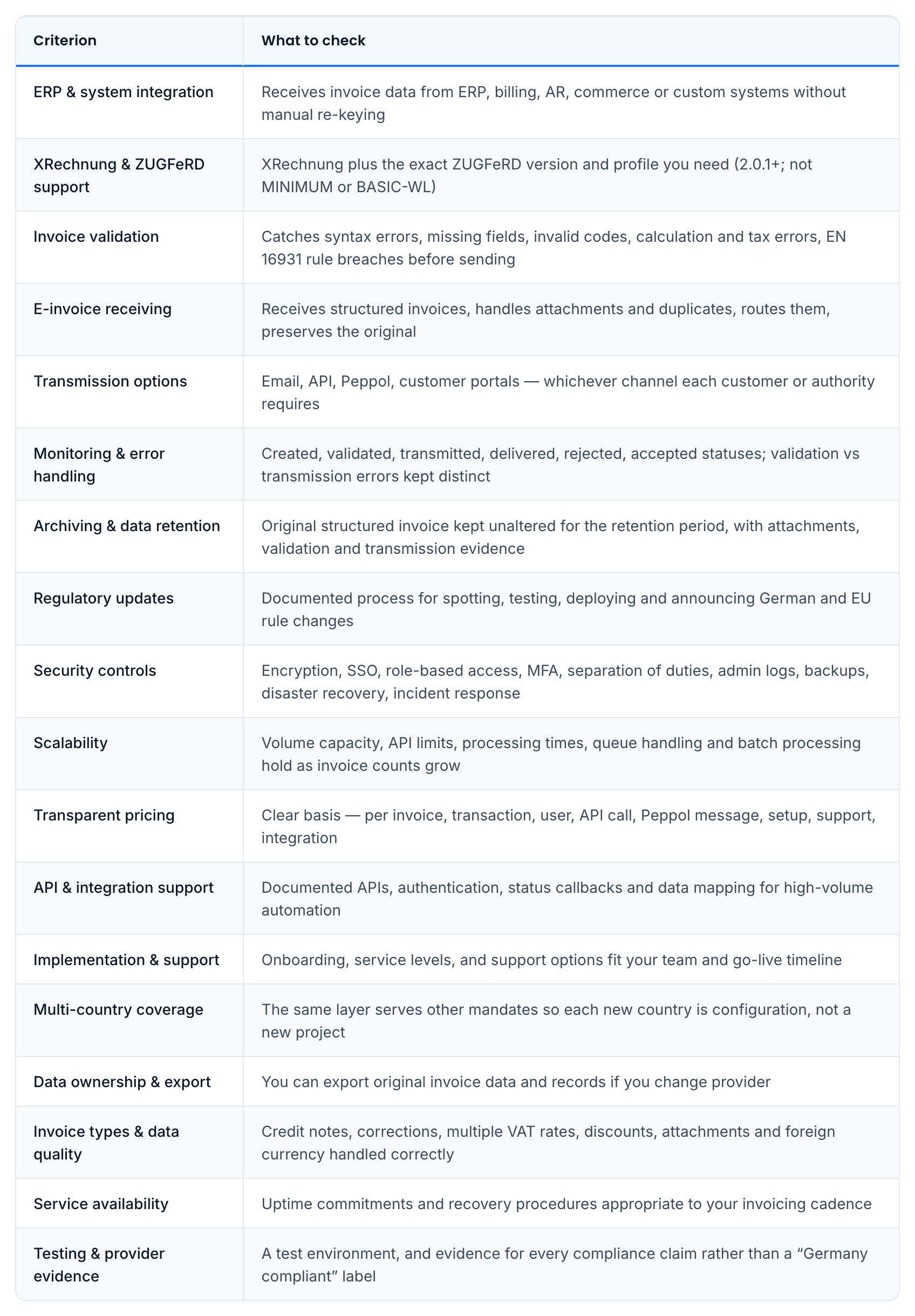
A useful e-invoicing solution should fit into the complete invoice process, from invoice data and validation to transmission, receiving, monitoring, and retention.
Germany's E-Rechnung framework includes structured invoice requirements, specific formats, transition periods, receiving requirements, and separate public-sector considerations. Businesses should therefore evaluate software based on how well it supports their actual processes and compliance needs, rather than relying on a simple feature checklist.
Key Takeaways
- German e-invoicing software should support structured invoice processing.
- Software should support EN 16931-based formats and, where relevant, other agreed structured formats that meet German legal requirements.
- Businesses should check support for XRechnung and qualifying ZUGFeRD versions and profiles.
- ERP or other source-system integration is critical for reducing manual data entry.
- Receiving and issuing should both be considered.
- Validation, transmission, monitoring, data portability, security, and retention matter for long-term use.
- Businesses should also evaluate attachments, corrections, service continuity, and regulatory-update processes.
- A dedicated e-invoicing platform is not legally required merely to receive an E-Rechnung, although software can make structured invoice processing much easier at scale.
What Is Germany E-Invoicing Software?
E-invoicing software helps businesses create, receive, validate, transmit, and manage structured electronic invoices.
The e-invoicing layer can sit between the business's source systems and customers or transmission channels. The ERP or other source system can remain the source of invoice data, while the e-invoicing layer applies the relevant format, validation, transmission, and compliance rules.
For businesses operating across multiple markets, this separation can make it easier to adapt invoice output to country-specific requirements without redesigning the underlying source system.
ERP and Source-System Integration
Integration should be one of the first evaluation points.
Your software should be able to receive invoice data from the ERP or other source system without forcing employees to re-enter information manually.
Depending on the business, source systems may include:
- ERP platforms should be supported where the business relies on an ERP as its primary source of invoice data.
- Billing systems should be supported when invoices are generated outside the main ERP environment.
- Accounts-receivable systems should be supported where they manage customer invoices and receivables.
- Commerce platforms should be supported when invoices are generated from online sales or digital commerce workflows.
- Logistics systems should be supported when billing depends on delivery or shipment information.
- Custom business applications should be supported where the business uses internally developed systems.
Check supported integrations, APIs, file formats, authentication, error handling, status callbacks, and data mapping before choosing a solution.
A good integration should also make it clear how incoming invoices are routed back into accounting or other internal systems.
XRechnung and ZUGFeRD Support
German businesses should check which structured invoice formats the platform supports.
Two important formats are:
XRechnung: Structured XML
ZUGFeRD: Hybrid PDF/A-3 with embedded structured XML
For ZUGFeRD, the exact version and profile matter. Verify that the provider supports the profile required for your use case. The BMF identifies ZUGFeRD from version 2.0.1 as meeting the German VAT-law requirements, except for the MINIMUM and BASIC-WL profiles.
Software should support EN 16931-based formats and, where relevant, other agreed structured formats that meet the German legal requirements.
Not every business needs the same format for every transaction. Customer requirements, public-sector rules, and the specific transaction should determine what the software needs to support.
Validation
Validation is more important than simply generating an XML file.
Software can help identify problems before an invoice is transmitted, including:
- Syntax errors should be identified when the invoice does not follow the required technical structure.
- Missing required fields should be identified before the invoice is submitted or transmitted.
- Invalid code values should be detected when invoice data contains incorrect or unsupported codes.
- Calculation errors should be identified when invoice totals or tax amounts do not match the underlying data.
- Tax-information issues should be identified when relevant tax information is incomplete or inconsistent.
- EN 16931 business-rule inconsistencies should be detected when the invoice does not comply with applicable business rules.
Validation by a particular software tool is not itself a legal condition for tax recognition, but it is an important operational control.
A useful validation process should allow businesses to identify the problem, correct the underlying data, and either revalidate or resend the invoice as appropriate.
Receiving E-Invoices
A complete e-invoicing setup should also consider incoming invoices.
Businesses qualifying as inländische Unternehmen under the German rules generally need to be able to receive E-Rechnungen from January 1, 2025. An email inbox is sufficient for the basic ability to receive an E-Rechnung.
The law does not require a dedicated e-invoicing platform merely to receive an invoice. However, higher-volume businesses may need software to access, process, retain, and route structured invoice data efficiently.
When evaluating receiving capabilities, check whether the solution can:
- Receive structured invoices
- Process attachments
- Identify duplicates
- Route invoices to the right team or system
- Transfer data into accounting or ERP systems
- Preserve the original structured invoice
- Track processing outcomes
Transmission Options
Germany does not prescribe one universal transmission channel for ordinary B2B E-Rechnungen.
Depending on the transaction and customer requirements, transmission can include:
- Email
- APIs or electronic interfaces
- Peppol
- Customer-specific portals
- Other permitted electronic methods
A customer, public authority, procurement framework, or contract may require a particular channel.
The software should make the transmission method clear and provide useful evidence or status information where the channel supports it.
Monitoring and Error Handling
A good system should provide visibility into invoice processing.
Depending on the transmission method, status tracking may include:
- Created status should show that the invoice has been generated or entered into the system.
- Validated status should show that the invoice has passed the applicable validation checks.
- Transmitted status should show that the invoice has been sent through the selected transmission channel.
- Technically delivered status should indicate technical delivery where the channel provides that information.
- Rejected status should identify when the invoice has been rejected by a system or recipient.
- Accepted status should be displayed where the relevant channel or recipient provides an acceptance status.
These statuses do not have uniform legal meaning across every channel. Email, portals, Peppol, and other transmission methods may expose different information.
Error handling should also distinguish between different types of failures. A validation error may require data correction, while a transmission or authentication error may require a resend or technical intervention.
A practical process can therefore involve identifying the error, correcting it, and then revalidating or resending the invoice as appropriate.
Archiving and Data Retention
The business remains responsible for compliant retention, whether archiving is performed internally or through a provider.
For German E-Rechnungen, retaining only a visual PDF can be insufficient. At least the structured part of an E-Rechnung must remain available in its original, unaltered form for the applicable retention period.
For hybrid invoices, the structured data is authoritative if it conflicts with the visual representation.
When evaluating software, ask how it stores:
- The original structured invoice should remain available in its original, unaltered form where required.
- Attached documents should remain associated with the relevant invoice where applicable.
- Validation information should be retained when it forms part of the business's operational records.
- Transmission information should provide relevant evidence about invoice delivery or submission.
- Audit trails should record relevant activities performed within the system.
- Relevant processing records should provide useful information about how invoices moved through the workflow.
Also check how data can be exported if the business changes providers.
Regulatory Updates
E-invoicing rules, standards, formats, and validation requirements can change.
A useful provider should have a clear process for monitoring relevant changes and updating the platform.
Ask:
- Regulatory-change identification should explain how relevant German and European changes are monitored.
- Change testing should verify regulatory updates before deployment.
- Update deployment should clearly explain when changes are introduced into production.
- Customer notifications should inform businesses about material changes affecting their workflows.
- Change documentation should explain important regulatory or technical updates.
- Pre-production testing should allow businesses to test significant changes before live use.
Software selection should account for the transition timetable, but a business may choose to implement structured issuing earlier because customers, contracts, group policies, or public-sector workflows may require it.
How to Compare E-Invoicing Software Providers
When comparing providers, ask:
- Can it integrate with our ERP or other source systems?
- Does it support EN 16931-based formats?
- Does it support XRechnung?
- Does it support the required ZUGFeRD versions and profiles?
- Can it receive invoices?
- Can it validate invoice data?
- Which transmission channels does it support?
- Can it process attachments and corrections?
- Can the business export its original invoice data?
- Can it operate across multiple countries?
- How are errors handled?
- How are regulatory changes managed?
- What security controls are available?
- What service levels and support options are provided?
Security in Germany E-Invoicing Software
Invoices contain sensitive financial and commercial information, so security should be part of provider selection.
Ask about:
- Encryption should protect invoice and account information during transmission and storage.
- Single sign-on should provide secure and convenient access for authorized users.
- Role-based access should restrict users to the information and functions they need.
- Multi-factor authentication should add another layer of protection to user accounts.
- Separation of duties should help prevent inappropriate access or unauthorized actions.
- Administrative activity logs should record important administrative actions.
- Customer-level data segregation should help keep different customers' information appropriately separated.
- Data backups should help protect invoice records against data loss.
- Disaster recovery should support restoration of services after significant failures.
- Incident response should define how security incidents are detected and handled.
- Subprocessor transparency should provide visibility into relevant third-party service providers.
Compliance is not only about whether an invoice passes validation. The platform also needs appropriate controls to protect invoice data throughout the process.
Scalability
A provider that works for 500 invoices a month should also be able to handle substantially higher volumes as the business grows.
Check:
- Invoice-volume capacity should support the business's current and expected invoice volumes.
- API limits should accommodate the expected level of automated data exchange.
- Processing times should remain appropriate as invoice volumes increase.
- Queue handling should manage periods of high invoice-processing activity.
- Monitoring should provide visibility into processing performance and bottlenecks.
- Failure recovery should help restore processing after system or integration failures.
- Batch processing should support efficient handling of large numbers of invoices.
Scalability is particularly important when businesses replace manual processes with structured invoice exchange and invoice volumes increase.
Commercial Transparency
Businesses should also understand the provider's pricing model.
Ask whether charges are based on:
- Invoice volume should clearly explain how pricing changes as invoice numbers increase.
- Transactions should clarify whether individual transactions are charged separately.
- Users should explain whether the number of platform users affects subscription costs.
- API calls should clarify whether automated API usage creates additional charges.
- Peppol messages should explain whether Peppol transmissions are charged separately.
- Setup should clearly identify implementation or onboarding fees.
- Support should clarify whether support services are included or charged separately.
- Additional integrations should identify extra costs for connectors or custom integrations.
A clear pricing model makes long-term planning easier and helps businesses compare the true cost of different solutions.
API and Integration Support
For businesses with large invoice volumes, API support can be important.
Ask the provider about:
- Authentication should provide secure access between connected systems.
- Data mapping should transfer invoice information accurately between the source system and e-invoicing platform.
- Retry handling should allow failed requests to be retried appropriately.
- Error responses should clearly explain API or integration problems.
- Status callbacks should return invoice-processing updates to connected systems.
- Monitoring should provide visibility into API activity and failures.
- Rate limits should accommodate the expected volume of API requests.
- Versioning should help businesses manage API changes over time.
- Test environments should allow integrations to be tested before production use.
For incoming invoices, also confirm how structured data and attachments can be transferred into the ERP, accounting system, or other source system.
Support and Implementation Services
Software is only useful if the implementation works.
Ask what happens during onboarding and whether the provider supports:
- Data mapping
- Integration
- Testing
- Go-live
- Production monitoring
- Regulatory updates
Also ask how support handles compliance questions, technical errors, customer-specific transmission problems, and integration issues.
For a mandatory tax workflow, implementation and support quality can matter as much as the software itself.
Multi-Country E-Invoicing
Businesses rarely operate under one tax rule forever.
A German business may later need to issue invoices in another European or international market. A platform should therefore be able to separate business data from country-specific compliance requirements.
The e-invoicing layer can transform the source invoice data into the applicable format and transmission method for each market, where supported.
This approach can reduce the amount of custom development required when new mandates appear.
When evaluating a multi-country provider, verify actual country coverage, supported formats, local validation rules, transmission methods, and how regulatory updates are managed.
Data Ownership and Export
Data portability is an important software-selection criterion because the business remains responsible for its invoice records.
Ask:
- Can the business export original XML and attached documents?
- Can it migrate data if it changes providers?
- Who owns the invoice data?
- Is there an accessible audit trail?
- Can the provider provide data in a usable format after termination?
- How long does data remain accessible after the contract ends?
The answers should be clear before implementation begins.
Invoice Types, Attachments, and Data Quality
A platform should support the invoice scenarios the business actually uses.
Depending on the business, this may include:
- Supporting attachments should allow PDFs or other relevant documents to accompany invoices.
- Structured invoice data with attachments should preserve the relationship between the structured invoice and its supporting documents.
- Credit notes should support the relevant credit-note scenarios used by the business.
- Invoice corrections should support appropriate correction workflows.
- Advance invoices should support invoices issued for advance payments.
- Partial invoices should support invoices covering part of a transaction.
- Final invoices should support references to previous advance or partial invoices where applicable.
- Recurring invoices should support repeated billing processes.
- Line-item and tax breakdowns should preserve detailed invoice information needed for processing and compliance.
Businesses should also consider recommended data-quality controls such as:
- Duplicate invoice numbers should be identified before they create processing problems.
- Duplicate incoming invoices should be detected before duplicate records enter the accounting workflow.
- VAT IDs should be checked for accuracy where relevant.
- Buyer references should be checked for completeness where required.
- Tax codes should be checked against the applicable tax treatment.
- Currency and totals should be checked for inconsistencies.
- Invoice dates should be checked for accuracy and completeness.
- Payment terms should be checked for consistency with the invoice.
- Supplier and customer master data should be checked for mismatches.
These are practical controls rather than individual statutory requirements, but they can reduce processing errors and improve invoice quality.
Service Availability and Incident Handling
If an e-invoicing platform is part of a mandatory invoice workflow, service continuity matters.
Ask about:
- Service-level commitments should define expected service availability and performance.
- Planned maintenance notices should provide advance information about scheduled maintenance.
- Incident notification should inform customers about significant service disruptions.
- Recovery time objectives should define the expected time to restore services after a disruption.
- Recovery point objectives should define acceptable data-loss limits following a disruption.
- Support response times should define how quickly support requests are handled.
- Business continuity should explain how critical services are maintained during disruptions.
- Redundant processing should reduce dependency on a single processing component.
- Disaster-recovery testing should demonstrate that recovery procedures are periodically tested.
Businesses should understand what happens if the provider or a transmission channel becomes temporarily unavailable.
Testing and Provider Evidence
Be careful with claims such as “certified for Germany.” There is no single general government certification that automatically proves a provider meets every German B2B e-invoicing requirement.
Instead, ask which formats, validation rules, transmission channels, and German use cases have been tested.
Request evidence such as:
- Test reports should provide evidence of completed testing.
- Validation results should demonstrate how invoices perform against applicable validation rules.
- Integration documentation should explain how the platform connects with business systems.
- Customer-specific test evidence should demonstrate compatibility with particular customer or authority requirements.
- Supported-version documentation should identify the versions and profiles supported by the provider.
This provides a more useful basis for evaluating whether a platform fits the business's actual requirements.
How Complyance Helps
Complyance can provide an e-invoicing and compliance layer between the source system and the relevant customer or transmission channel, depending on product configuration.
Businesses should confirm the formats, integrations, validation scope, receiving capabilities, archiving features, and transmission methods available for their specific workflow.
Where supported by the selected configuration, the platform can help businesses manage structured invoice processing, validation, transmission, and incoming invoice workflows through an integrated e-invoicing layer.
The exact capabilities and workflow depend on the business's source system, transaction requirements, country, invoice format, transmission method, and product configuration.
Conclusion
The best Germany e-invoicing software is not necessarily the one with the longest feature list.
Businesses should look for software that fits their actual invoice process and can adapt as their requirements change.
Key evaluation areas include:
- Source-system integration should connect the e-invoicing platform with the systems that generate and process invoice data.
- Invoice format support should cover the structured formats required for relevant transactions.
- Validation should help identify technical, data, tax, and business-rule issues before transmission.
- Transmission should support the channels required by customers, authorities, and business workflows.
- Receiving should support the structured invoice requirements applicable to the business.
- Monitoring and error handling should provide visibility into invoice processing and help resolve failures.
- Data retention should preserve the required structured invoice information in its original form.
- Data portability should allow businesses to retrieve their invoice records when needed.
- Security should protect sensitive financial and commercial information.
- Scalability should support growing invoice volumes and changing business requirements.
- Regulatory updates should help keep the platform aligned with relevant changes.
- Implementation and support should help businesses successfully deploy and operate the solution.
- Multi-country capabilities should support businesses operating across different regulatory environments.
A solution that brings these areas together can become a useful part of the finance infrastructure rather than another standalone tool.
Frequently Asked Questions
It should support the business's required structured invoice formats, relevant German and EN 16931 business rules, source-system integration, incoming and outgoing invoices, transmission channels, error handling, status tracking, data export, and retention of the original structured invoice data.
Not every business needs XRechnung for every transaction. However, software should support XRechnung where a customer, public authority, procurement framework, or transaction-specific requirement calls for it. Businesses should also check the applicable version and profile.
Yes, if the business falls within the German receiving framework. Businesses qualifying as inländische Unternehmen have generally needed to be able to receive E-Rechnungen since January 1, 2025. A dedicated platform is not legally required merely to receive one invoice, but software can help with structured-data access, routing, accounting integration, retention, and automation.
Not for every transaction. Peppol is one possible transmission method. It may be useful or required for particular public-sector, customer, procurement, or cross-border workflows.
Yes. A multi-country platform can apply country-specific formats, rules, and transmission methods while keeping the source system stable. Businesses should verify the provider's actual country coverage, update process, and local compliance capabilities.
Businesses should review integration capabilities, supported formats and profiles, validation coverage, incoming and outgoing invoice processing, transmission options, security, data export, retention, scalability, service continuity, implementation support, and regulatory-update processes.
About the Author

Swathy
Content Marketer
I’m a Content Marketer at Complyance, focused on e-invoicing. Over the years, I’ve created a wide range of content, including blog posts, whitepapers, and product guides, which have supported Complyance’s growth across markets such as the UAE and EU regions. My goal is to deliver content that is comprehensive, clear, accurate, and easy to understand, no matter how complex the topic.