Germany E-Invoicing Timeline: 2025, 2026, 2027 and 2028 Explained

Follow the Germany E-Invoicing Timeline from 2025 through 2028, including receiving, issuing deadlines, transition rules, formats, and practical preparation steps.
Table of Contents
Germany's E-Rechnung rules did not arrive with one deadline.
Instead, the government introduced them in stages.
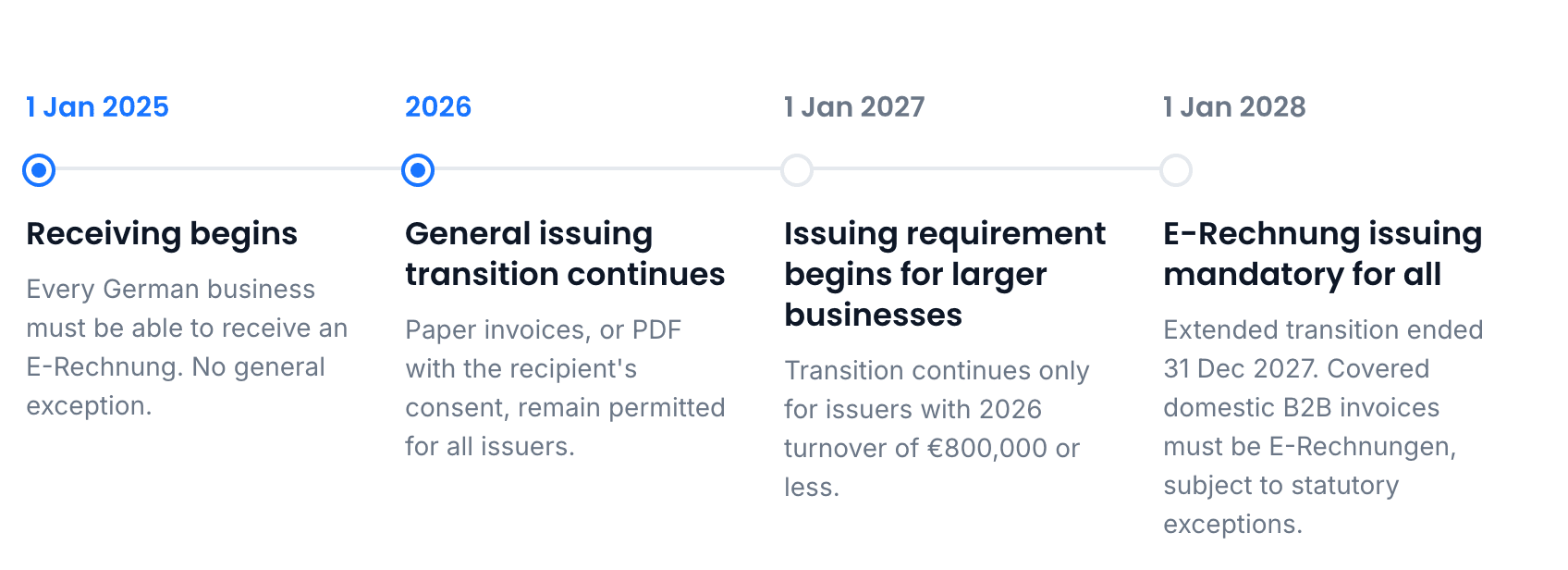
That is why businesses often come across several different dates when researching Germany e-invoicing. January 1, 2025 was important. December 31, 2026 is important. January 1, 2027 is another major point. And January 1, 2028 marks the end of the extended transition for smaller businesses.
The good news is that these dates are easier to understand when you look at them as a sequence.
2025: Receiving begins
2026: General issuing transition continues
2027: Major issuing requirement begins
2028: Extended transition ends
In this guide, we will walk through the Germany e-invoicing timeline year by year and explain what each date means for businesses.
Key Takeaways
- The German E-Rechnung framework started on January 1, 2025.
- Businesses covered by the rules have needed to be able to receive E-Rechnungen since that date.
- From 2025 through 2026, businesses can generally use the transition rules for issuing other types of invoices.
- From January 1, 2027, the general issuing transition ends.
- Businesses with previous-year turnover of no more than €800,000 can use an extended transition through the end of 2027.
- From January 1, 2028, the extended transition ends.
- The timeline mainly concerns covered domestic B2B transactions.
- The rules do not mean every invoice must be an E-Rechnung. Specific exceptions continue to apply.
- Businesses should prepare their ERP, invoice data, receiving process, validation, transmission, and archiving before their applicable deadline.
Germany E-Invoicing Timeline at a Glance
Before looking at each year, here is the simple version.
January 1, 2025: Businesses need to be able to receive E-Rechnungen
2025–2026: General transition period for issuing
January 1, 2027: General issuing transition ends
2027: Businesses with previous-year turnover of up to €800,000 can use extended transition
January 1, 2028: Extended issuing transition ends
The important point is that receiving and issuing have different timelines.
Receiving started first.
Issuing follows later.
What Changed in Germany in 2025?
January 1, 2025 was the starting point of the new German E-Rechnung framework.
From this date, businesses covered by the rules needed to be able to receive E-Rechnungen.
The BMF states that keeping an email inbox is enough to meet the basic receiving requirement. Businesses therefore did not need to have a complete automated e-invoicing system in place just to receive an invoice. (bundesfinanzministerium.de)
However, businesses also needed to understand that a simple PDF is not the same as an E-Rechnung under the new definition.
An E-Rechnung uses a structured electronic format that allows electronic processing.
So the first major change was that suppliers could send a structured E-Rechnung to the receiving business, and the receiving business needed to be able to accept that invoice.
Germany E-Invoicing 2026: Where Are We Now?
For businesses reading this in 2026, this is the most important part of the timeline.
The general transition period for issuing E-Rechnungen is still running.
From January 1, 2025 through December 31, 2026, businesses can generally continue issuing a "sonstige Rechnung", such as a paper invoice or, with the recipient's consent, a PDF or another electronic format that does not meet the E-Rechnung definition. (bundesfinanzministerium.de)
This means that in 2026, a business may still be legally issuing PDFs for transactions covered by the transition rules.
But that should not be confused with the long-term requirement.
The transition is temporary.
Businesses should use 2026 to prepare for the next stage rather than treating it as a reason to delay implementation.
What Should Businesses Do in 2026?
A practical preparation process should cover checking which transactions are within scope, reviewing the ERP or accounting system, choosing the appropriate E-Rechnung format, validating invoice data, testing transmission, preparing the receiving process, and setting up appropriate archiving.
The goal is to have the process working before the applicable issuing deadline arrives.
Germany E-Invoicing 2027: The Next Major Deadline
January 1, 2027 is the next major milestone in the Germany e-invoicing timeline.
From this date, the general transition period ends.
Businesses that cannot use the extended transition must generally issue E-Rechnungen for covered domestic B2B transactions.
This means businesses need to move away from relying on traditional PDF-based invoicing and establish a structured e-invoicing process. The ERP or accounting system should provide the required invoice data, which can then be validated, converted or generated in a compliant E-Rechnung format, and transmitted to the customer.
The change is not just about changing the file extension.
The invoice needs to contain the required structured information and meet the applicable requirements under German VAT law.
Who Needs to Issue E-Rechnungen in 2027?
The €800,000 turnover threshold becomes important here.
For businesses whose previous-year turnover exceeds €800,000, the general transition cannot be used for invoices issued from January 1, 2027.
These businesses generally need to issue E-Rechnungen for covered domestic B2B transactions, unless an exception applies. (bundesfinanzministerium.de)
For businesses whose previous-year turnover does not exceed €800,000, the law provides an extended transition through December 31, 2027. (bundesfinanzministerium.de)
This makes 2027 a year with two different situations.
Above €800,000 previous-year turnover: E-Rechnung generally required from January 1, 2027
Up to €800,000 previous-year turnover: Extended transition available through December 31, 2027
Businesses should therefore check their previous-year turnover before deciding which deadline applies.
Germany E-Invoicing 2028: What Changes?
January 1, 2028 marks the end of the extended transition period for businesses that qualified for it.
From this point, businesses that are required to issue E-Rechnungen can no longer rely on the extended transition for issuing other invoice formats.
For covered domestic B2B transactions, the standard process will involve creating the required invoice data, generating a structured E-Rechnung, transmitting it through an appropriate channel, and making it available to the customer.
The business needs to have the appropriate invoice format, data, systems, and workflow in place.
This is why Germany e-invoicing 2028 is important even for smaller businesses.
The additional time is useful, but it should be treated as preparation time.
Does the Timeline Apply to Every Invoice?
No.
The Germany e-invoicing timeline mainly concerns covered transactions between domestic businesses.
There are specific exceptions under the German rules.
These can include:
- Invoices to private consumers
- Small-value invoices up to €250 gross
- Certain VAT-exempt transactions
- Certain passenger transport tickets
- Certain invoices issued by Kleinunternehmer
- Other transactions covered by specific statutory exceptions
This means a business may have more than one invoice process.
For example, domestic B2B transactions generally fall within the E-Rechnung rules, while the mandatory B2B E-Rechnung requirement does not apply to B2C invoices. Specific exceptions may also apply to small-value invoices.
The transaction should therefore be classified before the invoice format is selected.
What Happens to Receiving in 2027 and 2028?
The receiving requirement does not wait until 2027 or 2028.
Businesses covered by the rules have already needed to be able to receive E-Rechnungen since January 1, 2025.
So there is no new receiving deadline in 2027.
The later dates mainly concern the transition for issuing E-Rechnungen.
This distinction is easy to miss.
Think of the timeline like this:
2025: Learn to receive
2026: Prepare to issue
2027: General issuing requirement begins
2028: Extended issuing transition ends
What About XRechnung and ZUGFeRD?
Businesses preparing for the next Germany e-invoicing deadline also need to decide which format fits their process.
Two important formats are:
XRechnung
XRechnung is a structured XML-based invoice format widely used for public-sector invoicing in Germany.
ZUGFeRD
ZUGFeRD combines a visual PDF/A-3 document with structured XML data.
The BMF identifies qualifying XRechnung and ZUGFeRD formats among the formats that can meet the German E-Rechnung requirements.
The format should be selected based on the business process, customer requirements, and applicable rules.
How Should Businesses Prepare for the Germany E-Invoicing Timeline?
Preparing for Germany's E-Rechnung requirements is not just about choosing an invoice format. Businesses should make sure their systems, tax data, teams, processes, and documentation are ready before their applicable deadline.
Step 1. Check if Your Billing System Is Ready
Review whether your ERP, accounting, or billing system can create and process the structured invoice data required for E-Rechnungen.
Step 2. Check Your Tax Information for E-Invoicing
Make sure your company, customer, VAT, invoice, and other required tax information is accurate and complete. Incorrect or missing data can cause validation issues.
Step 3. Choose the Right E-Invoicing Platform for the Long Term
Choose an e-invoicing solution that supports the required German formats, validation, transmission, and future compliance needs. It should also fit your existing ERP and accounting processes.
Step 4. Align and Train Your Teams
Make sure finance, accounting, IT, and other relevant teams understand the new requirements and know how the updated invoicing process will work.
Step 5. Test Early and Simulate Real Scenarios
Test the complete process before your applicable deadline. Include different invoice types, customers, formats, validation scenarios, transmission outcomes, and exception cases to identify issues early.
Step 6. Maintain SOPs and Living Documentation
Document your e-invoicing procedures, responsibilities, validation rules, exception handling, and operational processes. Keep this documentation updated as requirements and business processes evolve.
How Complyance Helps Businesses Prepare for 2027 and 2028
At Complyance, we see the Germany e-invoicing timeline as a preparation roadmap rather than just a set of deadlines.
Businesses do not need to wait until 2027 or 2028 to start changing their processes.
The work can happen now.
Your ERP can continue to manage your business information.
Complyance can connect to that existing system and handle the e-invoicing layer, including structured invoice processing, validation, transmission, and related workflows.
For example, your ERP can provide the required invoice data to Complyance. Complyance can validate the data, manage the structured E-Rechnung process, and support transmission to the customer.
This gives finance and IT teams time to test the workflow before their applicable deadline.
For businesses that operate in several countries, it can also help create a connected e-invoicing process instead of managing each country's requirements separately.
Germany E-Invoicing Timeline: What Should You Do Now?
The most important thing is to know which date applies to your business.
If you are still issuing PDFs in 2026, use the remaining transition period to prepare.
Check:
- Can we receive E-Rechnungen?
- Which transactions are covered?
- What was our previous-year turnover?
- Which issuing deadline applies to us?
- Does our ERP provide the required data?
- Which E-Rechnung format should we use?
- How will we validate invoices?
- How will we transmit them?
- How will we archive the structured invoice data?
Once these questions have clear answers, the transition becomes much easier to manage.
Conclusion: Understanding the Germany E-Invoicing Timeline
The German E-Rechnung rollout is easier to understand when you separate the dates.
2025: Receiving requirement begins
2026: General issuing transition continues
2027: General issuing transition ends, while smaller businesses can use the extended transition
2028: Extended transition ends
The important thing is not simply remembering four dates.
It is understanding what each date means for your business.
Your turnover, transaction type, customer, and applicable exceptions determine which rules you need to follow.
For Complyance, preparation should start with the complete invoicing lifecycle. This includes ERP data, validation, E-Rechnung generation, transmission, customer receipt, accounting, and archiving.
The earlier that process is tested, the less pressure your finance and IT teams will face when the applicable deadline arrives.
Frequently Asked Questions
The main timeline is January 1, 2025 for receiving E-Rechnungen, December 31, 2026 for the end of the general issuing transition, December 31, 2027 for the end of the extended transition available to businesses with previous-year turnover of no more than €800,000, and January 1, 2028 when that extended transition ends.
In 2026, businesses covered by the rules must already be able to receive E-Rechnungen. The general transition for issuing other invoice formats continues through December 31, 2026.
From January 1, 2027, the general transition for issuing other invoice formats ends. Businesses above the €800,000 previous-year turnover threshold generally need to issue E-Rechnungen for covered domestic B2B transactions.
From January 1, 2028, the extended transition for businesses with previous-year turnover of no more than €800,000 also ends. Businesses covered by the issuing requirement generally need to issue E-Rechnungen unless an exception applies.
Yes. The receiving requirement started on January 1, 2025 for businesses covered by the rules.
During the applicable transition period, businesses can generally continue issuing other invoice formats. For a PDF or another electronic format that is not an E-Rechnung, the recipient's consent is generally required.
No. The mandatory B2B E-Rechnung requirement does not apply to invoices issued to private consumers.
Businesses should check their transaction scope, previous-year turnover, ERP capabilities, invoice format, validation process, transmission method, receiving workflow, and archiving process.
About the Author

Swathy
Content Marketer
I’m a Content Marketer at Complyance, focused on e-invoicing. Over the years, I’ve created a wide range of content, including blog posts, whitepapers, and product guides, which have supported Complyance’s growth across markets such as the UAE and EU regions. My goal is to deliver content that is comprehensive, clear, accurate, and easy to understand, no matter how complex the topic.