Germany E-Reporting and ViDA: What Businesses Need to Know About Digital VAT Reporting

Understand Germany E-Reporting and EU ViDA, including current German rules, future Digital Reporting Requirements, 2030 timing, cross-border transactions, EN 16931, data quality, and preparation.

Table of Contents
Germany's E-Rechnung reform is already changing how businesses create, exchange, receive, and process invoice data. The next phase is broader: the European Union's VAT in the Digital Age (ViDA) package will connect structured e-invoicing with digital VAT reporting for relevant cross-border transactions.
This creates two related but different compliance layers.
German E-Rechnung rules: Current domestic invoicing requirements
ViDA Digital Reporting Requirements: Future EU reporting requirements for relevant cross-border transactions
Understanding the difference matters. Germany's E-Rechnung mandate is already being phased in, while the EU's Digital Reporting Requirements are scheduled to apply from July 1, 2030.
For businesses, the practical question is not whether Germany has a full real-time e-reporting system today. It does not. The more useful question is whether today's invoicing, tax, and ERP data can support the reporting requirements that are coming.
Key Takeaways
- Germany currently has no domestic VAT real-time reporting obligation based on e-invoicing, but the German government is working on a future digital reporting system.
- ViDA was adopted on March 11, 2025 and will be implemented progressively through 2035.
- From July 1, 2030, ViDA's Digital Reporting Requirements will apply to relevant intra-EU cross-border B2B transactions.
- E-invoicing and e-reporting are connected but are not the same process.
- Relevant cross-border transactions will require structured electronic invoicing and transaction-level digital reporting, replacing the current recapitulative statement process for those transactions.
- Businesses should improve master data, tax coding, structured invoice data, validation, reconciliation, and integration before the reporting rules become operational.
- Germany's domestic E-Rechnung requirements continue to apply independently of the future EU reporting layer.
What Is E-Reporting?
E-reporting is the electronic transmission of transaction or tax information to a tax authority.
That is different from e-invoicing, where structured invoice information is exchanged between a supplier and a customer.
A simple distinction is:
The business issues the E-Rechnung to the customer as part of the invoicing process.
The business reports the required transaction data to the tax authority under the applicable reporting framework.
The two processes can use the same underlying transaction data, but they serve different purposes. A business may therefore have to create an invoice for its customer and separately provide defined transaction data to the tax authority.
This distinction becomes especially important under ViDA.
What Is ViDA?
VAT in the Digital Age (ViDA) is an EU package that modernises VAT rules across the European Union.
It was adopted on March 11, 2025 and entered into force on April 14, 2025. The package covers three broad areas:
- Digital Reporting Requirements and e-invoicing.
- VAT rules for the platform economy.
- VAT registration and the expansion of the One Stop Shop framework.
For businesses focused on invoicing and reporting, the first area is the most important.
ViDA introduces a common EU framework for transaction-level digital reporting and makes structured electronic invoicing the basis for reporting relevant cross-border transactions.
How Does ViDA Affect Germany?
ViDA does not replace Germany's existing E-Rechnung rules.
Germany introduced its domestic B2B E-Rechnung framework under the German VAT Act. From January 1, 2025, domestic businesses have generally needed to be able to receive E-Rechnungen, while issuing obligations are being phased in through 2027 and 2028.
ViDA adds a European layer on top of this existing framework.
The relationship can therefore be understood as:
Germany today: Domestic E-Rechnung compliance
EU from 2030: Cross-border digital reporting under ViDA
The two systems should not be treated as one mandate.
Does Germany Have E-Reporting Today?
Not as a domestic VAT real-time reporting obligation based on e-invoicing.
The European Commission's 2026 Germany eInvoicing country sheet states that Germany currently has no VAT real-time reporting system. At the same time, Germany is already working toward a future digital reporting system.
The German Federal Ministry of Finance states that the mandatory E-Rechnung is closely connected with a future transaction-based reporting system and that the necessary legislative changes for that reporting system will be proposed later.
The 2026 German Financial Report also states that the federal government and the Länder are working on a digital reporting system for intra-Community and national B2B transactions. It states that, from July 1, 2030, businesses are expected to transmit data from their E-Rechnungen for intra-Community B2B transactions digitally and almost in real time.
This distinction is important:
Current law: No German domestic real-time e-reporting obligation
Future policy and EU requirements: A digital reporting system is being developed
Businesses should not treat a future German reporting design as if all of its technical and legal details were already final.
When Does ViDA E-Reporting Start?
The main ViDA reporting milestone is July 1, 2030.
From that date, the Digital Reporting Requirements will apply to relevant intra-EU cross-border B2B transactions.
The EU rules are designed around transaction-level reporting rather than a periodic summary of cross-border transactions.
For relevant transactions, the invoice and reporting process will become much more closely connected. The EU framework also changes the invoicing timeline: for specified cross-border supplies, the invoice generally has to be issued no later than 10 days after the chargeable event.
The reporting data is transmitted for each relevant transaction when the invoice is issued or should have been issued. Special five-day rules apply to certain transactions where the invoice is issued by the customer on behalf of the supplier or where the recipient has the reporting obligation.
A major operational change is that the existing Zusammenfassende Meldung (recapitulative statement) is phased out as the reporting mechanism for the relevant intra-Community transactions. From July 1, 2030, the transaction-level Digital Reporting Requirements replace the current periodic recapitulative reporting with more detailed and timely data. This means businesses that currently prepare a ZM for intra-EU transactions will need to move from a separate summary-reporting process to transaction-based digital reporting.
The exact reporting data, transmission mechanisms, and national implementation details need to be assessed against the final applicable rules and technical specifications.
What Transactions Are Covered?
ViDA's Digital Reporting Requirements are primarily focused on intra-EU cross-border B2B transactions that fall within the EU reporting framework.
This is different from saying that every German invoice will be reported to the tax authority from 2030.
Businesses should distinguish:
| Transaction type | Current position | ViDA relevance |
|---|---|---|
| German domestic B2B | Subject to Germany's E-Rechnung transition | Germany's future domestic reporting design must be monitored |
| German B2C | No general domestic E-Rechnung mandate | Not the main ViDA DRR scope |
| Intra-EU cross-border B2B | VAT reporting can include the Zusammenfassende Meldung (ZM); goods movements may also be subject to separate Intrastat reporting | Core ViDA DRR area from July 1, 2030; the ZM is replaced for the relevant transactions by transaction-level DRR |
| B2G | Separate German public-sector rules apply | Assess separately from ViDA DRR |
The scope should always be checked against the transaction's VAT treatment, customer location, establishment involved in the transaction, and whether a specific exception applies.
E-Invoicing vs E-Reporting in Germany
The difference becomes clearer when looking at the business process.
E-Invoicing
The supplier creates a structured invoice and sends it to the customer through an appropriate channel.
E-Reporting
Defined transaction information is transmitted electronically to the tax administration under the applicable reporting rules.
Under ViDA
The structured invoice becomes an important source of the data required for digital reporting.
This means businesses should avoid designing invoicing and reporting as completely separate systems.
A better architecture is:
The ERP provides the invoice data, which is validated and converted into structured transaction data and the required E-Rechnung before being sent to the customer.
Structured transaction data can be used to generate the reporting data required by the applicable framework and transmit it to the tax authority.
The same reliable source data can support both processes without assuming that the invoice itself and the tax report are identical documents.
What Happens to EN 16931?
EN 16931 becomes even more important under ViDA. From July 1, 2030, electronic invoices covered by the EU framework are to comply with the European e-invoicing standard and its permitted syntaxes. Paper or other non-e-invoice formats may still be accepted for transactions that are outside the new reporting scope, subject to the applicable national rules.
ViDA also changes the acceptance model. Since April 14, 2025, Member States that introduce domestic mandatory e-invoicing under the new EU rules can, under the directive's conditions, remove the need for recipient acceptance. This is separate from Germany's existing transition rules and should not be read as making every German invoice subject to the same treatment today.
Germany already uses EN 16931 as the foundation for its E-Rechnung framework. XRechnung is Germany's national CIUS based on EN 16931. Qualifying ZUGFeRD profiles can also meet German E-Rechnung requirements because they contain structured invoice data.
This gives businesses an important architectural advantage. A system that already produces clean, structured, EN 16931-based invoice data is better positioned for future European requirements than a process that depends heavily on PDFs and manual extraction.
Businesses should still avoid hard-coding today's exact syntax, profile, or validation rules into the ERP. EN 16931 and related technical specifications continue to evolve.
Does ViDA Require Peppol?
Not simply because ViDA exists.
ViDA establishes requirements for structured e-invoicing and digital reporting. It does not mean that every business must use one particular private transmission network.
Peppol can be an important interoperability option, particularly for cross-border e-invoicing, but businesses should distinguish:
Invoice standard: EN 16931 and applicable syntax
Transmission network: Peppol or another permitted channel
Tax reporting: Reporting mechanism defined by the applicable national framework
Keeping these layers separate makes it easier to adapt when national reporting mechanisms and technical specifications change.
What Data Will Businesses Need to Get Right?
Digital reporting increases the importance of the data already stored in the ERP and accounting system.
Businesses should review:
- Supplier and customer identification data.
- VAT identification numbers and tax status.
- Invoice numbers and dates.
- Transaction and supply dates.
- Line-level descriptions and amounts.
- Tax categories, rates, and exemption information.
- Reverse-charge information where applicable.
- Currency and invoice totals.
- References and document relationships.
- Cross-border transaction details.
- Credit notes, corrections, and other adjustment documents.
The objective is not to prepare a speculative 2030 reporting file today.
The objective is to make sure the business has accurate source data that can be transformed into whatever reporting structure becomes applicable.
Why Data Quality Matters More Under E-Reporting
With manual reporting, inconsistencies can sometimes remain hidden because different teams maintain separate records.
Digital reporting makes those differences more visible.
For example:
The sales transaction generates the invoice data, which is recorded in accounting, combined with the relevant VAT data, and used for reporting where required.
If the transaction amount, tax treatment, customer VAT ID, or reporting classification differs between these systems, reconciliation becomes harder.
Businesses should therefore establish a clear source of truth for transaction and tax data.
The most useful preparation is not collecting more data simply because it may be required later. It is making existing data accurate, structured, traceable, and reusable.
How Should Businesses Prepare for ViDA?
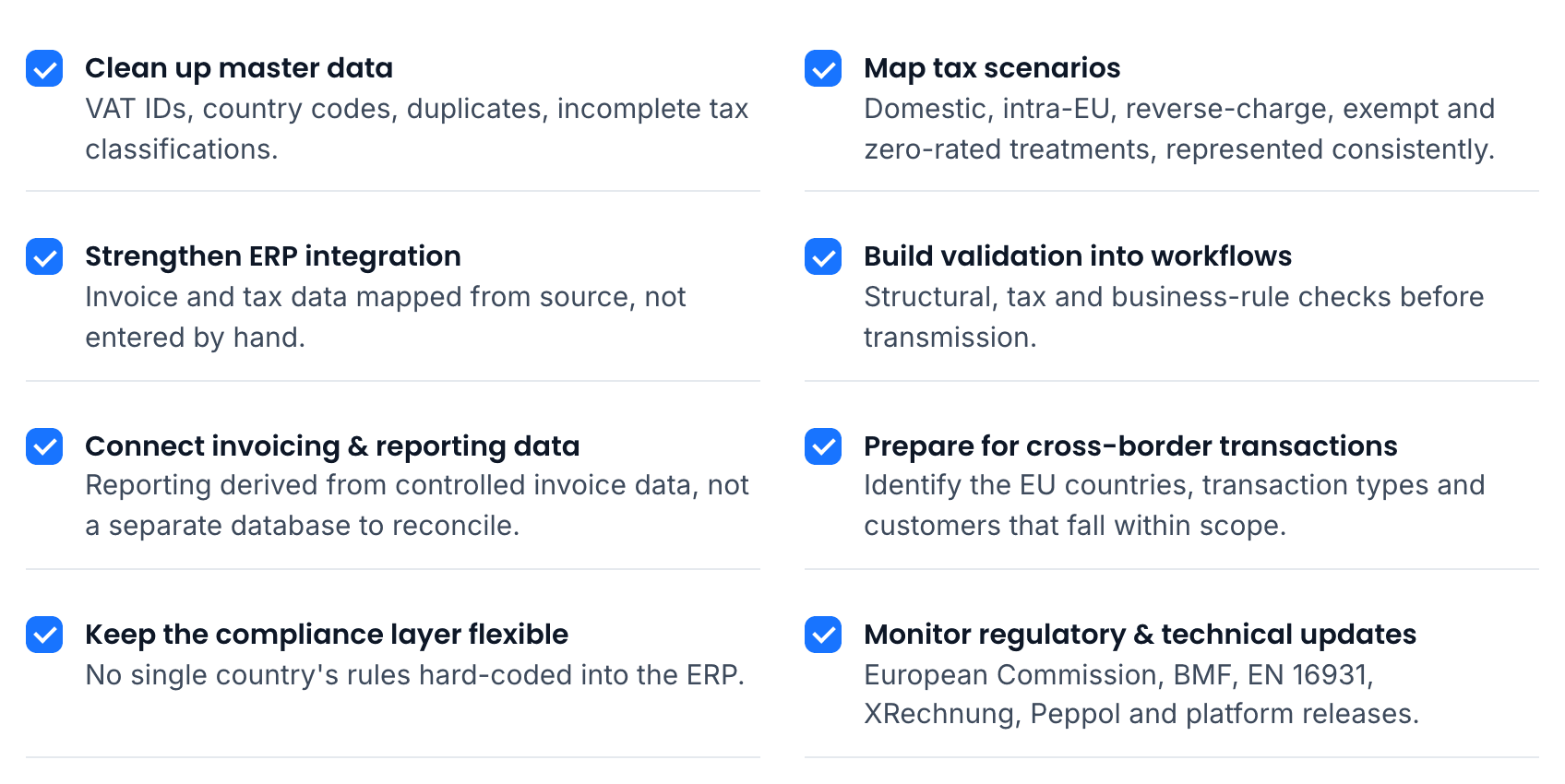
Businesses do not need to build a complete 2030 reporting system today. They should build the foundations that can support it.
1. Clean Up Master Data
Review customer, supplier, tax, product, service, and address data.
Pay particular attention to VAT identification numbers, country information, duplicate records, and incomplete tax classifications.
2. Map Tax Scenarios
Document the VAT treatment used for domestic, intra-EU, reverse-charge, exempt, zero-rated, and other relevant transaction scenarios.
Make sure those treatments can be represented consistently in structured invoice data.
3. Strengthen ERP Integration
Identify where invoice data originates and where tax data is calculated.
Map the required invoice information from the ERP or billing system into the structured invoice layer instead of relying on manual entry.
4. Build Validation Into the Process
Use technical and business validation before invoices are transmitted.
Validation should identify structural errors, missing information, tax inconsistencies, and applicable business-rule problems before they become downstream reporting or customer issues.
5. Connect Invoicing and Reporting Data
Do not build an isolated reporting database that has to be reconciled manually with invoices and accounting.
Design the architecture so reporting data can be derived from controlled transaction and invoice data.
6. Prepare for Cross-Border Scenarios
Identify the EU countries, transaction types, VAT treatments, and customer relationships that will fall within the future reporting scope.
This is especially important for businesses with significant intra-EU sales or services.
7. Keep the Compliance Layer Flexible
Avoid hard-coding one country's requirements into the ERP.
A separate compliance layer can help manage country-specific formats, validation rules, transmission requirements, and future reporting changes.
8. Monitor Regulatory and Technical Updates
Track the European Commission, German BMF guidance, German legislation, EN 16931 developments, XRechnung releases, Peppol specifications, and relevant ERP or platform updates. The European Commission's 13 May 2026 ViDA work programme confirms that implementation work is ongoing. In Germany, the VeR's May 2026 strategy paper, “Effiziente Umsetzung des Meldesystems,” also frames the future reporting system as a development of existing E-Rechnung infrastructure rather than a separate process. The VeR paper is an industry position, not legislation, but it is useful context for the direction of the German market.
The rules are evolving, so regulatory change management should be part of the implementation plan.
What Should Businesses Not Do Yet?
Businesses should avoid building an expensive system around assumptions that have not been legally or technically finalised.
In particular, do not assume that:
- Germany already has a fully operational domestic real-time e-reporting system.
- Every German invoice will automatically be reported to the tax authority from July 2030.
- Peppol is the only permitted transmission channel.
- Today's exact EN 16931 syntax or validation artefacts will remain unchanged until 2030.
- A vendor's generic claim of "ViDA ready" proves compliance with future German requirements.
Instead, build flexible foundations that can adapt as the German reporting model and technical specifications are finalised.
What Does ViDA Mean for ERP and E-Invoicing Architecture?
A future-ready architecture should separate the business transaction from the country-specific compliance requirements.
ERP / Accounting
↓
Common transaction and tax data
↓
Compliance layer
↓
Country-specific invoice and reporting rules
↓
Validation
↓
E-Invoice transmission and reporting
This structure can support today's German E-Rechnung requirements while allowing future EU and national reporting requirements to be introduced without redesigning the core ERP.
How Complyance Can Support the Transition
Depending on product configuration and the specific workflow, Complyance can provide an e-invoicing and compliance layer between source systems and external transmission or compliance processes.
A typical architecture can be represented as:
The ERP sends the invoice data to Complyance, where it is mapped, validated, and converted into the required E-Rechnung before transmission.
As German and European requirements evolve, the value of this type of layer is its ability to manage country-specific compliance logic without requiring businesses to rebuild their core ERP processes.
Specific supported formats, integrations, validation capabilities, receiving workflows, transmission channels, and future reporting capabilities should be confirmed for the required implementation.
ViDA Timeline for Germany
| Date | What it means |
|---|---|
| April 14, 2025 | ViDA entered into force at EU level. |
| 2025 | Germany's domestic E-Rechnung receiving requirement began. |
| 2026 | Germany remains in the domestic issuing transition period. |
| January 1, 2027 | German issuing transition changes for businesses above the €800,000 previous-year turnover threshold. |
| January 1, 2028 | Germany's general domestic B2B E-Rechnung issuing transition ends, subject to statutory exceptions. |
| July 1, 2030 | ViDA Digital Reporting Requirements begin for relevant intra-EU cross-border B2B transactions. The existing recapitulative statement is replaced for these transactions by transaction-level digital reporting. |
| January 1, 2035 | ViDA's alignment deadline applies to Member States that already had qualifying domestic digital real-time transaction reporting systems or authorisations under the directive's transitional rules. It should not be presented as a blanket deadline requiring Germany to introduce a domestic real-time reporting system by that date. |
The Practical Takeaway for German Businesses
Germany's E-Rechnung mandate and ViDA should be treated as connected stages of digital VAT transformation, not as two unrelated projects.
The immediate priority is to comply with Germany's domestic E-Rechnung rules.
For businesses operating across EU borders, the next priority is to make sure their transaction data, tax logic, ERP integrations, validation, and reconciliation processes can support the future ViDA reporting model.
The strongest preparation is therefore not to predict every technical detail of 2030.
It is to build reliable structured data today.
Structured data today: Better readiness for digital reporting tomorrow
Frequently Asked Questions
Germany does not currently have a domestic VAT real-time reporting obligation based on e-invoicing. However, the German government is working on a future digital reporting system, including reporting for intra-Community and potentially national B2B transactions.
The ViDA Digital Reporting Requirements for relevant intra-EU cross-border B2B transactions start on July 1, 2030. For those transactions, the current recapitulative statement is replaced by transaction-level digital reporting.
For the intra-Community transactions covered by the ViDA Digital Reporting Requirements, the current recapitulative statement process is replaced from July 1, 2030 by transaction-level digital reporting. The new reporting contains more detailed and timely information than the existing summary process.
No. E-invoicing concerns the structured exchange of invoice information, while e-reporting concerns the electronic transmission of defined transaction or tax data to the tax administration.
No. Germany's domestic E-Rechnung rules continue to apply. ViDA introduces an EU framework for future cross-border e-invoicing and digital reporting requirements.
No such blanket rule should be assumed. The initial ViDA Digital Reporting Requirements focus on relevant intra-EU cross-border B2B transactions. Germany's future domestic reporting scope is still being developed.
No. ViDA does not simply mandate Peppol as the universal transmission network. Businesses should separately assess the applicable invoice standard, transmission channel, and reporting mechanism.
No. Businesses can already improve master data, tax mappings, structured invoice generation, validation, ERP integration, reconciliation, and audit trails. These capabilities support current German E-Rechnung requirements and provide a stronger foundation for future reporting.
About the Author

Swathy
Content Marketer
I’m a Content Marketer at Complyance, focused on e-invoicing. Over the years, I’ve created a wide range of content, including blog posts, whitepapers, and product guides, which have supported Complyance’s growth across markets such as the UAE and EU regions. My goal is to deliver content that is comprehensive, clear, accurate, and easy to understand, no matter how complex the topic.