Peppol in Germany: How It Works for E-Invoicing and B2G

Learn how Peppol works in Germany for e-invoicing and B2G, including Access Points, identifiers, Peppol BIS Billing 3.0, XRechnung, routing, and delivery tracking.

Table of Contents
If you work with German public authorities or operate across European markets, you may come across Peppol Germany.
Peppol is important for electronic invoicing, but it is not the same thing as an invoice format such as XRechnung.
The easiest way to understand the difference is this:
- EN 16931 defines the semantic model for invoice information.
- XRechnung is a German EN 16931-based invoice specification, particularly important for German public-sector invoicing.
- Peppol BIS Billing 3.0 is a Peppol electronic billing specification based on EN 16931.
- Peppol is a governed interoperability framework and network for exchanging supported structured business documents.
- An Access Point is a service-provider connection to the Peppol network.
This distinction matters because businesses need to get both the invoice itself and the transmission method right.
Key Takeaways
- Peppol is a governed interoperability framework and network for exchanging structured business documents.
- Peppol is not itself an invoice format.
- XRechnung and Peppol BIS Billing 3.0 are different invoice specifications based on or aligned with EN 16931.
- Germany supports Peppol for electronic invoice transmission, including federal public-sector workflows.
- German federal authorities generally require the currently valid XRechnung standard, subject to applicable submission and procurement rules.
- Peppol and XRechnung address different parts of the e-invoicing process.
- Correct recipient identifiers, including the Leitweg-ID where applicable, are essential for successful delivery.
- Peppol is not a universally mandatory network for German B2B invoicing.
What Is Peppol?
Peppol is a governed interoperability framework and network for exchanging structured business documents.
It provides common rules and infrastructure for participant identification, technical specifications, Access Points, and document-exchange processes.
Peppol is therefore more than a generic transport mechanism. It defines how participants can identify each other and exchange supported structured documents through a common framework.
Peppol is not itself an invoice format.
The invoice still needs to follow an accepted specification, such as XRechnung or Peppol BIS Billing 3.0, depending on the recipient and workflow.
Businesses normally connect to Peppol through a Peppol Access Point operated by a service provider. The provider can handle network connectivity, participant discovery, document exchange, technical acknowledgements, delivery-status reporting, and error handling.
The benefit is that a business does not need to build a separate network connection for every trading partner.
Peppol, EN 16931, XRechnung and Peppol BIS Billing 3.0
These terms are closely related, but they do different jobs.
| Component | Role |
|---|---|
| EN 16931 | European semantic data model for invoice information |
| XRechnung | German EN 16931-based invoice specification |
| Peppol BIS Billing 3.0 | Peppol electronic billing specification based on EN 16931 |
| Peppol | Interoperability framework and network for exchanging supported structured documents |
| Access Point | Service-provider connection to the Peppol network |
EN 16931 describes the meaning and structure of invoice information. XRechnung and Peppol BIS Billing 3.0 define specific ways that structured invoice information can be represented for particular use cases.
Peppol then provides the framework and network through which supported documents can be exchanged.
This means Peppol does not replace the invoice specification.
What Is Peppol BIS Billing 3.0?
Peppol BIS Billing 3.0 is a Peppol specification for exchanging electronic invoices.
It is a Core Invoice Usage Specification, or CIUS, based on the EN 16931 semantic model. The specification uses structured XML, with UBL 2.1 as its primary syntax.
Germany supports Peppol BIS Billing 3.0 in relevant e-invoicing workflows.
However, businesses should not treat Peppol BIS Billing 3.0 as simply "the German Peppol format."
The recipient's requirements still matter.
A recipient may require XRechnung, accept Peppol BIS Billing 3.0, or apply additional national, procurement, or platform-specific rules.
For that reason:
XRechnung and Peppol BIS Billing 3.0 are different invoice specifications. They are not automatically interchangeable for every German recipient or workflow.
Businesses should confirm the accepted specification before sending the invoice.
Peppol for German B2G Invoices
Peppol is particularly relevant to public-sector invoicing in Germany.
Germany supports Peppol for electronic invoice transmission, including submissions to the federal administration and other public-sector recipients where the relevant authority or platform supports it.
The federal E-Rechnung environment supports Peppol as a transmission option.
For invoices addressed to the federal administration, businesses generally need to use the currently valid XRechnung standard, subject to applicable portal and procurement rules. Other formats may be accepted where the applicable requirements permit them, so businesses should verify the specific recipient's rules before sending an invoice.
Federal, state, and municipal authorities can have different portals, identifiers, and technical requirements. Businesses should therefore not assume that one Peppol setup applies identically to every German public authority.
The key distinction is:
Invoice requirement: Which invoice specification does the recipient accept?
Transmission requirement: Which channel can be used to send the invoice?
Peppol addresses the second part, while the invoice specification addresses the first.
XRechnung and Peppol BIS Billing 3.0 Are Not Automatically Interchangeable
This is one of the most important points for businesses implementing Peppol in Germany.
Peppol can transport invoices that comply with an accepted Peppol or national specification.
For German public-sector recipients, XRechnung is generally the required or preferred standard, while Peppol BIS Billing 3.0 may be accepted where the recipient and platform support it.
Businesses should not assume that:
- Every XRechnung can automatically be sent through every Peppol workflow.
- Peppol BIS Billing 3.0 always replaces XRechnung.
- XRechnung and Peppol BIS Billing 3.0 are identical formats.
The correct approach is to identify the recipient, confirm the accepted invoice specification, validate the document, and then use an appropriate transmission channel.
Leitweg-ID and Peppol Identifiers
Correct recipient identification is an important part of electronic invoice delivery.
For German federal public-sector invoices, the Leitweg-ID is used as the buyer reference or routing identifier needed to direct the invoice to the correct authority and organisational unit.
It is important to distinguish this from the Peppol participant identifier and the recipient endpoint or Access Point.
These identifiers can serve different purposes and should not be treated as universally identical.
The correct identifier scheme and value depend on the specific workflow and recipient requirements.
A technically valid invoice can still fail delivery if the recipient information is wrong.
That is why customer and recipient master data should be treated as an important part of the e-invoicing process.
How Peppol E-Invoicing Works
A typical implementation can follow this flow:
The ERP provides the invoice data. The provider maps it to the accepted invoice specification, validates the invoice, sends it through the appropriate Access Point and Peppol network, and tracks the delivery status at the recipient.
The ERP usually supplies the underlying invoice data.
The e-invoicing provider maps and transforms that data into the accepted invoice specification, such as XRechnung or Peppol BIS Billing 3.0.
The resulting document is validated before submission.
The provider then submits the invoice through a Peppol Access Point.
Peppol exchanges the document with the recipient endpoint or Access Point.
The recipient platform can then process the invoice and return relevant status information.
For Complyance, the flow can look like this:
The ERP sends invoice data to Complyance, which maps it to XRechnung or Peppol BIS Billing 3.0, validates it, sends it through the Peppol Access Point to OZG-RE or the recipient endpoint, and tracks the status.
This separates the responsibilities clearly. The ERP supplies business data, while the e-invoicing provider can handle transformation, validation, transmission, and status management.
How Peppol Access Points Work
Businesses normally connect to Peppol through a Peppol Access Point operated by a service provider.
The provider can handle:
- Network connectivity
- Participant discovery
- Document exchange
- Technical acknowledgements
- Delivery-status reporting
- Error handling
This means a business does not have to build and maintain the complete Peppol network infrastructure itself.
The Access Point is the technical connection into the Peppol network. The invoice itself still needs to comply with the applicable document specification and recipient requirements.
Peppol for German B2B Invoices
Peppol can also be used to exchange structured invoices between businesses in Germany.
However, Peppol itself does not determine whether a business must issue an E-Rechnung.
The legal obligation comes from the applicable German e-invoicing rules, not from joining Peppol.
Where a German transaction falls within the applicable E-Rechnung rules, the invoice must satisfy the relevant legal and technical requirements.
Peppol is one possible transmission channel. It is not a universal mandatory network for German B2B invoicing.
Businesses should therefore distinguish between two separate questions:
Does the transaction require a compliant E-Rechnung?
This is determined by the applicable German legal requirements.
How should the invoice be transmitted?
This depends on the recipient and the permitted transmission methods. Peppol is one possible option.
Why Businesses Use Peppol
Peppol can reduce the need for one-off integrations with individual trading partners.
Without a common network approach, a business might need separate connections for different customers.
With a Peppol-enabled provider, the architecture can be simplified:
The ERP sends invoice data to a Peppol provider, which transmits it through the Peppol network to customers.
This can be particularly useful for businesses with many trading partners.
The benefit is not that every customer or country uses exactly the same invoice rules. They do not.
The benefit is that a common interoperability framework can support structured document exchange while the e-invoicing platform manages the relevant format, validation, identification, and country-specific requirements.
Peppol and Cross-Border E-Invoicing
Peppol is designed to support interoperable exchange of structured business documents across participating countries.
This makes it useful for businesses operating in Germany and other European markets.
However, Peppol does not eliminate country-specific tax or invoice requirements.
A business still needs to make sure that the invoice complies with the rules applicable to the transaction and recipient.
A practical cross-border setup therefore separates:
- Common business data
- Country-specific invoice requirements
- Invoice specifications
- Validation rules
- Recipient identifiers
- Transmission methods
A dedicated e-invoicing provider can bring these layers together while allowing the ERP to remain the source of business data.
How to Prepare for Peppol in Germany
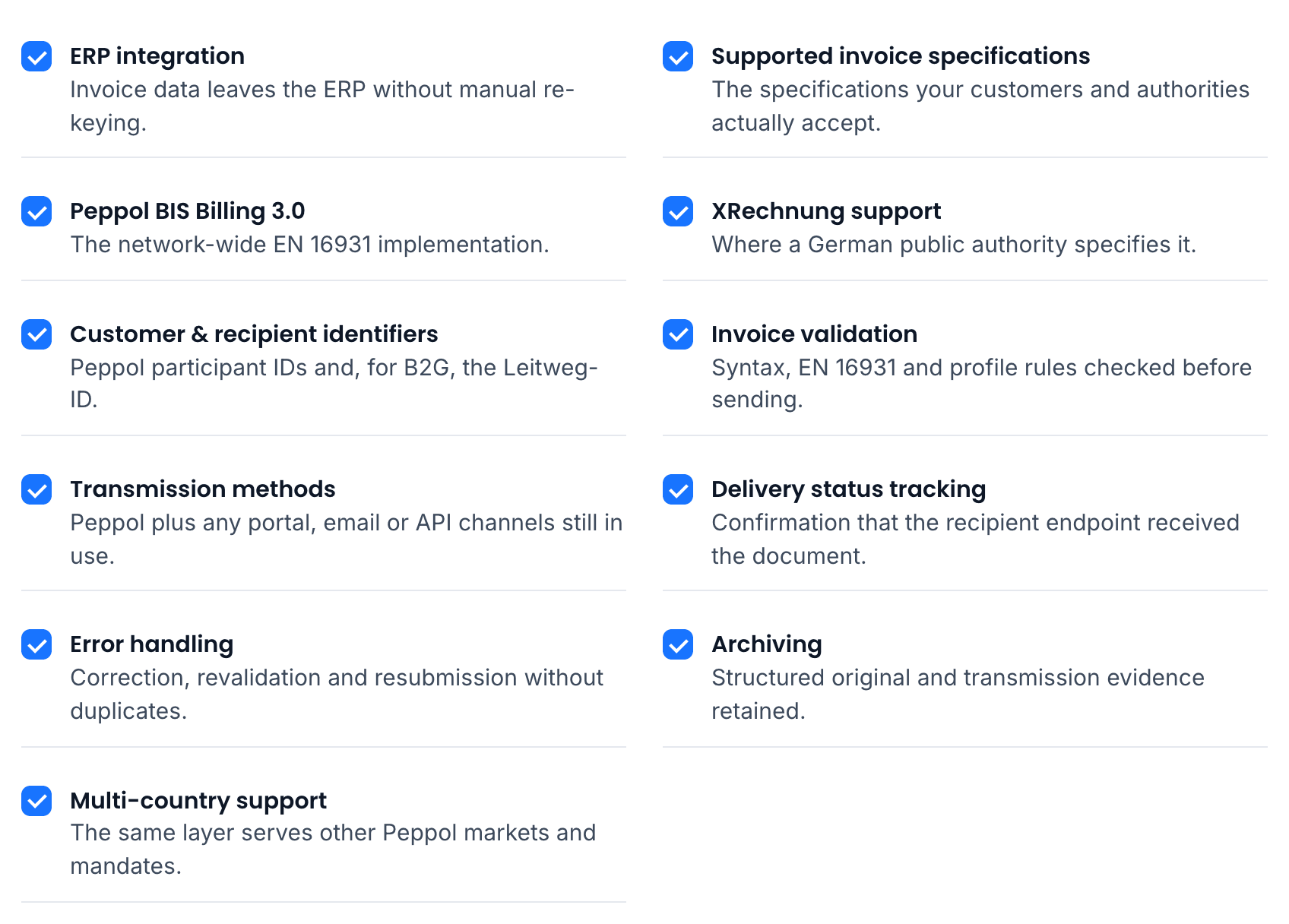
Before implementing Peppol, businesses should check more than the network connection.
Consider:
- ERP integration
- Supported invoice specifications
- Peppol BIS Billing 3.0 support
- XRechnung support where required
- Customer and recipient identifiers
- Validation
- Transmission methods
- Delivery status
- Error handling
- Archiving
- Support for other countries and mandates
A practical implementation should connect invoice creation, validation, transmission, status tracking, and archiving into one controlled process.
The overall process can be understood as:
The process begins by creating the correct structured invoice and validating it. The business then chooses an accepted transmission method, sends the invoice through the appropriate channel, tracks the result, and archives the records.
Peppol and Complyance
Complyance can provide the e-invoicing layer between an ERP and supported Peppol workflows.
The ERP remains the source of invoice data.
Complyance can then map and transform the data into the required invoice specification, validate the resulting document, and support transmission through a Peppol Access Point.
For a German workflow, the process can look like:
The ERP sends invoice data to Complyance, which maps it to XRechnung or Peppol BIS Billing 3.0, validates it, sends it through the Peppol Access Point to OZG-RE or the recipient endpoint, and tracks the status.
This allows businesses to keep their existing ERP while using a dedicated compliance layer for invoice transformation, validation, transmission, and status management.
For businesses operating across multiple countries, this approach can also help manage different invoice specifications and country-specific requirements without creating a separate integration for every market.
Peppol Germany: What a Business Should Expect From Its Provider
Businesses should not choose a Peppol provider only because it offers network connectivity.
The broader service matters.
Ask:
- Can the provider validate invoices before transmission?
- Which Peppol BIS versions and invoice specifications are supported?
- Can it generate XRechnung where required?
- Can it send and receive invoices?
- Can it show delivery and processing status?
- Can it handle transmission and validation errors?
- Can it connect to the existing ERP?
- Can it support Germany and other countries?
- How are customer and recipient identifiers managed?
- How are invoice records and status information retained?
The Peppol connection is only one part of the overall e-invoicing process.
Peppol and Customer Identifiers
Electronic delivery depends on correctly identifying the recipient.
In relevant German public-sector workflows, the Leitweg-ID can be used as the buyer reference or routing identifier.
For other Peppol participants, the relevant participant identifier and identifier scheme need to be correct.
These identifiers should not be treated as interchangeable.
A wrong identifier can cause an otherwise valid invoice to fail delivery or reach the wrong destination.
That makes customer master data an important part of the e-invoicing implementation.
Tracking Peppol Deliveries
A good e-invoicing system should distinguish between the different events that happen after an invoice is created.
A practical status lifecycle is:
A typical status lifecycle moves from creation and validation to submission, delivery, recipient processing, and final acceptance or rejection.
These statuses represent different stages.
A successful Peppol delivery does not necessarily mean that the recipient has approved the invoice for payment.
Network delivery, recipient-platform processing, and commercial acceptance are different events.
A provider should expose these statuses separately where possible so finance teams can understand exactly what happened to an invoice.
Conclusion
Peppol is best understood as a governed interoperability framework and network for exchanging structured business documents, not simply as an invoice format or delivery channel.
XRechnung and Peppol BIS Billing 3.0 address the invoice specification layer, while EN 16931 provides the underlying semantic model for invoice information.
For German public-sector invoicing, businesses also need to consider recipient-specific requirements, including the applicable invoice specification, submission platform, and recipient identifiers such as the Leitweg-ID where relevant.
For B2B transactions, Peppol is one possible transmission method. It is not a universal mandatory network for German businesses.
The practical process is:
The process begins by creating the correct structured invoice and validating it. The business then chooses an accepted transmission method, sends the invoice through the appropriate channel, tracks the result, and archives the records.
When these responsibilities are separated clearly, Peppol becomes a practical part of a wider e-invoicing architecture rather than another standalone integration project.
Frequently Asked Questions
No. Peppol is not a universal mandatory transmission method for German B2B invoicing. It is one available transmission option in relevant public-sector and business workflows. The recipient's requirements and applicable German e-invoicing rules determine which format and transmission method must be used.
No. XRechnung is a German invoice specification based on EN 16931. Peppol is a governed interoperability framework and network for exchanging supported structured documents.
Yes. Peppol is available for transmitting invoices to the German federal administration through the relevant federal invoice submission environment. The invoice must still comply with the applicable invoice specification and submission requirements.
Peppol BIS Billing 3.0 is a Peppol electronic billing specification based on EN 16931. It defines how structured invoice data is represented and exchanged within supported Peppol workflows.
Not automatically. They are different invoice specifications, and acceptance depends on the recipient, platform, and applicable German requirements. Businesses should confirm which specification the recipient accepts before sending the invoice.
XRechnung can be exchanged through Peppol where the recipient and workflow support it. Peppol provides the interoperability framework and network, while XRechnung provides the invoice specification.
Businesses should still confirm the recipient's accepted specification and submission requirements before sending the invoice.
Not automatically. XRechnung and Peppol BIS Billing 3.0 are different invoice specifications. Whether Peppol BIS Billing 3.0 can be used depends on the recipient, platform, and applicable requirements.
Yes. Peppol is designed to support interoperable exchange of structured business documents across participating countries.
It does not eliminate country-specific tax or invoice requirements, so the invoice still needs to comply with the rules applicable to the transaction and recipient.
About the Author

Swathy
Content Marketer
I’m a Content Marketer at Complyance, focused on e-invoicing. Over the years, I’ve created a wide range of content, including blog posts, whitepapers, and product guides, which have supported Complyance’s growth across markets such as the UAE and EU regions. My goal is to deliver content that is comprehensive, clear, accurate, and easy to understand, no matter how complex the topic.