EN 16931 in Germany: E-Invoice Standard, Requirements and Compliance

Understand EN 16931 in Germany, including its semantic model, relationship with XRechnung and ZUGFeRD, business rules, validation, interoperability, and ERP impact.
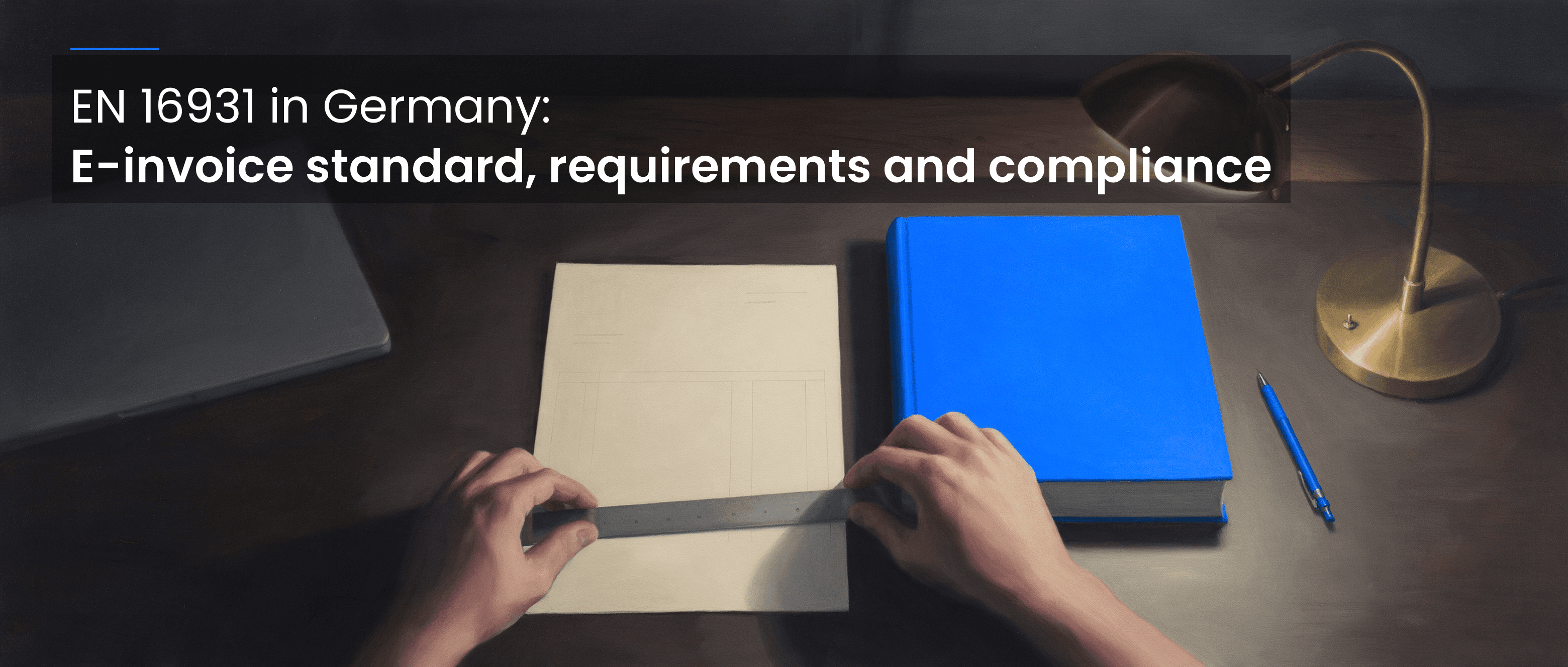
Table of Contents
When people first hear EN 16931 Germany, it can sound like a technical code that only IT teams need to understand.
It is actually much easier.
EN 16931 is the European standard that provides a common semantic model for electronic invoices.
Think of it as a common invoice language.
If one system says "invoice number" and another system stores the same concept under a different technical field, both systems need a common meaning.
EN 16931 provides that shared structure.
Germany uses this European standard as an important foundation for its E-Rechnung framework. In Germany, EN 16931 underpins the E-Rechnung rules in § 14 UStG and the related BMF guidance.
Key Takeaways
- EN 16931 is the European standard for electronic invoice information.
- It defines a common semantic data model rather than simply one file type.
- XRechnung is Germany's national CIUS based on EN 16931.
- Qualifying ZUGFeRD profiles can also be based on EN 16931.
- EN 16931 does not mean every compliant invoice must look identical.
- Validation can check the required syntax and applicable business rules.
- Other structured formats, including certain EDI arrangements, can be used when the applicable legal requirements are met.
What Is EN 16931?
EN 16931 is the European standard for electronic invoicing.
It defines a semantic data model for the core elements of an electronic invoice.
That means it focuses on what invoice information means and how the information relates to other information.
For example, the model covers concepts such as the seller, buyer, invoice identification, invoice date, tax, amounts, and payment information.
The goal is interoperability.
A business in one system should be able to send structured invoice information to another system without both sides inventing their own meaning for every field.
EN 16931 Is Not Just a File Format
One common misunderstanding is that EN 16931 is a file extension.
It is not.
EN 16931 defines the semantic model. Technical syntaxes can represent that model, including XML syntaxes such as UBL and UN/CEFACT CII.
Germany's BMF guidance explains that XRechnung uses structured XML and is based on the EN 16931 core data model.
The important distinction is that EN 16931 defines the meaning and structure of the invoice information, while a technical syntax defines how that information is represented electronically.
This distinction is important when choosing an e-invoicing solution.
EN 16931 and XRechnung
XRechnung is Germany's national CIUS (Core Invoice Usage Specification) based on EN 16931.
It uses structured XML and incorporates German-specific requirements.
The BMF explains that XRechnung corresponds to the EN 16931 standard and that its core data model contains the VAT-required information.
XRechnung can be represented using supported XML syntaxes such as UN/CEFACT CII and UBL. German-specific requirements can also include fields such as the buyer reference and, for relevant B2G scenarios, the Leitweg-ID.
This makes XRechnung one of the most important practical examples of EN 16931 in Germany.
EN 16931 and ZUGFeRD
Qualifying ZUGFeRD profiles also use the EN 16931 framework.
A ZUGFeRD invoice combines structured XML with a visual PDF/A-3 representation.
The structured part carries the machine-readable information.
The visual part helps people review the invoice.
The BMF identifies ZUGFeRD from version 2.0.1, except MINIMUM and BASIC-WL profiles, as capable of meeting the E-Rechnung requirements under the relevant conditions.
For additional precision, EN 16931-compliant ZUGFeRD profiles include EN 16931 (COMFORT), EXTENDED, and XRECHNUNG. The BASIC profile is not EN 16931 compliant and therefore does not qualify under the German E-Rechnung mandate on that basis.
What Information Does EN 16931 Cover?
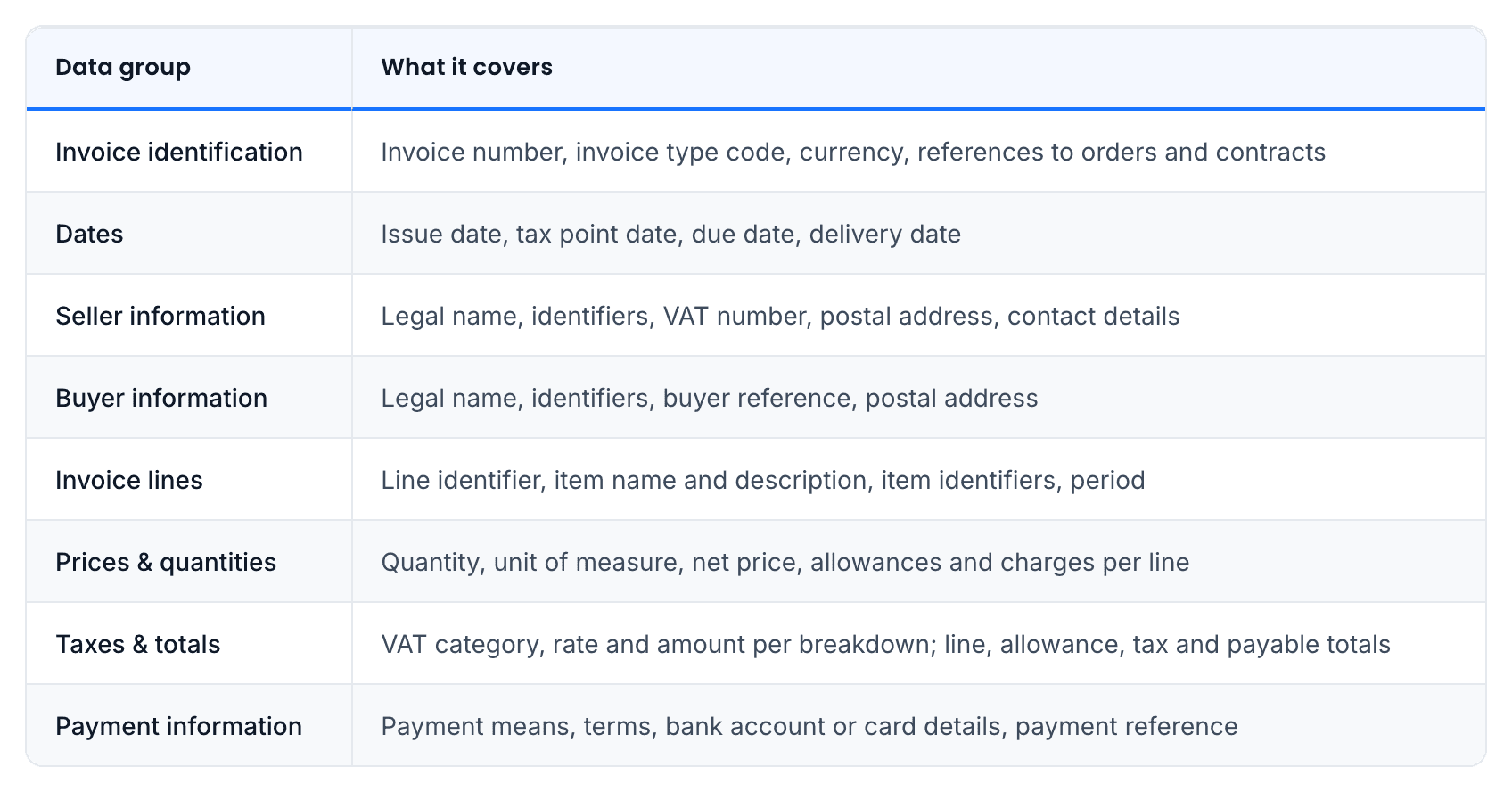
The standard covers the core information needed to understand and process an invoice.
This includes concepts such as:
- Invoice identification
- Dates
- Seller information
- Buyer information
- Invoice lines
- Prices
- Quantities
- Taxes
- Totals
- Payment information
The model also includes conditional information. Whether a particular field is required can depend on the transaction and applicable business rules. For example, certain transactions may require additional tax or buyer identification information.
The exact implementation can also involve business rules and national requirements.
EN 16931 Business Rules
A structured invoice can be technically valid and still contain incorrect business information.
For example, a calculation may not match the stated tax rate, or required relationships between invoice values may not satisfy the applicable business rules.
That is why validation is important.
A complete validation approach should check the invoice syntax, the semantic structure, and the applicable business rules before transmission.
The BMF specifically notes that suitable validation applications can be used to check compliance with EN 16931 and its applicable business rules.
Can Businesses Use Other Formats?
Yes.
German law does not simply say "use XRechnung".
The BMF explains that electronic invoice formats are not limited to national formats when they meet the applicable requirements.
Another structured format may be used by agreement if it allows the correct and complete extraction of the VAT-required data into an EN 16931-compatible or interoperable format.
This can also apply to certain EDI arrangements.
Businesses therefore have flexibility, but the underlying legal requirements still matter.
EN 16931 Validation
Validation is an important quality check before an invoice is sent to the customer.
A practical validation process can include:
- Check the invoice fields.
- Check calculations and tax information.
- Check codes and required values.
- Check the XML structure and syntax.
- Check applicable EN 16931 business rules.
- Correct identified issues before sending.
A good validator can identify problems before the invoice reaches the customer.
Validation is not itself a legal precondition for the invoice's recognition, but it is recommended because it can help identify missing or incorrect mandatory data and business-rule violations.
That is particularly useful when invoice data comes from large ERP systems where one mapping error can affect thousands of invoices.
Why EN 16931 Matters to ERP Teams
ERP systems store business data. E-invoicing standards such as EN 16931 define how that data must be represented and exchanged for compliant e-invoices.
In many implementations, the ERP does not generate EN 16931 directly. Instead:
- The ERP exports invoice details such as customer information, dates, invoice lines, taxes, and totals.
- The e-invoicing provider maps those fields to the EN 16931 data model.
- The provider generates the required format, such as XRechnung XML or a qualifying ZUGFeRD invoice, validates it, and transmits it.
Even so, mapping quality still matters. If the source data is incomplete or inconsistent, the resulting EN 16931 invoice may fail validation or be rejected.
Typical mappings include:
- ERP customer ID: e-invoice buyer identifier, and for relevant B2G scenarios, buyer reference BT-10 / Leitweg-ID
- ERP invoice date: invoice issue date
- ERP tax code: e-invoice tax category and rate
- ERP totals: invoice payable amount and tax breakdown
So while the ERP does not have to output EN 16931 directly, clean, complete source data and accurate field mapping remain critical to compliant e-invoicing.
How Complyance Uses the Standard
Complyance can act as the e-invoicing layer between your ERP and customers.
The ERP remains the source of invoice data, while Complyance can map that data to the EN 16931 model, apply the relevant country-specific requirements, generate the required structured format, validate the invoice, and support transmission.
This allows businesses to keep their existing ERP while using a dedicated e-invoicing workflow for Germany and other markets.
EN 16931 and Interoperability
The biggest practical benefit of EN 16931 is interoperability.
Without a shared model, every business could define invoice fields differently.
One system might treat a value as a tax amount while another interprets it as a total amount.
A common semantic model reduces that problem.
For businesses operating internationally, this is especially useful.
EN 16931-based implementations can include country-specific CIUS and technical syntaxes. Peppol BIS Billing 3.0 is another example of an EN 16931-based implementation used for electronic invoicing across markets.
This allows businesses to work with a common invoice data foundation while adapting the technical implementation to the requirements of a particular market.
EN 16931 and National Requirements
EN 16931 does not remove national tax rules.
Germany still has its own VAT requirements and business rules.
That means a business should not assume that meeting EN 16931 automatically means every German requirement has been satisfied.
Instead, businesses should treat EN 16931 as the European foundation and then account for the applicable German national requirements and the technical implementation used to transmit the invoice.
The e-invoicing platform needs to bring these layers together.
Why This Matters for Multi-Country Businesses
A company operating in Germany, France, Belgium, and other markets may face different local implementations.
If its ERP is tightly connected to one country's file format, every new mandate can become an integration project.
A better architecture separates business data from compliance output.
The ERP can provide common invoice data to a compliance layer. That layer can then apply the relevant country-specific requirements, produce the required format, validate it, and support transmission to the customer.
That is one of the strongest reasons to use a dedicated e-invoicing layer.
How Complyance Helps
At Complyance, we treat EN 16931 as the data foundation rather than as a technical label.
The goal is to take reliable invoice information from your ERP, map it correctly to the EN 16931 data model, apply the relevant country-specific requirements, generate the required structured invoice, validate it, and support transmission.
This reduces the need for finance teams to manage every technical detail of the standard while helping businesses maintain a consistent e-invoicing approach across different markets.
Conclusion
EN 16931 matters because it gives European businesses a common way to describe invoice information.
Germany then builds its practical E-Rechnung implementations around that foundation.
For a business, the important lesson is to start with correct invoice data, map it accurately to the required semantic model, select the appropriate technical format, validate the result, and meet the applicable transmission and compliance requirements.
Once that process is in place, EN 16931 becomes a manageable part of the e-invoicing workflow.
Frequently Asked Questions
EN 16931 is the European standard for the semantic data model used for electronic invoices and forms an important foundation of Germany's E-Rechnung framework.
Yes. XRechnung is Germany's national CIUS based on the EN 16931 framework and is implemented using supported XML syntaxes.
Qualifying ZUGFeRD profiles are based on or aligned with EN 16931. The exact version and profile should be checked because not every ZUGFeRD profile is EN 16931 compliant.
No. It is a European standard and semantic data model. Technical syntaxes such as UBL and UN/CEFACT CII are used to represent the invoice information electronically.
Validation checks whether the invoice syntax, structure, and applicable business rules meet the required standard. Validation is recommended, although it is not itself a legal precondition for recognition of an invoice.
About the Author

Swathy
Content Marketer
I’m a Content Marketer at Complyance, focused on e-invoicing. Over the years, I’ve created a wide range of content, including blog posts, whitepapers, and product guides, which have supported Complyance’s growth across markets such as the UAE and EU regions. My goal is to deliver content that is comprehensive, clear, accurate, and easy to understand, no matter how complex the topic.