XRechnung in Germany: Requirements, Format, Examples and When to Use It

Understand XRechnung in Germany, including its XML structure, EN 16931 basis, key requirements, B2G use, Leitweg-ID, validation, and when to use it.
Table of Contents
XRechnung is a structured XML-based electronic invoice standard used in Germany, particularly for invoicing public-sector organizations.
Unlike a PDF, XRechnung stores invoice information in a structured format that software can process. It is based on the European EN 16931 standard and adds German-specific requirements through the XRechnung CIUS and its business rules.
XRechnung is especially important for businesses invoicing German public authorities, but it can also be used for B2B transactions where it meets the applicable German E-Rechnung requirements.
Key Takeaways
- XRechnung is a structured electronic invoice standard based on EN 16931.
- It adds German-specific business rules beyond the common EN 16931 requirements.
- XRechnung supports two XML syntaxes: UBL and UN/CEFACT CII.
- It is particularly important for B2G invoicing in Germany.
- A valid XRechnung must satisfy the applicable syntax and business rules.
- A Leitweg-ID is used for routing invoices to public authorities, while B2B invoices can use another suitable buyer reference.
- XRechnung is different from ZUGFeRD, although both can be used for compliant electronic invoicing when the applicable requirements are met.
What Is XRechnung?
XRechnung is Germany's structured electronic invoice standard, developed for use in electronic invoicing and particularly relevant to public procurement.
The standard implements the European EN 16931 semantic model in Germany and is maintained by KoSIT on behalf of the IT Planning Council. KoSIT provides the specification, technical components, validation resources, and related documentation for the standard.
Instead of presenting invoice information primarily as a visual document, XRechnung represents the information as structured data.
That allows accounting, procurement, and other business systems to process the invoice without relying on manual entry.
For example, a traditional document may display an invoice number as visible text. In XRechnung, the invoice number is stored as a defined data element that software can identify and process.
How Does the XRechnung Format Work?
XRechnung uses XML to represent structured invoice information.
An invoice can contain information such as:
- Invoice number
- Invoice date
- Seller and buyer information
- Invoice lines
- Quantities and prices
- VAT information
- Payment information
- References and supporting documents
- Delivery information
The important distinction is that each piece of information has a defined meaning within the invoice data model.
XRechnung is therefore not simply a PDF converted into XML. The underlying invoice data must be mapped to the appropriate structured elements and must satisfy the applicable business rules.
XRechnung Supports Two XML Syntaxes
XRechnung supports two XML syntaxes:
- UBL (Universal Business Language)
- UN/CEFACT CII (Cross Industry Invoice)
Both syntaxes implement the XRechnung semantic model. This distinction matters when selecting or integrating invoicing software because different ERP and accounting systems may generate different syntaxes.
The XRechnung specification explicitly supports both UBL and CII.
This also matters when comparing XRechnung with ZUGFeRD. ZUGFeRD uses the CII syntax for its structured invoice data, including its XRECHNUNG profile.
XRechnung and EN 16931
XRechnung is based on the European EN 16931 standard.
EN 16931 defines a common semantic model for electronic invoices. XRechnung uses that model as its foundation and adds German-specific requirements through its national business rules.
This means an invoice can satisfy the general EN 16931 model without necessarily satisfying every XRechnung-specific requirement.
The distinction is important when validating an invoice for the German market.
XRechnung Requirements
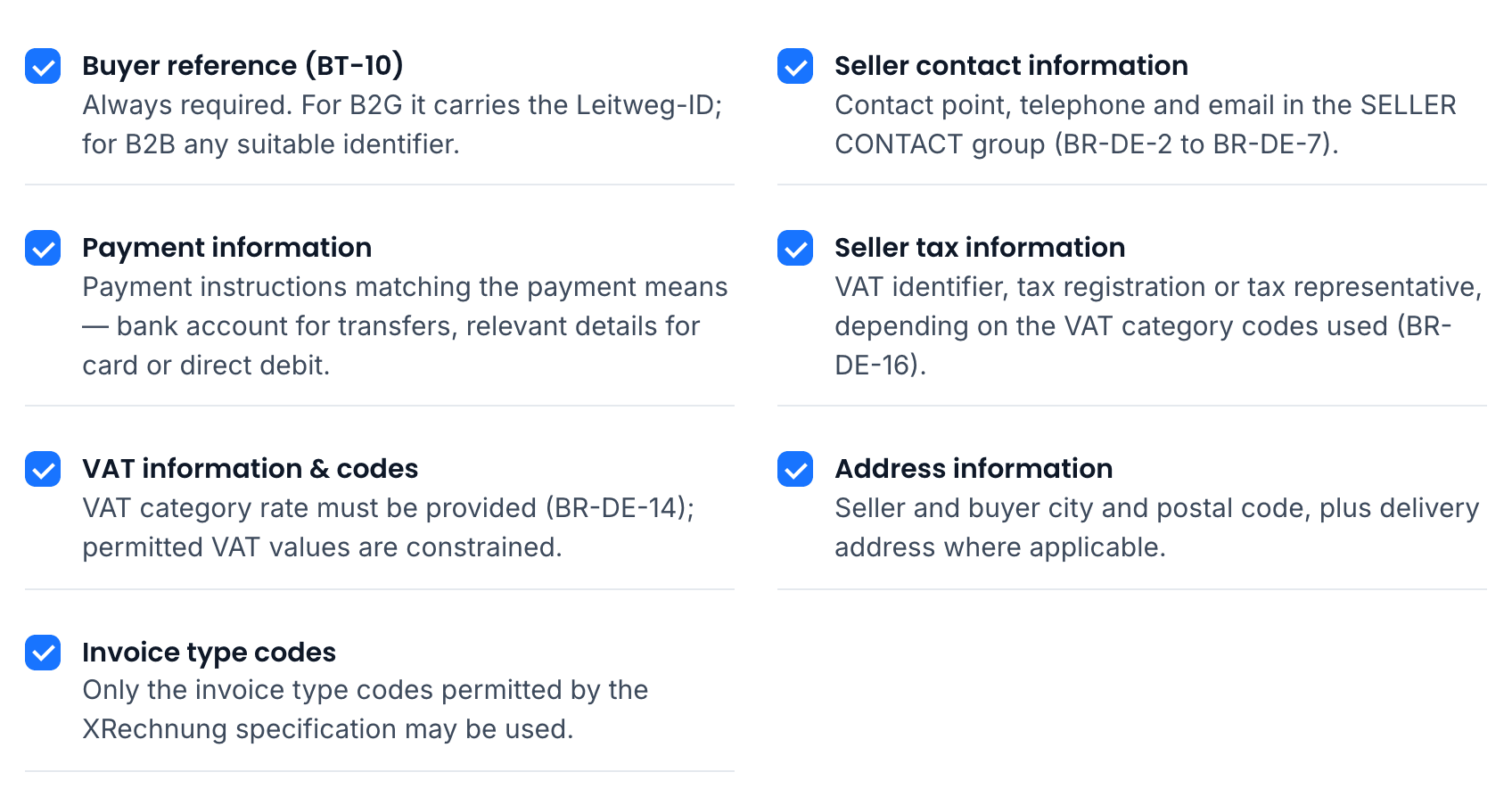
A compliant XRechnung must satisfy the applicable EN 16931 requirements as well as the German-specific XRechnung business rules.
These national rules are identified with BR-DE rule numbers.
Some of the requirements that commonly matter in practice include the following.
Buyer Reference
The Buyer reference (BT-10) must be provided.
For B2G invoicing, the buyer reference is where the Leitweg-ID is used to route the invoice to the appropriate public authority.
For B2B invoicing, a Leitweg-ID is not required. Another suitable identifier can be used in the buyer reference field.
Seller Contact Information
XRechnung requires seller contact information through the SELLER CONTACT group.
This includes the seller's:
- Contact point
- Telephone number
- Email address
These requirements are defined in BR-DE-2 through BR-DE-7 of the XRechnung business rules.
Payment Information
XRechnung requires payment instructions.
The applicable payment information depends on the payment method. The XRechnung rules define requirements for payment-related information, including bank account information for transfers and the relevant payment details for card payments or direct debit.
Seller Tax Information
Depending on the VAT treatment and tax codes used on the invoice, XRechnung can require the seller's VAT identifier, tax registration identifier, or information about a tax representative.
For example, BR-DE-16 requires at least one of these tax identifiers when certain VAT category codes are used.
VAT Information and Codes
XRechnung also defines specific requirements around VAT information and the values used in the invoice.
For example, BR-DE-14 requires the VAT category rate to be provided. Other rules control which invoice type codes and VAT-related values can be used.
Address and Delivery Information
The XRechnung rules also specify required address elements for sellers, buyers, and, where applicable, delivery addresses.
For example, seller and buyer city and postal code information are covered by the BR-DE rules.
These rules are one of the reasons why simply generating an XML file is not enough. An invoice can contain all the information normally expected on an invoice and still fail XRechnung validation because a specific German business rule has not been satisfied.
XRechnung for B2G in Germany
XRechnung has a particularly strong role in German B2G e-invoicing.
For invoices addressed to the German federal administration, XRechnung is generally the standard format used for electronic invoices, although other formats can be accepted when they satisfy the applicable requirements.
There is an important distinction between federal and state-level requirements.
Germany's federal structure means that the Bund and the Länder have their own legal and administrative rules for electronic invoicing. Submission methods, thresholds, technical requirements, and other details can therefore differ depending on the public authority receiving the invoice. Businesses should check the requirements of the specific contracting authority.
At the federal level, the E-Rechnungsverordnung includes an exception for certain direct awards below €1,000 net, so the statement that XRechnung is required for every federal invoice would be too broad.
What Is a Leitweg-ID?
A Leitweg-ID is a routing identifier used for invoices submitted to German public authorities.
It helps identify the public-sector recipient and route the invoice to the appropriate administrative unit.
The Leitweg-ID is particularly relevant to B2G invoicing.
It should not, however, be treated as a universal XRechnung requirement for every business invoice.
For B2B invoices, the buyer reference field can contain another appropriate identifier instead.
How to Create an XRechnung
Creating an XRechnung starts with the invoice data in an ERP or accounting system.
Before implementing the process, check whether the system supports XRechnung and which syntax it produces:
- UBL
- UN/CEFACT CII
The next step is to map the ERP data to the XRechnung data model.
The mapping needs to cover both the EN 16931 requirements and the applicable German BR-DE rules.
After the XML is generated, the invoice should be validated before transmission.
Businesses using an external e-invoicing platform should also confirm that the platform supports the relevant XRechnung version, syntax, and validation requirements.
KoSIT provides the technical components and validator resources used with the XRechnung standard.
How to Validate an XRechnung
Validation checks whether an XRechnung meets the applicable technical and business requirements.
A validation process can identify problems such as:
- Missing mandatory information
- Invalid code values
- Incorrect calculations
- Invalid XML structure
- Missing German-specific fields
- Violations of EN 16931 business rules
- Violations of XRechnung BR-DE rules
KoSIT provides technical validation components for XRechnung. Its documentation also shows how European and German-specific rules are incorporated into the validation process.
A practical validation process is:
- Create the invoice data.
- Map the data to the selected XRechnung syntax.
- Generate the XML.
- Validate the syntax and business rules.
- Correct any errors.
- Transmit the invoice through the required channel.
- Retain the invoice and relevant records according to the applicable retention requirements.
This is particularly important during implementation because many XRechnung errors are caused by missing fields or incorrect mappings rather than problems with the XML file itself.
When Should a Business Use XRechnung?
XRechnung is particularly relevant when a customer or public authority requires it.
It is a natural choice for businesses that regularly invoice German public-sector organizations and need a format designed for structured electronic processing.
For B2B transactions, businesses have more flexibility as long as the selected format meets the applicable German E-Rechnung requirements.
Before choosing XRechnung, consider:
- Customer requirements
- Whether the customer is a federal, state, or local public authority
- ERP compatibility
- UBL or CII support
- EN 16931 compliance
- XRechnung business-rule support
- Validation capabilities
- Transmission method
- Archiving requirements
XRechnung vs ZUGFeRD
XRechnung and ZUGFeRD both support structured electronic invoicing, but they are designed differently.
| XRechnung | ZUGFeRD |
|---|---|
| Structured electronic invoice | Hybrid electronic invoice |
| Supports UBL and UN/CEFACT CII syntaxes | Structured CII data embedded in a PDF/A-3 file |
| Primarily designed for machine processing | Combines structured data with a human-readable PDF |
| Particularly important for B2G | Can be useful for B2B and other business scenarios |
| German XRechnung business rules apply | Requirements depend on the selected ZUGFeRD version and profile |
ZUGFeRD can therefore be useful when a business wants structured invoice data together with a visual representation in the same document.
XRechnung is particularly familiar in public-sector invoicing.
The right choice depends on the customer requirements, ERP capabilities, transmission method, and business process.
How to Send an XRechnung
Creating a valid XRechnung is only one part of the process.
The invoice must also be submitted through a transmission channel supported by the relevant recipient.
Depending on the public authority and applicable requirements, electronic invoices can be submitted through channels such as:
- Peppol
- Email
- Public-sector submission portals
- Other supported electronic submission methods
The available options can differ between federal and state-level authorities, so businesses should confirm the submission requirements of the specific recipient.
How Complyance Helps
At Complyance, we treat XRechnung as part of the complete e-invoicing process rather than as an isolated XML generator.
Your ERP can remain the system where your business creates the underlying invoice data.
Complyance can then support the downstream process by transforming invoice data into the required structured format, validating the invoice, and supporting transmission and compliance workflows.
For businesses operating across Germany and other markets, this can also provide a common integration layer while applying the relevant country-specific invoice requirements.
The goal is not simply to generate an XML file. It is to make sure the invoice data is correctly structured, validated, transmitted, and handled as part of the wider business process.
Conclusion
XRechnung is more than an XML representation of a standard invoice.
It is a German implementation of the EN 16931 framework with additional national business rules that determine whether an invoice is valid as an XRechnung.
For businesses, the most important considerations are the required data fields, BR-DE business rules, supported XML syntax, validation process, and transmission requirements.
XRechnung is particularly important for German B2G invoicing, but it can also be used for B2B transactions where it meets the applicable E-Rechnung requirements.
Choosing the right ERP or e-invoicing platform therefore means looking beyond whether it can generate XML. It should support the relevant XRechnung syntax, map the required invoice data correctly, apply the German rules, and validate the resulting invoice before transmission.
Frequently Asked Questions
XRechnung is a structured electronic invoice standard based on EN 16931 and adapted for German requirements through national business rules. It is particularly important for invoicing German public-sector organizations.
The answer depends on the recipient and applicable rules.
At the federal level, electronic invoicing is generally required for invoices within the scope of the federal E-Rechnung rules, subject to applicable exceptions such as certain direct awards below €1,000 net.
The Länder have their own rules, so requirements can differ between federal, state, and local public authorities.
No. XRechnung is a structured XML-based invoice.
A human-readable representation can be generated separately, but the underlying XRechnung is structured invoice data.
Yes. XRechnung is based on the EN 16931 semantic model and adds German-specific business rules.
XRechnung requirements include the applicable EN 16931 rules as well as German BR-DE rules. These cover areas such as buyer reference, seller contact information, payment information, tax information, VAT-related data, address information, and permitted invoice codes.
Yes. XRechnung supports both UBL and UN/CEFACT CII XML syntaxes.
No. The Leitweg-ID is used to route invoices to public-sector recipients.
For B2B invoicing, another suitable identifier can be used in the Buyer Reference field.
Yes. XRechnung can be used for B2B where it meets the applicable German E-Rechnung requirements and is suitable for the business relationship.
XRechnung is a structured electronic invoice format that supports UBL and CII. ZUGFeRD combines structured CII invoice data with a human-readable PDF/A-3 representation.
XRechnung should be validated against the applicable syntax and business rules before transmission. KoSIT provides technical validation components for the XRechnung standard.
About the Author

Swathy
Content Marketer
I’m a Content Marketer at Complyance, focused on e-invoicing. Over the years, I’ve created a wide range of content, including blog posts, whitepapers, and product guides, which have supported Complyance’s growth across markets such as the UAE and EU regions. My goal is to deliver content that is comprehensive, clear, accurate, and easy to understand, no matter how complex the topic.