Chorus Pro vs Approved Platforms: France B2G and B2B E-Invoicing

France's e-invoicing reform introduces Plateformes Agréées, or PAs, for the wider B2B e-invoicing and e-reporting framework. But businesses that invoice public-sector customers will continue to encounter Chorus Pro, France's public-sector e-invoicing platform.
Table of Contents
France's e-invoicing reform introduces Plateformes Agréées, or PAs, for the wider B2B e-invoicing and e-reporting framework. But businesses that invoice public-sector customers will continue to encounter Chorus Pro, France's public-sector e-invoicing platform.
These two routes are related to the same wider move toward electronic invoicing, but they are not interchangeable commercial platforms.
Understanding the difference matters for companies that sell to both private businesses and public-sector organisations.
What Is Chorus Pro?
Chorus Pro is France's public-sector e-invoicing platform, operated by AIFE.
Since 1 January 2017, public administrations have used Chorus Pro to receive, process, track the status of, and exchange electronic invoices within the public sphere.
It became the established route for suppliers invoicing the French public sector, including State bodies, local authorities, public establishments, and other public entities.
Chorus Pro remains the reference platform for public-sector electronic invoicing after the wider reform begins.
This is the first distinction to understand: Chorus Pro has a specific public-sector role, while PAs support the broader private-sector B2B e-invoicing and e-reporting architecture.
What Is a Plateforme Agréée?
A Plateforme Agréée, or PA, is a private operator immatriculated by the State for the French e-invoicing framework.
Businesses use a PA for regulated B2B e-invoice exchange and applicable e-reporting flows.
A PA can receive and transmit electronic invoices and support the regulated exchange of relevant transaction and payment data.
A business can use a PA directly or use a compatible e-invoicing solution connected to a PA.
This means the software a business uses and the entity that holds the PA registration are not necessarily the same.
When selecting a technology provider, businesses should confirm the contracting entity, the PA registration holder, and the responsibilities of each party.
Chorus Pro vs PA: The Main Difference
| Area | Chorus Pro | Plateforme Agréée |
|---|---|---|
| Main role | Public-sector e-invoicing | Wider B2B e-invoicing and e-reporting framework |
| Operator | AIFE | Private operator immatriculated by the State |
| Main users | Public entities and their suppliers | Businesses using the private-sector e-invoicing architecture |
| B2B private-sector role | Not the commercial PA model | Core regulated route |
| Public-sector invoices | Reference platform | Can be used by suppliers in applicable cases |
| E-reporting | Supports relevant public-sector data flows | Supports applicable regulated reporting flows |
They should therefore not be treated as simple competitors.
How Does Chorus Pro Work After September 2026?
The wider reform does not replace Chorus Pro.
Chorus Pro will continue receiving public-sector invoices and will act as the public-sector issuing platform for public entities, including State bodies, public operators, and local public-sector entities, when they issue e-invoices to VAT-taxable businesses or other public entities.
It will also support the related transaction and payment-data transmission.
For suppliers to public bodies, existing Chorus Pro channels remain accessible.
From September 2026, public-sector suppliers may use a PA in applicable cases or use Chorus Pro's established channels:
- Portal entry or deposit
- EDI deposit
- API
These are continuing options, not merely temporary transition arrangements.
Can a Supplier Use a PA for Public-Sector Invoices?
Yes, in applicable cases.
A supplier that uses a PA can have its business systems connected to that PA and use the relevant route for public-sector invoicing.
However, the PA route does not cover every public-sector process.
DGFiP identifies specific flows that remain tied to Chorus Pro, including:
- Construction-contract invoices
- Justice-expense claims
- Reimbursement requests
- Management of the public-sector legal-commitment reference system
These are public-sector-specific processes and should be tested separately during implementation.
The practical lesson is simple: do not assume that moving to a PA removes every Chorus Pro requirement.
What Formats Does Chorus Pro Support?
Chorus Pro already receives Factur-X, UBL, and CII formats that are close to those required by the wider reform.
However, businesses should not assume that a format accepted by Chorus Pro automatically satisfies every requirement of another route.
The public-sector route can still have its own data, routing, reference, and process requirements.
For a supplier, the format is only one part of the implementation.
The system also needs the correct public-sector identifiers, references, routing information, attachments where required, and status handling.
Chorus Pro and B2B E-Invoicing Are Different Flows
Consider a manufacturer with two customers.
The first is a French private company. A qualifying domestic B2B invoice follows the private-sector e-invoicing framework and the business's PA arrangement.
The second is a French municipality. The invoice follows the public-sector route through Chorus Pro, either directly through its supported channels or through a PA where the applicable route allows it.
The ERP may create both invoices from the same source system, but the routing and compliance logic are different.
This is why businesses selling to both public and private customers should design routing at transaction level.
What About E-Reporting?
E-reporting is another layer.
A business may have a private-sector B2B invoice that follows the e-invoicing route, a public-sector invoice that follows Chorus Pro, and B2C or qualifying cross-border transactions that require e-reporting.
The same ERP can support these flows if it captures the relevant customer, establishment, VAT, transaction, and routing data.
The important point is not to force every transaction into one channel.
Instead, the business should classify the transaction and then apply the appropriate route.
What Should Public-Sector Suppliers Check?
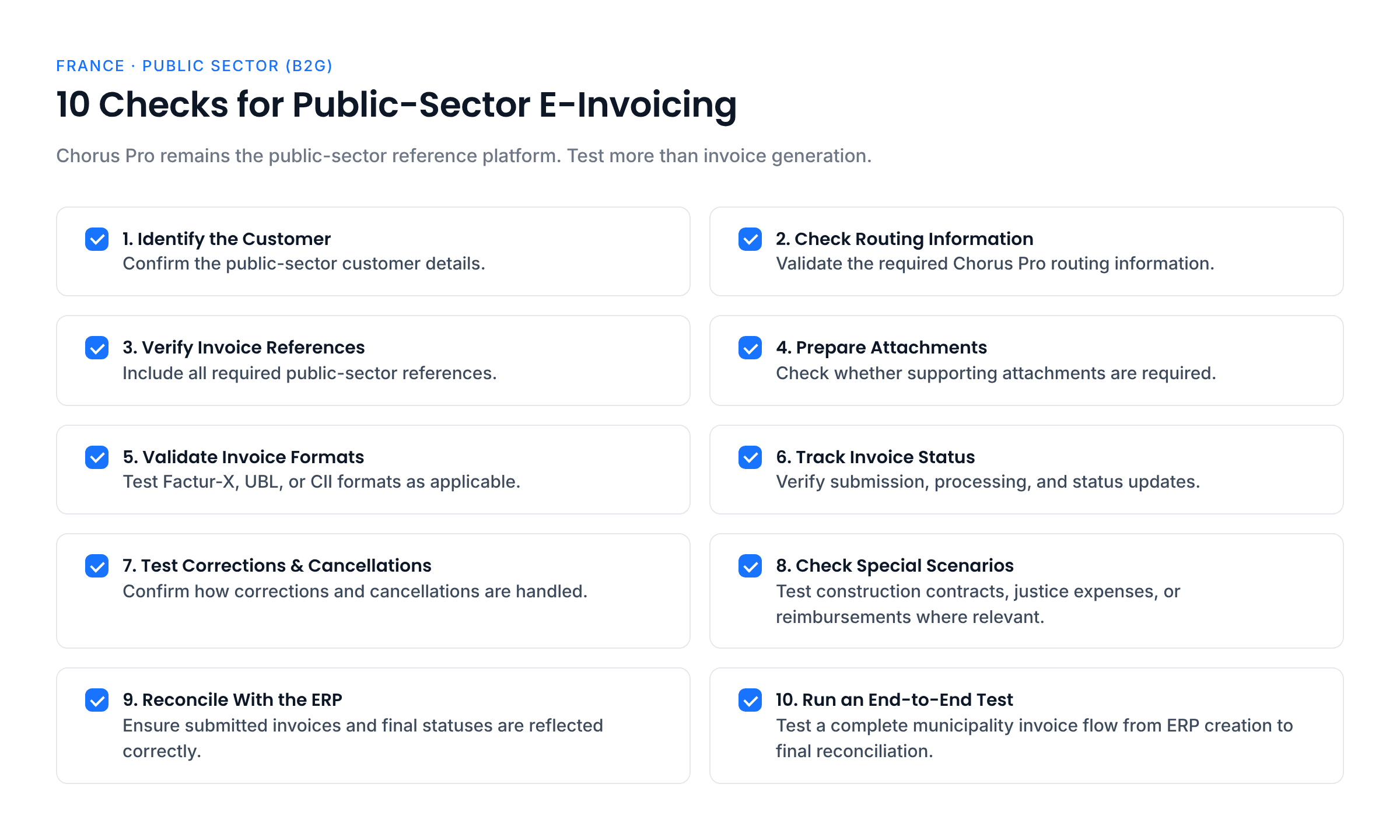
A supplier should test more than invoice generation.
Before go-live, check:
- Public-sector customer identification
- Chorus Pro routing information
- Required public-sector references
- Invoice attachments where applicable
- Factur-X, UBL, or CII validation
- Invoice status handling
- Corrections and cancellations
- Construction-contract scenarios where relevant
- Justice-expense or reimbursement flows where relevant
- ERP reconciliation after submission
A municipality invoice is a useful end-to-end test. Create the invoice in the ERP, send it through the selected route, verify the public-sector references and status updates, and reconcile the final result back into the ERP.
What Should Businesses With Both B2B and B2G Customers Do?
Businesses with both private and public customers should avoid creating two completely separate finance processes.
The ERP or billing system should identify the customer type and transaction characteristics.
The routing layer can then determine whether the transaction needs:
- Private-sector B2B e-invoicing through a PA
- Public-sector invoicing through Chorus Pro or an applicable PA route
- Consumer transaction e-reporting
- Cross-border e-reporting assessment
- Payment e-reporting where applicable
This approach keeps the source data central while allowing the regulatory route to vary.
How Does Complyance Fit?
Businesses can use Complyance as a technology layer connecting ERP and business systems with the required e-invoicing infrastructure.
For companies with both B2B and B2G activity, the important capability is managing the data and routing differences between private-sector and public-sector transactions.
The exact PA arrangement should be confirmed during implementation. Complyance should not be treated as a PA unless the applicable PA registration and legal arrangement have been verified.
For public-sector invoices, businesses should also confirm which flows continue to require Chorus Pro-specific handling.
A Simple Decision Framework
Before sending an invoice, ask:
- Is the customer a private business, public entity, consumer, or foreign customer?
- Is the transaction a qualifying French domestic B2B transaction?
- Does it fall under the public-sector invoicing route?
- Is the transaction subject to e-reporting instead?
- Does payment e-reporting apply?
- Which PA or Chorus Pro route is applicable?
- Are the required identifiers and references present?
- Has the exact transaction type been tested end to end?
This decision should be built into the system rather than left to manual processing.
Conclusion
Chorus Pro and Plateformes Agréées are part of France's electronic invoicing landscape, but they serve different roles.
Chorus Pro remains the public-sector reference platform. PAs provide the regulated private-sector B2B e-invoicing and applicable e-reporting layer.
For businesses selling to both public and private customers, the right approach is to keep the source data connected while allowing the transaction type and customer determine the routing.
That makes the ERP, integration layer, PA arrangement, and Chorus Pro process work together instead of treating them as competing systems.
Frequently Asked Questions
Chorus Pro is the public-sector reference platform operated by AIFE. It is not a commercial PA selected by private businesses under the private-sector B2B model.
No. Chorus Pro remains the reference platform for public-sector electronic invoicing.
Yes. From September 2026, suppliers can continue using Chorus Pro's established portal, EDI, and API channels. These remain accessible for suppliers invoicing public bodies.
Yes, in applicable cases. However, certain public-sector-specific processes remain tied to Chorus Pro.
No. Public-sector processes can have specific requirements and exceptions. Construction-contract invoices, justice-expense claims, reimbursement requests, and public-sector legal-commitment reference management require particular attention.
It should assess its actual transaction mix. If it also has in-scope private-sector B2B or e-reporting obligations, it needs the appropriate PA arrangement. A business invoicing only public-sector customers should assess its Chorus Pro obligations and any separate e-reporting position.
About the Author

Swathy
Content Marketer
I’m a Content Marketer at Complyance, focused on e-invoicing. Over the years, I’ve created a wide range of content, including blog posts, whitepapers, and product guides, which have supported Complyance’s growth across markets such as the UAE and EU regions. My goal is to deliver content that is comprehensive, clear, accurate, and easy to understand, no matter how complex the topic.