How to Connect Your ERP to a France E-Invoicing Platform

Connecting an ERP to France e-invoicing does not normally mean replacing the ERP.
Table of Contents
Introduction
Connecting an ERP to France e-invoicing does not normally mean replacing the ERP.
The practical task is to connect the business data already held in the ERP and other systems to the French e-invoicing infrastructure, while keeping invoice creation, accounting and business workflows stable.
A good implementation starts with data and process mapping. The technology architecture comes after the business understands where invoice, tax, customer, payment and reporting data already lives.
Start With the Existing ERP Architecture
First document the current landscape.
Identify the ERP, accounting system, billing application, tax engine, CRM, POS, e-commerce platform and payment systems involved in invoicing or reporting.
Then identify which system owns each important field.
For example, the ERP may own customer and invoice records, a tax engine may determine VAT treatment, a POS may hold B2C sales, and a payment gateway may hold collection information.
This prevents the project from assuming that every French reporting field exists in one database.
Choose the Integration Architecture
There are several practical patterns.
An ERP can connect directly to a PA when its technical capabilities and the PA interface support that model.
An integration layer can sit between the ERP and PA and manage mapping, validation and exchange.
A compatible business solution can also connect to a PA while the ERP continues to manage the underlying commercial records.
The right choice depends on the ERP, number of systems, countries covered, data quality, internal development resources and the PA selected.
The architecture should make responsibilities clear. The ERP remains the business system of record, while the integration layer and PA handle the regulatory transformation and exchange functions assigned to them.
Build an ERP Field Map
Do not begin with a generic invoice template. Build a field-level map.
| ERP or source field | French integration requirement |
|---|---|
| Seller legal entity | Seller identity, VAT details and applicable SIREN |
| Customer legal entity | Buyer identity and buyer SIREN where required |
| Customer establishment | SIRET and internal routing information where applicable |
| Invoice number | Unique invoice identifier |
| Invoice date | Issue date |
| Invoice lines | Description, quantity, unit price, tax category and line amounts |
| Tax code | VAT rate, exemption, reverse charge or other applicable treatment |
| Totals | Tax-exclusive total, VAT by rate and tax-inclusive total |
| Transaction category | Goods, services or mixed operation |
| Delivery address | Complete address where different from billing address |
| Payment data | Payment terms, method and collection information where relevant |
| Reporting classification | Domestic B2B e-invoice, B2C reporting, international reporting or payment reporting |
The French administration identifies additional invoice data requirements including the customer SIREN, transaction category, the VAT-on-debits option where applicable, and a complete delivery address where different from the billing address.
The business should also assign owners for master-data governance, tax-code mapping, identifier validation and change management.
Do Not Forget Inbound Invoices
Reception needs to be designed alongside outbound invoicing.
All businesses established in France and concerned by the reform must be able to receive e-invoices from 1 September 2026.
The inbound process should receive the structured invoice through the PA or compatible solution, preserve the original structured payload and readable representation, validate the supplier and buyer information, check totals and tax data, detect duplicates and pass the invoice into accounts payable.
The business should also retain the PA and message identifiers with the ERP record.
This supports matching against purchase orders, goods receipts, contracts or approval workflows and gives finance teams a clear record when an invoice is rejected, corrected or credited.
A normal PDF can still be useful as a visual business document, but it is not a replacement for the regulated structured e-invoice flow.
Formally Designate the Receiving PA
Connecting an ERP to a PA is not the only setup step.
The business must formally designate its receiving PA, either directly or through an explicit mandate to an accountant, software provider or other intermediary.
This designation allows the relevant receiving address to be maintained in the central directory so suppliers can route invoices correctly.
The implementation plan should therefore include PA designation and directory data, not just API credentials.
Routing and Directory Data
French invoice routing uses directory information and identifiers such as SIREN, SIRET and the applicable addressing line.
The ERP integration should therefore maintain customer and supplier master data with enough detail to support the required routing level.
A customer record that contains only a legal name and postal address may not be sufficient for regulated delivery.
When routing information changes, the master-data process should provide a controlled way to update the ERP or integration layer before invoices are sent.
Connect E-Reporting Sources
The ERP may not contain every record needed for e-reporting.
A retailer can have B2C sales in a POS, online transactions in an e-commerce platform, B2B invoices in the ERP and payment information in a gateway or banking system.
The integration design should identify the system of record for each data set and define how the relevant information is consolidated.
International reporting also needs careful classification. Exports, exempt intra-EU supplies, acquisitions, reverse-charge transactions and other VAT treatments should not be treated as one generic international category.
Test the Complete Process
Testing should follow real business scenarios, not only a successful invoice creation test.
Test:
- Outbound B2B invoice
- Inbound invoice
- Rejected invoice
- Corrected invoice
- Credit note
- Routing error
- Duplicate invoice
- B2C reporting where applicable
- International reporting where applicable
- Payment reporting where applicable
For each test, confirm the source ERP record, transformed data, validation result, PA response, routing information and final status.
The objective is to prove that the business can recover when the process does not follow the happy path.
Keep the ERP as the Business System of Record
The integration layer does not need to replace the ERP.
The ERP can remain responsible for customers, products, invoices and accounting records, while the integration layer handles regulatory transformation and exchange.
This is particularly useful for groups operating several ERP systems. A common technology layer can centralise France-specific mapping and validation instead of distributing the same rules across every application.
What Changes for Finance Teams?
ERP integration changes daily operations as well as technology.
Accounts receivable teams need visibility into invoice submission and rejection states.
Accounts payable teams need to receive structured invoices and connect them to approval and accounting workflows.
Tax teams need confidence that transaction classification and reporting data are complete.
IT teams need monitoring, retry and recovery processes after go-live.
The project should therefore have clear owners across finance, tax, master data and technology.
Example: One ERP, Several Transaction Sources
Consider a group with one ERP, a French B2B sales process, a retail POS and an international e-commerce channel.
The ERP creates the French B2B invoice and holds the customer SIREN and accounting data. The POS produces consumer sales that may feed transaction e-reporting. The e-commerce platform identifies international transactions and their VAT treatment. A payment system supplies collection information where payment reporting applies.
The integration layer consolidates only the data required for each French flow. It does not turn every transaction into a domestic B2B e-invoice. The tax classification determines whether the record belongs to e-invoicing, transaction e-reporting, payment reporting or an exclusion.
This model also gives finance and IT teams a clear ownership structure. Each source system owns its business data, while the integration layer controls the mapping and validation needed before exchange through the PA.
How Complyance Can Fit
Complyance can provide a technology and integration layer connecting existing ERP and business systems with the French e-invoicing infrastructure.
For France, the exact PA arrangement, supported formats, API functions and reporting responsibilities should be confirmed for the intended deployment.
This approach allows the business to keep its existing ERP while using an integration layer to manage France-specific data transformation, validation, routing and exchange.
ERP Go-Live Checklist
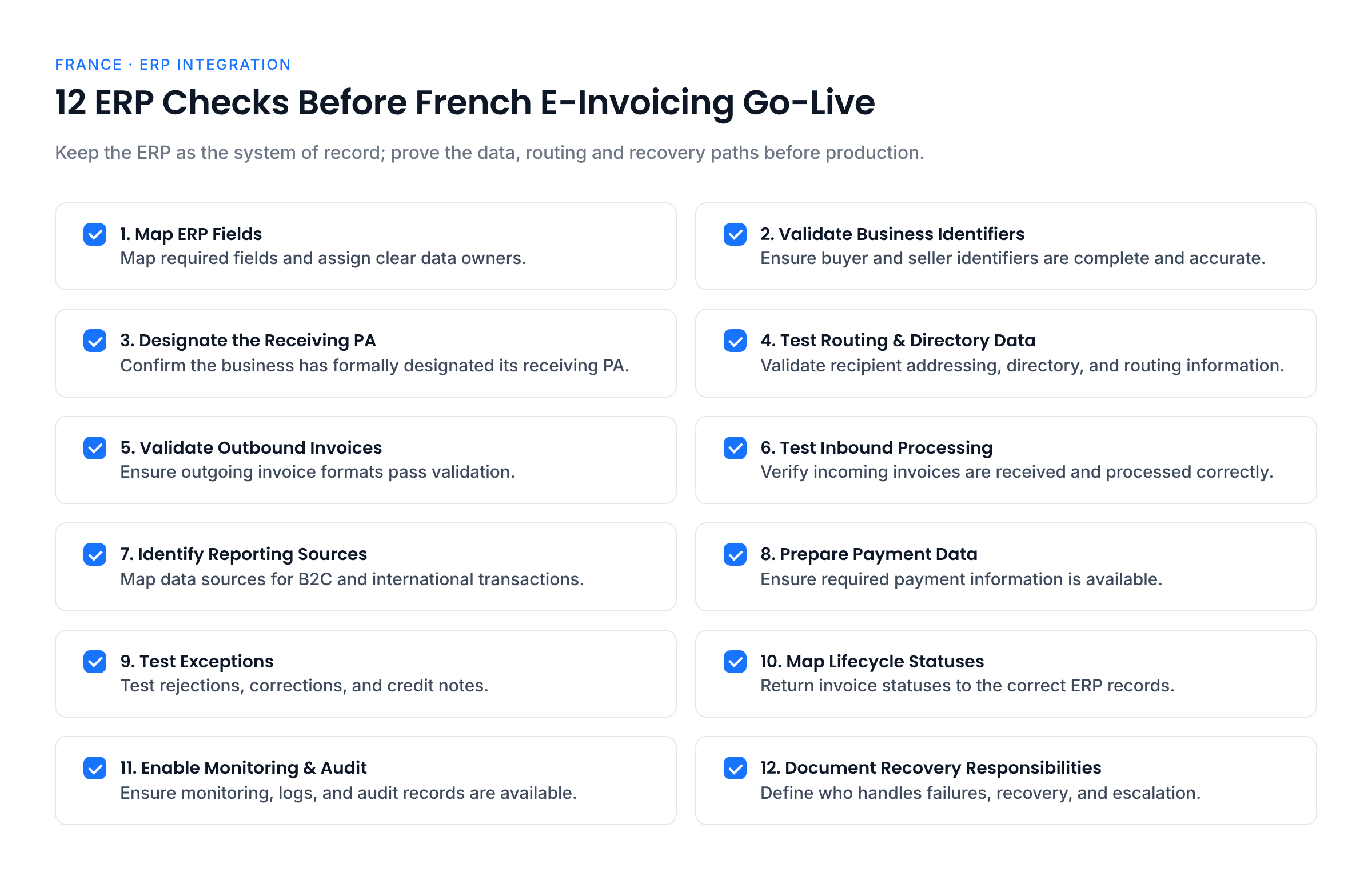
Before production, confirm:
- ERP fields are mapped and data owners are assigned
- Buyer and seller identifiers are complete
- Receiving PA has been formally designated
- Directory and routing information is tested
- Outbound invoice formats validate
- Inbound processing is tested
- B2C and international reporting sources are identified
- Payment data is available where required
- Rejections, corrections and credit notes are tested
- Lifecycle statuses return to the correct ERP record
- Monitoring and audit records are available
- Recovery responsibilities are documented
Conclusion
Connecting an ERP to France e-invoicing is mainly a data and process integration project.
The ERP does not need to be replaced simply because the regulatory process changes. What matters is connecting the right source data to the right validation, routing, PA exchange and reporting processes.
Starting with field mapping, master data and inbound processing gives the project a stronger foundation than starting with an API endpoint alone.
Official Sources
DGFiP reform and data requirements
About the Author

Swathy
Content Marketer
I’m a Content Marketer at Complyance, focused on e-invoicing. Over the years, I’ve created a wide range of content, including blog posts, whitepapers, and product guides, which have supported Complyance’s growth across markets such as the UAE and EU regions. My goal is to deliver content that is comprehensive, clear, accurate, and easy to understand, no matter how complex the topic.