Factur-X in France: Format, Structure and Requirements

Factur-X is one of the formats businesses can use for France's electronic invoicing reform. It is different from a normal PDF because it combines a readable invoice with structured invoice data that software can process.
Table of Contents
Introduction
Factur-X is one of the formats businesses can use for France's electronic invoicing reform. It is different from a normal PDF because it combines a readable invoice with structured invoice data that software can process.
For businesses preparing for France e-invoicing, Factur-X matters because it works for both people and systems. The PDF is readable, while the embedded XML carries structured data for automated processing.
Key Takeaways
Factur-X combines a readable PDF/A-3 invoice with embedded structured XML. It uses the UN/CEFACT CII syntax and fits within the EN 16931 framework. Businesses need to select the appropriate profile, validate the data and connect their invoice workflow with the regulated exchange infrastructure.
What Is Factur-X?
Factur-X is a hybrid invoice format designed to combine human readability with machine-readable data.
A Factur-X invoice contains a PDF/A-3 file that represents the invoice visually. Inside that PDF/A-3 file, a structured XML file contains invoice data that software can read and process.
This is different from simply sending a PDF by email. Under the French reform, a standard PDF sent by email does not qualify as an electronic invoice because the required structured data and regulated exchange process are missing.
Factur-X sits within the EN 16931 semantic framework and is one of the invoice syntaxes supported by the French technical framework, alongside UBL and UN/CEFACT CII.
How Is a Factur-X Invoice Built?
A Factur-X invoice has two connected representations.
The visual document
The PDF/A-3 file is the part a person can open and read. It contains the invoice as it would normally appear, including information such as:
- Seller and buyer details
- Invoice number and date
- Invoice lines and quantities
- Prices and taxes
- Invoice totals
- Payment information
- Other required invoice information
The French specifications state that the complete invoice information must be present in the readable PDF.
The structured XML
The embedded XML is designed for automated processing.
It carries structured invoice information using the UN/CEFACT CII syntax. Business software can read this information without relying on someone to manually extract values from the PDF.
The XML does not necessarily need to reproduce every piece of information shown in the PDF. Its role is to carry the information needed for automated processing under the selected profile.
One invoice, two representations
The PDF and XML are not two separate invoices. They are two representations of the same transaction.
This is important during implementation. If the PDF shows one amount while the structured data contains another, the invoice can create validation or processing problems.
Which Factur-X Profiles Are Used in France?
Factur-X supports different profiles because businesses do not all need the same level of structured information.
French technical documentation identifies Factur-X profiles including BASIC WL, BASIC, EN 16931 and EXTENDED. Current AFNOR material also identifies MINIMUM as an additional Factur-X profile.
| Profile | General role |
|---|---|
| MINIMUM | Carries a limited set of structured invoice information |
| BASIC WL | Provides structured information without line-level detail |
| BASIC | Provides a broader structured representation |
| EN 16931 | Implements the European semantic model used in the French framework |
| EXTENDED | Supports additional structured information beyond the EN 16931 profile |
The profile should be selected according to the current French specifications, business requirements and system capabilities. The key question is whether the solution can generate and validate the required profile correctly.
What Data Does Factur-X Need?
A Factur-X implementation needs more than a PDF template.
The structured data must represent the invoice information required by the applicable profile. Depending on the invoice and profile, structured data can include seller and buyer identification, invoice number and date, invoice lines, quantities, prices, tax information, totals, payment information and other required references.
France's electronic invoicing specifications also define French-specific business rules and data requirements.
Businesses should therefore map their ERP, accounting or billing fields to the required invoice data model before going live.
Is a Normal PDF the Same as Factur-X?
No.
A PDF can look exactly like a Factur-X invoice and still not be a Factur-X invoice.
A normal PDF is primarily a visual document. Factur-X adds structured XML data inside the PDF/A-3 container.
The French tax administration explicitly states that a PDF generated from an office application or a scanned invoice sent by email is not an electronic invoice under the reform.
Replacing email attachments with another PDF-generation tool does not by itself create a compliant electronic invoicing process.
How Does Factur-X Fit Into France E-Invoicing?
Factur-X is the invoice format. The Plateforme Agréée is part of the regulated exchange infrastructure.
Under the French model, businesses must use a Plateforme Agréée for the issuance and receipt of electronic invoices and for the relevant transmission of transaction and payment data.
A business can continue using its ERP, accounting software or billing application for its internal workflow. The architecture then needs to connect that system with the appropriate regulated platform.
A typical implementation has several technical stages:
- The business system creates the invoice information.
- The invoice data is mapped to the required format and profile.
- Factur-X is generated and validated where Factur-X is used.
- The Plateforme Agréée handles the regulated exchange process.
- The recipient's platform receives and processes the invoice.
The architecture depends on the company's systems, integration model and selected platform.
What Should Businesses Check Before Using Factur-X?
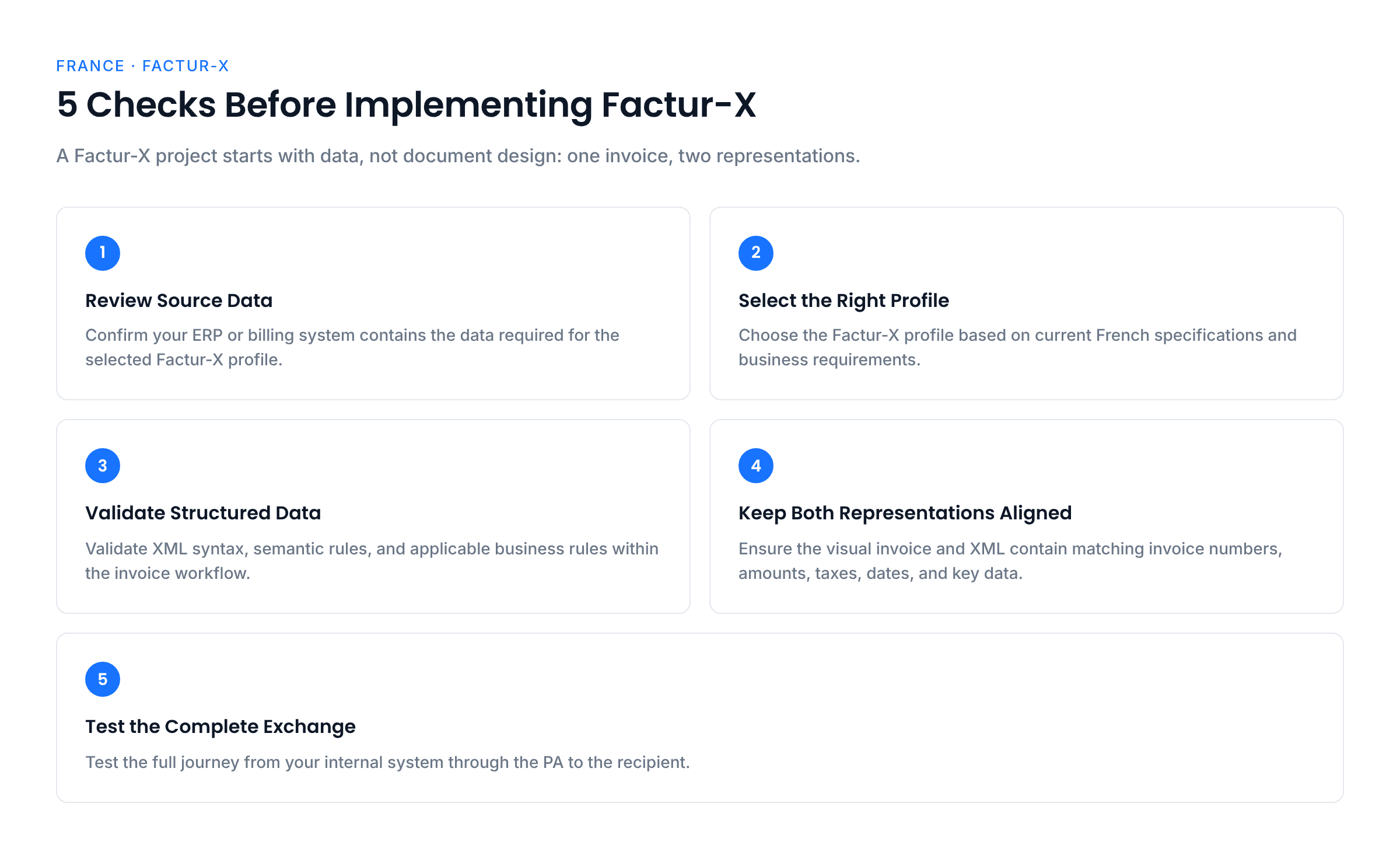
A successful Factur-X implementation starts with data, not document design.
Review your source data
Check whether your ERP or billing system already stores the information required for the selected profile.
Missing structured data often becomes an integration problem later.
Select the appropriate profile
Do not assume that every Factur-X invoice uses the same profile. The choice should reflect the current French specifications and the needs of the business.
Validate the structured data
The XML needs to comply with the applicable syntax, semantic rules and business rules. Validation should be part of the invoice workflow rather than a manual step at the end.
Keep both representations aligned
The visual invoice and structured data represent the same transaction. Your process should prevent differences in invoice number, amounts, tax values, dates or other important fields.
Test the complete exchange
Generating a technically valid file is only one part of implementation. Businesses should also test how invoices move from their internal system through the Plateforme Agréée to the recipient.
How Complyance Can Fit Into a Factur-X Architecture
Businesses do not necessarily need to replace their existing finance or ERP systems to prepare for electronic invoicing.
Complyance can serve as a technology layer between existing business systems and the French e-invoicing infrastructure. The implementation can focus on connecting invoice data, applying the required validation and transformation logic, and supporting electronic invoice exchange through the appropriate regulated platform.
For businesses already generating invoices from an ERP or accounting system, the practical objective is to connect existing data and workflows with the requirements of France's electronic invoicing framework.
Architecture depends on the source system, data availability, integration method and selected PA.
Conclusion
Factur-X brings together two important parts of electronic invoicing: a document that people can read and structured data that software can process.
Preparing for France e-invoicing is not simply about creating a PDF/A-3 file. Invoice data, the selected profile, validation rules, internal systems and regulated exchange infrastructure need to work together.
A practical implementation starts by mapping existing invoice data, selecting the appropriate Factur-X profile, validating the structured information and testing the complete exchange workflow.
With the right integration approach, businesses can keep their existing finance and ERP systems while connecting their invoice processes to France's electronic invoicing framework.
Frequently Asked Questions
Factur-X is one of the formats supported by France's electronic invoicing framework. It is not the only supported syntax. The French framework also includes UBL and UN/CEFACT CII.
No. Factur-X combines a PDF/A-3 visual representation with embedded structured XML data.
The Factur-X file is structurally different from an ordinary PDF, but France's regulated B2B e-invoicing process requires invoices to be exchanged through the appropriate Plateforme Agréée. Simply emailing a file does not replace that process.
It is the structured representation of the invoice. Factur-X uses the UN/CEFACT CII syntax for this structured data.
Yes. Factur-X is part of the French technical framework built around the European EN 16931 semantic model. The selected Factur-X profile determines how the structured information is represented.
It can, provided the ERP or connected solution supports the required Factur-X profile and applicable French validation rules. Businesses should confirm this with their software provider and test the complete integration before production use.
About the Author

Swathy
Content Marketer
I’m a Content Marketer at Complyance, focused on e-invoicing. Over the years, I’ve created a wide range of content, including blog posts, whitepapers, and product guides, which have supported Complyance’s growth across markets such as the UAE and EU regions. My goal is to deliver content that is comprehensive, clear, accurate, and easy to understand, no matter how complex the topic.