Factur-X vs UBL vs CII: France E-Invoice Formats Compared

Choosing an e-invoice format is an important part of preparing for France e-invoicing.
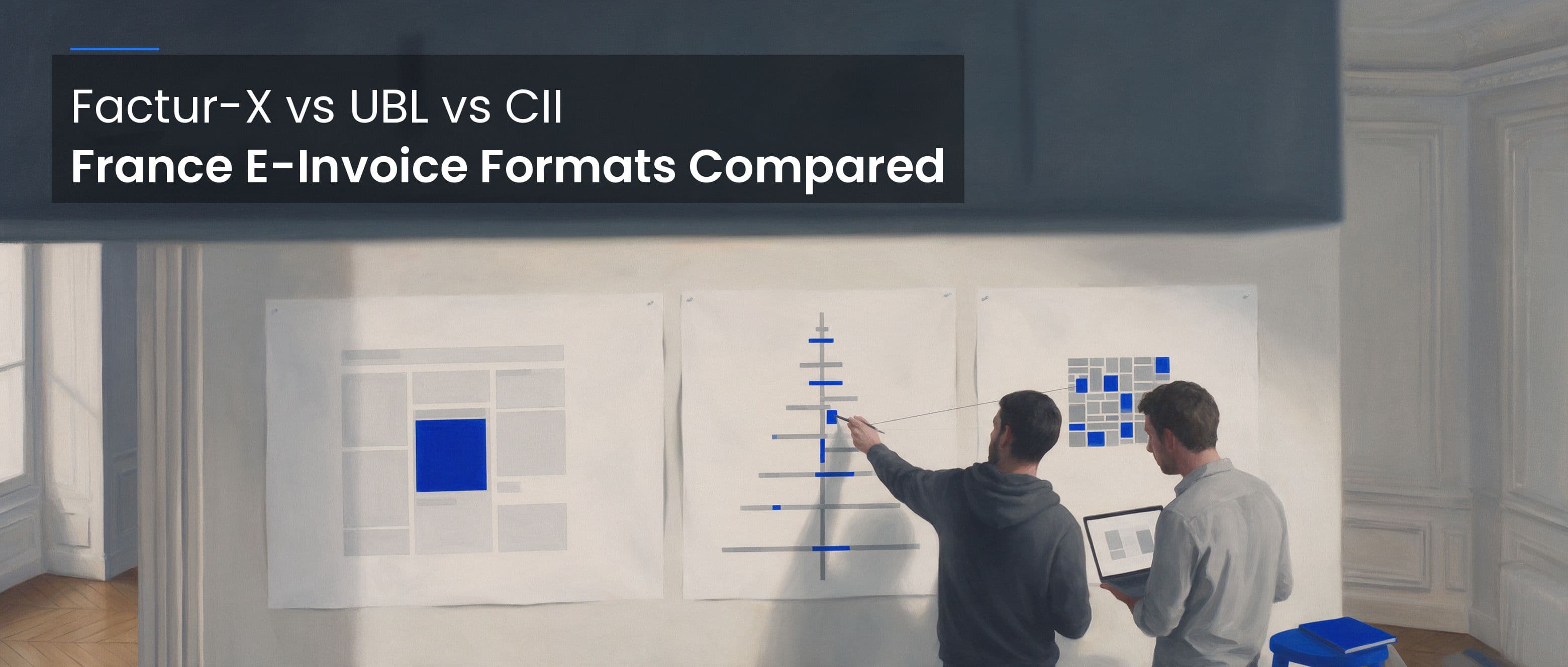
Table of Contents
Introduction
Choosing an e-invoice format is an important part of preparing for France e-invoicing.
The French technical framework supports three invoice formats for the reform: Factur-X, UBL and UN/CEFACT CII. They all carry structured invoice information, but they do not present that information in the same way.
This guide compares the three formats without turning the choice into a one-size-fits-all decision.
At a Glance
| Format | What it is | Main characteristic | Typical technical fit |
|---|---|---|---|
| **Factur-X** | Hybrid PDF + XML | Human-readable PDF with structured XML | Businesses that need a visual invoice alongside structured data |
| **UBL** | Structured XML | Machine-readable business document | ERP and system-to-system processing |
| **CII** | Structured XML | UN/CEFACT Cross Industry Invoice | Businesses using CII-based invoice data models or integrations |
All three formats are in the French minimum technical framework. The current French specifications define the relevant profiles and syntax requirements for implementation.
What Do UBL, CII and Factur-X Actually Mean?
Before comparing them, it helps to understand what each format is.
UBL
UBL stands for Universal Business Language. It is an XML-based standard developed by OASIS.
For France's e-invoicing framework, the relevant invoice syntax is UBL 2.1. An invoice is represented as structured XML, allowing software systems to process the information directly.
UBL does not depend on a visual PDF as the invoice representation.
This makes it particularly relevant for businesses whose ERP or finance systems already work with structured XML documents.
CII
CII stands for Cross Industry Invoice. It is an XML-based syntax developed through UN/CEFACT.
France's current technical framework uses the UN/CEFACT CII D22B language version for the reform.
Like UBL, CII is designed for structured machine-to-machine processing. The invoice is represented as structured data rather than as a PDF with embedded XML.
CII can be relevant where existing ERP, finance or international electronic invoicing environments already use UN/CEFACT structures.
Factur-X
Factur-X takes a different approach.
It combines a PDF/A-3 visual invoice with embedded structured XML. The XML uses the UN/CEFACT CII syntax.
This means a recipient can open the PDF and read the invoice while software can access the structured data inside the file.
Factur-X is therefore often described as a hybrid or mixed invoice format.
The Main Difference: How the Invoice Is Represented
The simplest way to understand the distinction is to look at the invoice itself.
With UBL, the invoice is structured XML.
With CII, the invoice is structured XML.
With Factur-X, the invoice is a PDF/A-3 document containing structured XML.
That difference affects how businesses generate, validate, store and process invoices.
For example, a company with a highly automated ERP-to-ERP process may work naturally with a structured XML syntax. Another company may prefer a hybrid format because finance teams and customers still need a familiar visual representation.
Factur-X vs UBL vs CII: Detailed Comparison
| Area | Factur-X | UBL | CII |
|---|---|---|---|
| Data structure | XML embedded in PDF/A-3 | XML | XML |
| Human-readable invoice | Yes | Not inherently | Not inherently |
| Machine-readable data | Yes | Yes | Yes |
| XML syntax | UN/CEFACT CII | UBL 2.1 | UN/CEFACT CII D22B |
| EN 16931 foundation | Yes | Yes | Yes |
| PDF container | Yes | No | No |
| Useful for automated processing | Yes | Yes | Yes |
| Suitable for ERP integration | Yes | Yes | Yes |
| French reform support | Yes | Yes | Yes |
What Does EN 16931 Have to Do With These Formats?
EN 16931 is the European semantic standard for electronic invoices.
A semantic model defines what invoice information means, such as the invoice number, seller, buyer, tax amount and total amount. The syntax then determines how that information is represented technically.
This distinction matters.
UBL and CII are XML syntaxes. Factur-X is a hybrid format using a PDF/A-3 container with structured CII XML.
For the French reform, these formats implement EN 16931-based requirements and French adaptations.
So businesses should not think of the choice as selecting three completely unrelated invoice models. They are different technical representations within the same broader electronic invoicing framework.
Which Format Works Best With an ERP?
There is no single format that fits every ERP environment.
The better question is what your existing system already produces and what your integration layer can reliably support.
If your ERP already produces UBL
Continuing with UBL may reduce unnecessary transformation work. Your integration layer can map the existing invoice data to the French requirements and apply the relevant validation rules.
If your ERP already uses CII
CII may fit naturally into the existing data model, especially where the business already exchanges CII-based electronic documents.
If your business works heavily with PDF invoices
Factur-X can provide a bridge between the familiar visual invoice and structured electronic data. However, the PDF should not become the only focus. The embedded XML must contain the structured information required by the applicable profile and rules.
The key implementation task is data mapping, not selecting a file extension.
Can Businesses Choose Any of the Three?
The French framework supports the three formats, but that does not mean a business should choose randomly.
The selected format needs to work with:
- The company's ERP or accounting system
- The invoice data available internally
- Customer and supplier requirements
- Existing integration standards
- Validation capabilities
- The chosen Plateforme Agréée
- Cross-border or international invoicing processes where relevant
Businesses should confirm the current profile and technical requirements before production implementation. The current official specifications are version 3.2, dated 30 April 2026.
What Happens During Validation?
Format is only one part of invoice validation.
France's technical specifications describe several levels of controls. These include technical checks, syntax checks for UBL, CII and Factur-X, semantic and functional checks, uniqueness checks, data consistency checks and addressing checks.
This matters because an invoice can have the correct file format and still fail because its data does not meet the applicable rules.
For example, having a valid XML structure does not automatically mean that the invoice contains all required information or that the buyer can be correctly addressed.
A production-ready implementation therefore needs both format support and business-rule validation.
Where Does the Plateforme Agréée Fit?
The invoice format and the Plateforme Agréée are separate concepts.
The format defines how the invoice data is represented.
The Plateforme Agréée is part of the regulated infrastructure used to issue and receive electronic invoices and transmit the relevant data to the administration.
French businesses are free to choose among the platforms registered by the tax administration.
This means a company can have an internal ERP, an integration or compatible solution, a selected invoice format and a Plateforme Agréée without those being the same product.
How Complyance Can Support the Format Layer
For businesses preparing for France e-invoicing, Complyance can act as a technology layer connecting existing business systems with the French e-invoicing infrastructure.
The practical focus is on the invoice data behind the document. Existing ERP or billing data can be connected, mapped to the required structure, validated and prepared for electronic exchange through the appropriate regulated platform.
The format depends on the company's data model, ERP capabilities, customer requirements and integration architecture.
Conclusion
Factur-X, UBL and CII all provide ways to represent structured electronic invoices within France's e-invoicing framework.
The key difference is how the invoice is packaged. UBL and CII are structured XML formats, while Factur-X combines a readable PDF/A-3 document with embedded CII XML.
The decision should start with existing ERP data, integration architecture and customer requirements.
Once the format is selected, businesses still need to address data mapping, validation, directory information and connection to their Plateforme Agréée.
That is what turns format support into a working France e-invoicing process.
Frequently Asked Questions
The French framework supports all three. The appropriate choice depends on the business's systems, data model, integration requirements and operational needs.
No. UBL is a structured XML syntax. It does not use a PDF as its invoice representation.
No. CII is a structured XML syntax. Factur-X uses CII structured data inside a PDF/A-3 hybrid invoice.
Yes. Factur-X embeds structured XML using the UN/CEFACT CII syntax.
The French minimum technical framework supports Factur-X, UBL and UN/CEFACT CII for invoice messages.
Yes. An ERP or connected integration layer can support multiple invoice formats where its capabilities allow it. The relevant French rules and validation requirements still need to be applied to the selected output.
About the Author

Swathy
Content Marketer
I’m a Content Marketer at Complyance, focused on e-invoicing. Over the years, I’ve created a wide range of content, including blog posts, whitepapers, and product guides, which have supported Complyance’s growth across markets such as the UAE and EU regions. My goal is to deliver content that is comprehensive, clear, accurate, and easy to understand, no matter how complex the topic.