France E-Invoicing for Foreign Companies: When Does It Apply?

France e-invoicing for foreign companies is not a simple question of whether a business sells to France.
Table of Contents
Introduction
France e-invoicing for foreign companies is not a simple question of whether a business sells to France.
The correct analysis starts with the company's VAT establishment status, the transaction location, the role of the company in the transaction, the customer type and who is liable for French VAT.
A foreign company without a French establishment within the meaning of VAT is outside the French domestic e-invoicing issuance and receipt obligation. It can still have French e-reporting obligations for transactions located in France where it is liable for French VAT.
French VAT Establishment Is the Key Distinction
A French VAT registration number is not the same thing as a French VAT permanent establishment.
For this reform, the business should determine whether it has an establishment in France within the meaning of VAT. A postal address, French customer, warehouse or VAT registration should not automatically be treated as a permanent establishment.
A foreign group operating through a French VAT establishment can fall within the domestic French e-invoicing framework for qualifying transactions carried out through that establishment.
A foreign company without such an establishment is treated differently and generally looks first to e-reporting rather than domestic B2B e-invoicing.
Foreign Company Without a French VAT Establishment
A foreign company without a French VAT establishment is not subject to the French domestic e-invoicing issuance and receipt obligation.
It can nevertheless be subject to transaction and payment e-reporting for operations located in France where it is liable for French VAT, subject to the relevant exclusions and special schemes.
Relevant situations can include taxable B2B international operations, taxable supplies to non-taxable persons, certain domestic sales by non-established businesses, and other transactions for which French VAT is due.
The analysis must be transaction-specific. Not every transaction involving a French customer is reportable.
Transactions That Need Careful Classification
A foreign business should distinguish several categories.
Foreign company to French business: determine whether the French customer accounts for VAT through reverse charge or whether the foreign supplier is liable for French VAT. The reporting responsibility can change accordingly.
Foreign company to French consumer: determine whether French VAT is due, who is liable for it and whether an applicable European VAT One Stop Shop scheme changes the French reporting obligation.
Foreign company acquiring goods or services in France: determine whether the acquisition is subject to French VAT and whether reverse-charge or intra-EU acquisition reporting applies.
Foreign company with a French VAT establishment: assess qualifying domestic B2B transactions through that establishment under the domestic e-invoicing framework.
Reverse Charge Can Change Who Reports
Consider a foreign software company providing a service to a French VAT-registered business.
If the French customer is liable for French VAT under reverse charge, the foreign supplier generally does not report the sale as a supplier-liable French VAT transaction. The French customer's reporting treatment must then be assessed, including the specific 1 September 2027 timetable for relevant reverse-charge purchases.
If instead the foreign supplier is liable for French VAT, the supplier's own e-reporting obligations need to be assessed.
The important point is that the seller, buyer and VAT debtor are not always the same party.
B2C Transactions and OSS or IOSS
B2C transactions require a separate assessment.
For foreign operators, the French administration identifies exclusions where qualifying B2C transactions are covered by an applicable EU VAT One Stop Shop scheme.
OSS can cover certain intra-EU B2C supplies, including relevant distance sales and services.
IOSS applies to eligible imported low-value goods.
Where a foreign operator is registered under the applicable EU VAT One Stop Shop scheme, qualifying B2C transactions covered by that scheme are excluded from French transaction e-reporting.
The exclusion does not automatically cover unrelated French transactions, reverse-charge purchases, domestic B2B operations or payment data outside the scheme.
OSS or IOSS participation should therefore be assessed transaction by transaction.
Exclusions Matter Too
A foreign company should not classify every international transaction as reportable.
The French guidance identifies important exclusions, including exports and exempt intra-EU supplies for transaction e-reporting.
Imports and other transactions can have their own VAT treatment and reporting rules, so they should be mapped separately rather than grouped under one international-sales category.
A simple example is an exempt intra-EU supply. Its treatment is not the same as a taxable domestic sale in France merely because the customer or supplier is in another EU country.
E-Reporting Deadlines for Foreign Companies
Foreign companies without a French VAT establishment do not enter the domestic e-invoicing issuance and receipt obligation. Their e-reporting timetable depends on their role in the transaction.
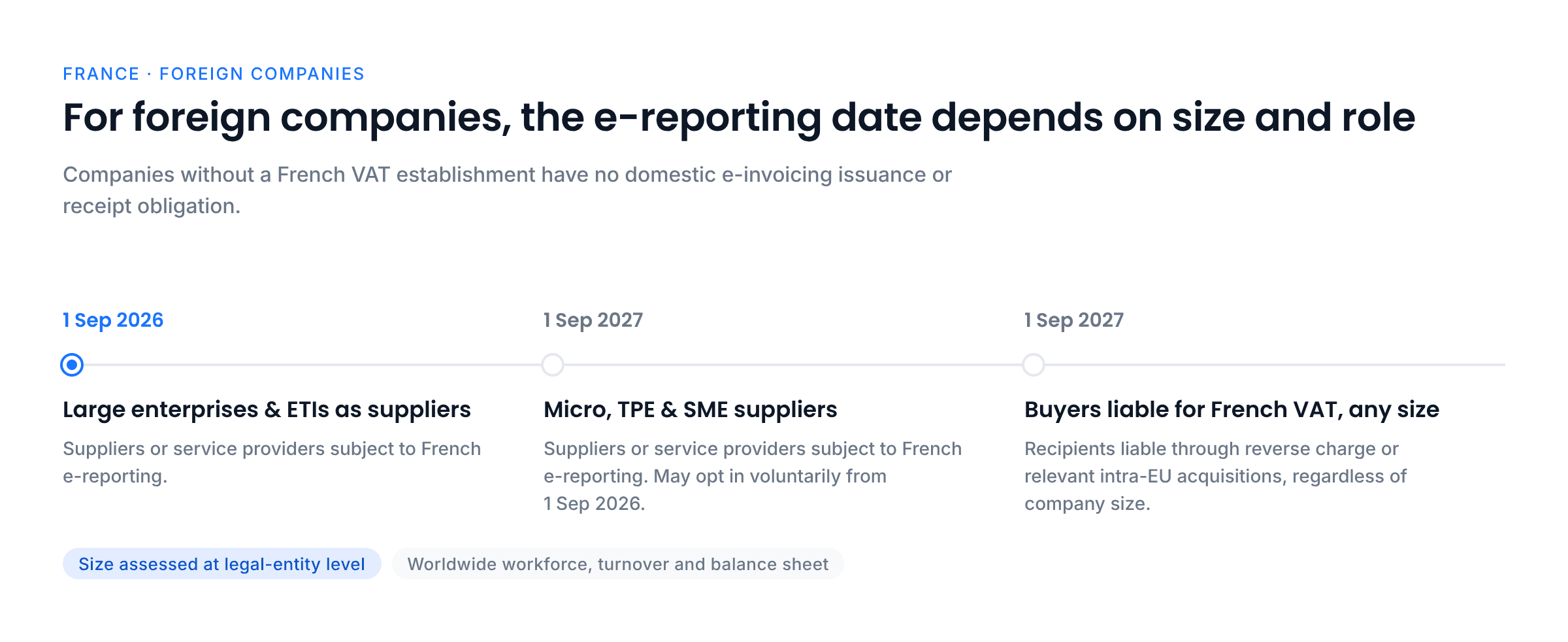
- 1 September 2026: large enterprises and ETIs that are suppliers or service providers subject to French e-reporting.
- 1 September 2027: micro-enterprises, TPEs and SMEs that are suppliers or service providers subject to French e-reporting.
- 1 September 2027: foreign companies acting as buyers or service recipients liable for French VAT through reverse charge or relevant intra-EU acquisitions, regardless of company size.
Smaller foreign suppliers may voluntarily anticipate their reporting from 1 September 2026.
Company size is assessed at the legal-entity level, using the company's global workforce, turnover and balance-sheet criteria, not only its French activity.
Does a Foreign Company Need a PA?
A foreign company must choose a PA if it has a French e-reporting obligation.
It does not need to select a PA solely because it has a French customer or a French VAT number when it has no reportable French VAT transaction.
Before selecting a PA, confirm:
- Definitive PA registration status
- E-reporting capabilities
- Integration methods
- Supported data formats
- Handling of foreign identifiers
- Payment-reporting capabilities
- Monitoring and error handling
- Data retention and export
Foreign Identifiers and the French Directory
A foreign company without a French SIREN should not invent one simply because an integration field expects one.
Where no SIREN exists, the applicable foreign VAT or other foreign identification number is used according to the French reporting requirements.
A foreign company subject only to e-reporting is not necessarily required to appear in the French e-invoicing directory. A foreign business can be listed where it has a SIREN and needs to receive e-invoices voluntarily, but directory presence does not itself create a domestic e-invoicing obligation.
Conversely, a foreign company can have e-reporting obligations without being listed as a receiving entity in the directory.
Payment E-Reporting
Payment reporting should be assessed separately from transaction reporting.
It can concern services and advances on goods where French VAT becomes chargeable on collection.
Payment e-reporting does not apply where the supplier has opted for VAT on debits or where the transaction is subject to reverse charge.
This distinction matters for foreign service businesses whose French VAT treatment depends on when payment is collected.
International ERP Integration
Most international groups will keep their global ERP rather than create a separate French finance system.
The ERP or tax architecture should identify the legal entity, customer type, transaction location, VAT treatment and role in the transaction, supplier or buyer.
The integration layer can then prepare the French reporting data and connect it to the selected PA.
Complyance can provide an integration and technology layer between existing business systems and the French e-invoicing infrastructure. The exact PA arrangement, supported formats, API functions and reporting responsibilities should be confirmed for the intended deployment.
Practical Scope Checklist
Before implementation, answer:
- Does the group have a French VAT establishment?
- Which legal entity performs the transaction?
- Is the company the supplier or the buyer?
- Where is the transaction considered to take place for VAT?
- Who is liable for French VAT?
- Is the customer a business or consumer?
- Does reverse charge apply?
- Does OSS, IOSS or another special scheme apply?
- Is transaction e-reporting required?
- Is payment e-reporting required?
- Is a PA required for the reporting obligation?
Conclusion
For foreign companies, France e-invoicing compliance depends on the transaction, not simply on the location of the head office.
The practical sequence is to establish the French VAT establishment position, identify the transaction role and location, determine who is liable for French VAT, classify B2B or B2C treatment, check OSS or IOSS where relevant, and then determine the applicable e-reporting and PA requirements.
That approach gives international finance and technology teams a clear basis for designing the French reporting flow without applying domestic e-invoicing rules to transactions that do not belong in that scope.
Official Sources
DGFiP e-reporting for foreign companies without a French establishment
DGFiP reform overview and data requirements
Frequently Asked Questions
No. A foreign company without a French VAT establishment is outside the domestic French e-invoicing issuance and receipt obligation, but it can still have e-reporting obligations.
No. VAT registration and a French VAT permanent establishment are not the same test.
No. Exports are excluded from transaction e-reporting under the French foreign-business guidance.
They are excluded from transaction e-reporting. Other intra-EU transactions can have different treatment, so acquisitions and reverse-charge cases must be assessed separately.
Yes, where the relevant French VAT is due on collection and the transaction is not excluded by the VAT-on-debits or reverse-charge rules.
About the Author

Swathy
Content Marketer
I’m a Content Marketer at Complyance, focused on e-invoicing. Over the years, I’ve created a wide range of content, including blog posts, whitepapers, and product guides, which have supported Complyance’s growth across markets such as the UAE and EU regions. My goal is to deliver content that is comprehensive, clear, accurate, and easy to understand, no matter how complex the topic.