France E-Invoicing for Manufacturers: Preparing Invoice Data and Systems

Manufacturers often have complex invoice data spread across legal entities, plants, warehouses and sales organisations. Invoices may link to orders, deliveries, contracts, rebates and credit notes.
Table of Contents
Manufacturers often have complex invoice data spread across legal entities, plants, warehouses and sales organisations. Invoices may link to orders, deliveries, contracts, rebates and credit notes.
France facturation électronique therefore needs to be considered as part of the wider manufacturing data architecture.
Key Takeaways
- Map ERP, order, logistics and customer data before integration.
- Manage SIREN and applicable routing information carefully.
- Separate domestic B2B, cross-border and payment-reporting flows.
- Test pricing, delivery, credit notes, inbound invoices and exceptions.
Why Manufacturing Needs a Data-Led Approach
A manufacturing invoice may follow orders, production, goods issue, delivery and invoice creation. Payment or collection data matters separately where payment e-reporting applies.
Manufacturers should map this data chain before changing the transmission process.
1. Identify the Legal Entities in Scope
Large manufacturing groups may have several French companies, each with its own VAT position, SIREN, establishments, invoice numbering, ERP configuration and PA arrangement.
Do not treat the entire group as one technical entity. Start with a legal-entity inventory and map each entity to its invoicing systems and French obligations.
Businesses must use a PA directly or through a compatible solution connected to a PA for the regulated flows that apply to them.
2. Map the ERP Invoice Data
Manufacturers should identify where each invoice field comes from.
| Invoice information | Typical source |
|---|---|
| Seller and buyer legal entity, SIREN | ERP and customer master |
| SIRET and routing data, where applicable | Customer master |
| Invoice number and date | ERP billing |
| Product, quantity and unit price | Product, order or logistics systems |
| Tax treatment and VAT data | ERP or tax engine |
| Delivery address, where required | Logistics or order system |
| Payment terms and correction reference | Customer master and ERP |
The exact architecture varies, but every field should have an owner.
These are not automatically mandatory French e-invoice fields in every case. They may still be essential for purchase-order matching, customer acceptance, delivery reconciliation, rebate settlement, or credit-note processing. Examples include purchase-order and contract references, delivery-note references, batch or serial numbers, project references, freight charges, partial-delivery references, and original invoice links.
Distinguish baseline fields from conditional data. The baseline includes seller and buyer identifiers, invoice date and number, transaction category, tax-exclusive amounts, VAT data, and currency. Conditional data can include VAT numbers, delivery or completion date, correction reference, delivery address, rebates, freight charges, reverse-charge wording, and special VAT-regime information.
3. Customer Master Data Matters
Manufacturers often sell to large customers with several establishments. The invoice must contain the structured recipient data needed to match the customer's active Annuaire addressing line, which may operate at SIREN, SIRET, or internal routing-code level.
Review the legal name, customer SIREN, SIRET and internal routing data where applicable, VAT identifier, receiving PA, active addressing line, billing address, delivery address and internal customer account.
Master-data cleanup should happen before integration testing.
4. Delivery Data Can Affect the Invoice
Manufacturing invoices often relate to physical deliveries.
The delivery address may differ from the customer's billing address.
The French e-invoicing framework requires the structured delivery address where it differs from the customer's address. The published detailed-data timetable identifies this data as required no later than 1 September 2027, so manufacturers should prepare the source data and interface before that date.
A logistics system may be the authoritative source for delivery address, delivery date, quantity delivered and shipment references. The billing system should consume those values through a controlled interface. Distinguish French structured invoice fields from logistics data that remains in the ERP or supporting repository.
This matters for direct-to-customer delivery, third-party warehouses, drop shipments and multi-site customers.
5. Pricing and Tax Data
Manufacturing invoices can contain quantity discounts, contract prices, rebates, freight, handling charges, multiple VAT rates, zero-rated transactions and credit adjustments.
The integration should receive calculated values from the appropriate source and validate relationships between quantities, prices, taxable bases and VAT totals. The business remains responsible for the underlying tax treatment.
6. Domestic B2B and International Sales
Manufacturers frequently export or sell across Europe, but these transactions should not be routed using one generic French domestic B2B rule.
A French manufacturer selling goods to another VAT-taxable business established in France can fall within domestic B2B e-invoicing where the transaction is subject to French VAT and French invoicing rules.
A sale to a foreign customer requires separate classification. Depending on the transaction, it may be an export, an exempt intra-EU supply, a taxable cross-border operation, or another reportable category. Exports and exempt intra-EU supplies are generally excluded from transaction e-reporting, while certain other international operations may be reportable.
The system should therefore capture the customer’s country, customer VAT status, seller establishment, place-of-supply result, transaction category, export or intra-EU classification, reverse-charge treatment, and applicable reporting outcome.
7. Production and Warehouse Systems
Some manufacturers create invoice-relevant information outside the ERP, such as quantities or delivery references in manufacturing, warehouse, transport or logistics systems.
The integration architecture should identify the authoritative source for each field. A controlled data model is easier to validate and reconcile than manual copying between systems.
The invoice does not necessarily need every warehouse or transport field. The integration team should distinguish legally required invoice data, customer-required references, and internal reconciliation fields.
8. Credit Notes and Corrections
Manufacturing businesses may issue credit notes for quantity differences, price adjustments, returned goods, rebates, quality claims, settlements or invoice corrections. The e-invoicing process should preserve the link to the original invoice.
Depending on the invoice state and reason for adjustment, the process may involve a corrected invoice, credit note, cancellation and replacement, or commercial adjustment. Define the permitted process with the PA and ERP provider and reference the original invoice where French data rules require it.
Test full and partial credits, multiple VAT rates, credits after payment or correction, returned goods, reversal of an erroneous credit note, and duplicate-credit prevention.
9. Multi-Entity Manufacturing Groups
A group may operate several French legal entities on shared technology. The integration should keep entity-specific data separate.
Legal entities should use their own identifiers and invoice numbering, customer routing should be evaluated for the correct seller, PA configuration should be traceable to the relevant entity, and reporting records should identify the correct taxpayer.
A shared service centre does not automatically make multiple legal entities one reporting entity. Preserve the issuing or receiving entity, SIREN, VAT position, invoice sequence, PA arrangement and accounting record. The shared platform can centralise mappings and controls without merging taxpayer-level data or routing configuration.
This matters for multiple French subsidiaries, VAT groups or assujetti unique arrangements, shared AR teams, central procurement, separate manufacturing and distribution entities, and intercompany stock transfers. Treatment depends on the relevant French VAT structure and transaction.
10. Testing for Manufacturing
Test more than a standard invoice. Include multiple lines and VAT rates, different delivery addresses, partial deliveries, credit notes, price corrections, customers with multiple establishments, cross-border transactions, duplicate submissions, invalid routing, ERP failures, inbound invoices, and applicable e-reporting or payment-reporting scenarios.
Use real manufacturing transaction patterns rather than only generic sample invoices.
11. Reconciliation and Audit Trail
Manufacturers should reconcile the ERP invoice with the document exchanged through the PA.
Retain the ERP invoice number, source version, integration message ID, PA submission ID, validation and routing results, lifecycle statuses and accounting record. For inbound invoices, connect the supplier invoice and PA message to the accounts-payable record.
This gives finance teams a traceable record when an invoice is rejected or appears differently across systems.
How Complyance Can Fit
Complyance can provide a technology and integration layer between manufacturing ERP, order-management, logistics and finance systems and the French e-invoicing infrastructure.
This can support source-data mapping, validation, routing and electronic invoice exchange. For France, the exact PA arrangement, supported formats, API functions and reporting responsibilities should be confirmed for the intended deployment. Complyance should not be assumed to be the PA, a direct DGFiP transmitter, or the system that determines VAT treatment.
Manufacturers can therefore retain their core ERP and operational systems while adding an e-invoicing integration layer.
France E-Invoicing Checklist for Manufacturers
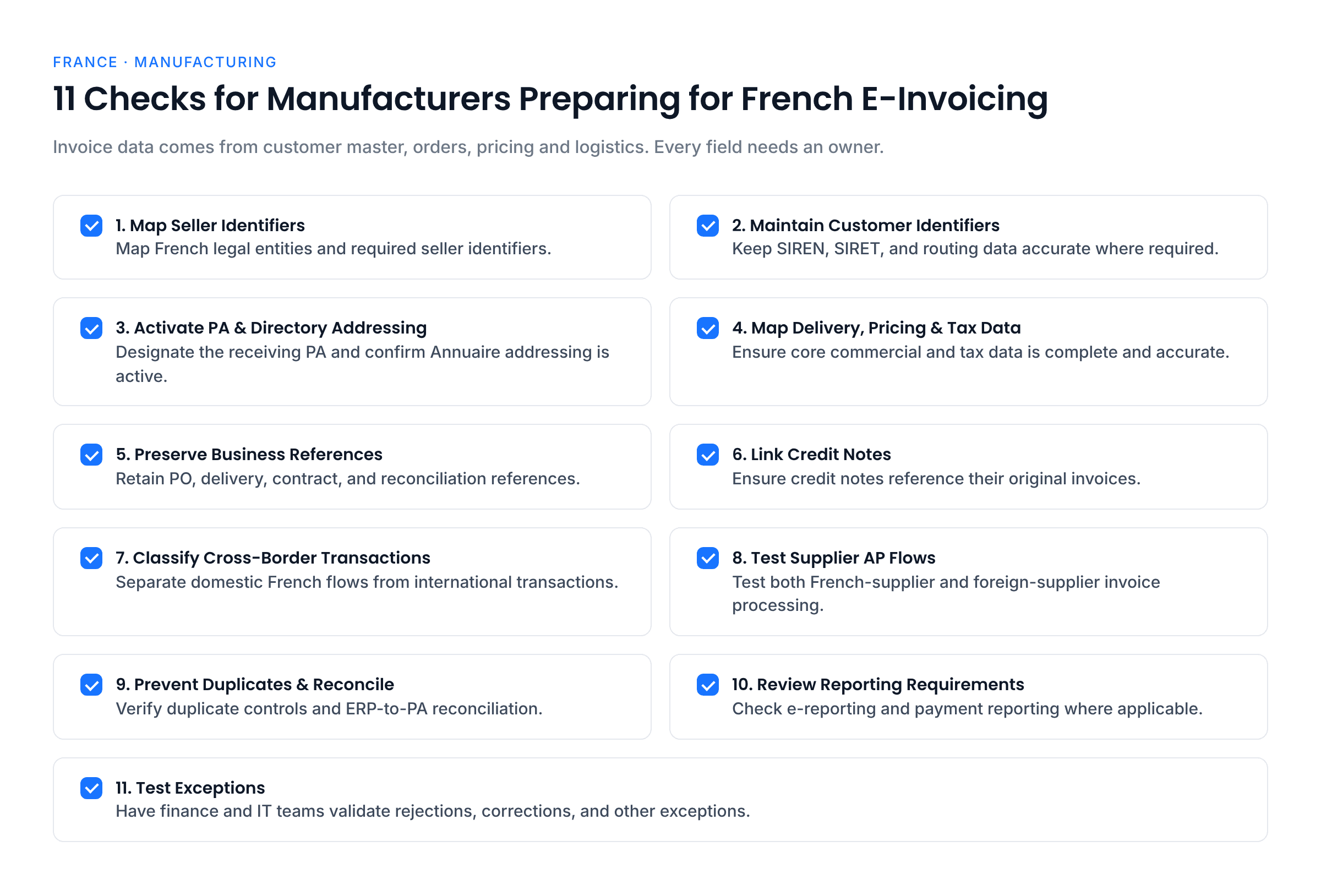
Before go-live, confirm:
- French legal entities and seller identifiers are mapped.
- Customer SIREN and applicable SIRET or routing data are maintained.
- The receiving PA is designated and the Annuaire addressing line is active.
- Delivery, pricing and tax data are mapped.
- Required PO, delivery, contract and reconciliation references are preserved.
- Credit notes reference original invoices.
- Cross-border transactions are classified separately.
- French-supplier and foreign-supplier AP flows are tested.
- Duplicate prevention and ERP-to-PA reconciliation work.
- E-reporting and payment reporting are reviewed where applicable.
- Finance and IT teams have tested exceptions.
Conclusion
France e-invoicing for manufacturers is a data integration project as much as an invoicing project.
The ERP may remain the system of record, but invoice information can come from customer master data, order management, pricing, logistics and production systems. Manufacturers should map these sources, clean their master data and test real transaction scenarios before production.
Official Sources
DGFiP technical specifications
About the Author

Swathy
Content Marketer
I’m a Content Marketer at Complyance, focused on e-invoicing. Over the years, I’ve created a wide range of content, including blog posts, whitepapers, and product guides, which have supported Complyance’s growth across markets such as the UAE and EU regions. My goal is to deliver content that is comprehensive, clear, accurate, and easy to understand, no matter how complex the topic.