France E-Invoicing for Retailers: POS, Omnichannel and E-Reporting

Retailers face a different France e-invoicing challenge from businesses that issue every invoice from one ERP.
Table of Contents
Retailers face a different France e-invoicing challenge from businesses that issue every invoice from one ERP.
A retailer may process sales through stores, websites, marketplaces, customer-service teams and wholesale channels. Some customers are businesses. Others are consumers. Some transactions are domestic. Others are cross-border.
That means facturation électronique readiness for retail starts with transaction classification and data sources, not only the invoice template.
Key Takeaways
- Retailers need to separate domestic B2B e-invoicing from B2C and cross-border reporting.
- POS systems can become important sources of e-reporting data.
- ERP, POS, e-commerce, marketplace and payment systems may all need to contribute data.
- High transaction volumes make data quality and automation important.
- Refunds, credit notes and corrections should be tested before go-live.
- B2B invoices need the required structured data and routing information.
- Payment data can matter for e-reporting in applicable situations.
- A technology layer can connect retail systems with the French e-invoicing infrastructure.
Why Retail E-Invoicing Is More Complex
A retailer rarely has one customer journey.
A consumer may buy a product in a store. Another customer may buy through the website. A French business may request an invoice after an online purchase. A wholesale customer may receive regular B2B invoices from the ERP.
These transactions can follow different French tax and reporting processes.
The key question is not simply, “Did the retailer issue an invoice?”
It is, “What type of transaction is this, who is the customer, where is the transaction treated for VAT, and which reporting process applies?”
1. Separate B2B and B2C Flows
Qualifying domestic B2B transactions between businesses established in France and subject to French VAT fall within the French e-invoicing framework.
Consumer transactions are different.
B2C sales can fall under transaction e-reporting where the relevant French VAT rules apply.
A retailer therefore needs to classify transactions before sending data into the appropriate flow.
For example:
| Transaction | Likely French process |
|---|---|
| French business buys from French retailer | Domestic B2B e-invoicing, where conditions apply |
| French consumer buys in store | Transaction e-reporting, where applicable |
| French consumer buys online | Transaction e-reporting, where applicable |
| Foreign business purchase | Cross-border VAT analysis and applicable reporting |
| Foreign consumer sale | VAT and e-reporting analysis |
The table is a starting point, not a substitute for transaction-level VAT analysis.
2. POS Systems Become Important
A retailer's POS system often contains the information needed to understand consumer sales.
That can include:
- Transaction date
- Store
- Product
- Quantity
- Net amount
- VAT rate
- VAT amount
- Payment method
- Refunds
- Customer information where captured
If the POS only sends a daily revenue figure to the ERP, the business should check whether the data available is sufficient for the applicable e-reporting requirements.
The solution is not necessarily to replace the POS.
Instead, the retailer should determine what data the POS can export and how that data can be classified and consolidated before reporting.
3. Omnichannel Makes Classification More Important
An omnichannel retailer may have:
- Physical stores
- Online shop
- Marketplace sales
- Click-and-collect
- Customer-service orders
- Wholesale sales
- B2B account portals
Each channel can produce different data.
The e-invoicing architecture should therefore have a common transaction model.
At minimum, capture:
- Legal entity
- Customer type
- Customer country
- VAT treatment
- Transaction category
- Sales channel
- Taxable amount
- VAT amount
- Payment information where applicable
This prevents each sales channel from creating its own interpretation of the French rules.
4. B2B Invoices Need Better Master Data
Retailers that sell to businesses need accurate customer master data.
For French B2B invoices, review:
- Customer legal name
- Customer SIREN where required
- Customer establishment and SIRET or addressing information where applicable
- Receiving PA
- Addressing line
- Billing address
- Delivery address when different
- VAT information
- Payment terms
This is especially important for large customers with several establishments.
A customer name alone is not enough to route a structured invoice reliably.
5. Refunds and Credit Notes Need Their Own Tests
Retail creates a high number of refunds.
A customer may return a product after the original sale. A partial refund may happen later. A cancelled order may create a credit note.
These events need to remain connected to the original transaction.
Test:
- Full refund
- Partial refund
- Return after invoice
- Order cancellation
- Credit note
- Price correction
- Duplicate refund
- Refund after payment
The accounting and reporting records should remain consistent.
Do not design refunds as a separate process owned only by the payment system. Finance, tax and technology teams need a common view of the original sale and the adjustment.
6. E-Commerce and Marketplaces
Online retail adds another source of transaction data.
The e-commerce platform may know the customer country and checkout status. A marketplace may hold order and payment data. The ERP may hold the accounting record.
The retailer needs to decide which system is the source for each field.
For example:
| Data | Possible source |
|---|---|
| Customer account | E-commerce or CRM |
| Product | ERP or product system |
| Tax treatment | Tax engine or ERP |
| Order | E-commerce |
| Invoice | ERP or billing system |
| Payment | Payment gateway |
| Accounting | ERP |
| Reporting status | E-invoicing technology layer |
This source-of-truth model reduces conflicting records.
7. Payment Reporting
Payment reporting can apply to specific transactions where French VAT becomes chargeable on collection, subject to the applicable exceptions.
Retailers should therefore understand whether any of their relevant transactions create a payment reporting requirement.
The payment gateway, acquirer or ERP may hold the necessary information.
Do not assume that every card payment needs to be reported individually. The reporting obligation depends on the applicable French rules and the transaction.
The system should instead be capable of identifying the transactions for which payment data is required.
8. High-Volume Processing
Retail systems can create thousands of transactions.
High volume creates technical risks:
- Duplicate messages
- Delayed batches
- Incomplete exports
- Incorrect aggregation
- Missing refunds
- Data mismatches between POS and ERP
- Reporting failures
The integration should support controlled processing and reconciliation.
For each reporting period, the retailer should be able to compare source transactions with the records prepared for transmission.
This is particularly important when several stores or sales channels feed the same reporting process.
9. Testing a Retail E-Invoicing Integration
A useful retail test plan includes:
Store transaction tests
Test normal sales, returns, discounts, multiple VAT rates and customer identification.
B2B tests
Test a French business customer, multiple establishments, correct routing and invoice correction.
E-commerce tests
Test consumer sales, cancellations, refunds and cross-border orders.
Marketplace tests
Test marketplace order data, seller-of-record arrangements and payment data where relevant.
Reconciliation tests
Compare POS, e-commerce, ERP and reporting records.
Failure tests
Test duplicate records, missing data, failed transmissions and retry handling.
Testing should use realistic transaction volumes where possible.
10. How Complyance Can Fit
Complyance can provide a technology and integration layer between retail systems and the French e-invoicing infrastructure.
This can help connect ERP, POS, e-commerce and other source systems, apply mapping and validation, and prepare the appropriate data for regulated exchange and reporting.
For France, the exact PA arrangement, supported formats, API functions and reporting responsibilities should be confirmed for the intended deployment.
The goal is to connect the retailer's existing systems without forcing every store, website or POS application to become its own French compliance system.
Retail France E-Invoicing Checklist
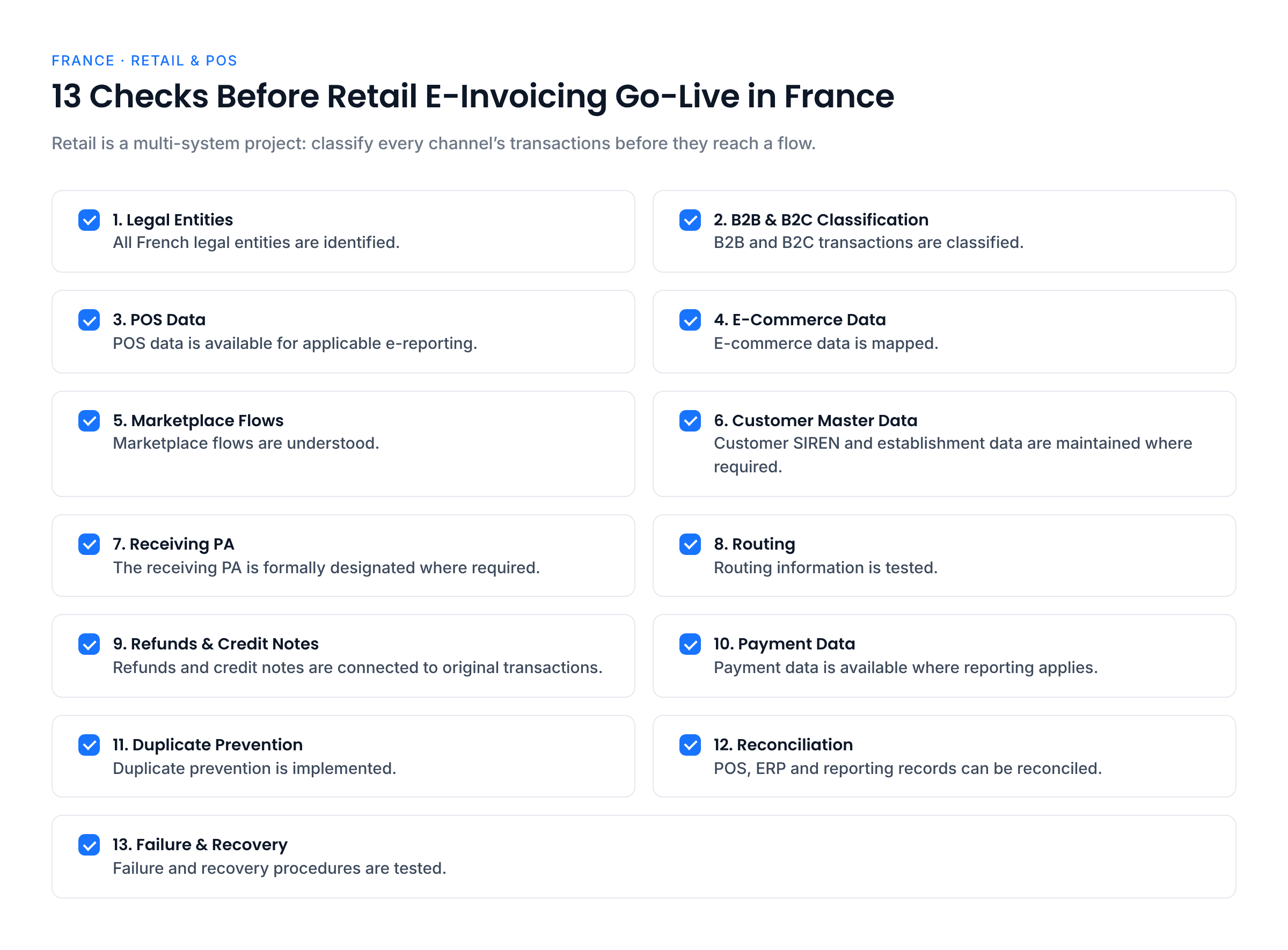
Before go-live, confirm:
- All French legal entities are identified.
- B2B and B2C transactions are classified.
- POS data is available for applicable e-reporting.
- E-commerce data is mapped.
- Marketplace flows are understood.
- Customer SIREN and establishment data are maintained where required.
- Receiving PA is formally designated where required.
- Routing information is tested.
- Refunds and credit notes are connected to original transactions.
- Payment data is available where reporting applies.
- Duplicate prevention is implemented.
- POS, ERP and reporting records can be reconciled.
- Failure and recovery procedures are tested.
Conclusion
France e-invoicing for retailers is a multi-system project.
The important work happens across the POS, e-commerce platform, ERP, customer master data, payment systems and reporting process.
Retailers that map their transaction types and data sources early can build a more reliable process for both B2B e-invoicing and e-reporting.
Official Sources
DGFiP, discover the French e-invoicing reform
DGFiP, e-invoicing and approved platforms
DGFiP, external e-invoicing specifications
Frequently Asked Questions
No. Domestic B2B e-invoicing and consumer transaction e-reporting are different processes.
No. A POS is a business system. Regulated exchange and reporting use the PA framework.
Yes. The reform does not by itself require an ERP replacement. The important question is whether the existing systems can provide the required data and connect to the relevant infrastructure.
Not automatically. The VAT treatment, transaction structure and parties involved determine the applicable process.
About the Author

Swathy
Content Marketer
I’m a Content Marketer at Complyance, focused on e-invoicing. Over the years, I’ve created a wide range of content, including blog posts, whitepapers, and product guides, which have supported Complyance’s growth across markets such as the UAE and EU regions. My goal is to deliver content that is comprehensive, clear, accurate, and easy to understand, no matter how complex the topic.