France E-Invoicing for SaaS and Digital Businesses

SaaS and digital businesses often have a billing model that looks simple on the surface. A customer subscribes, the system creates an invoice, and payment is collected.
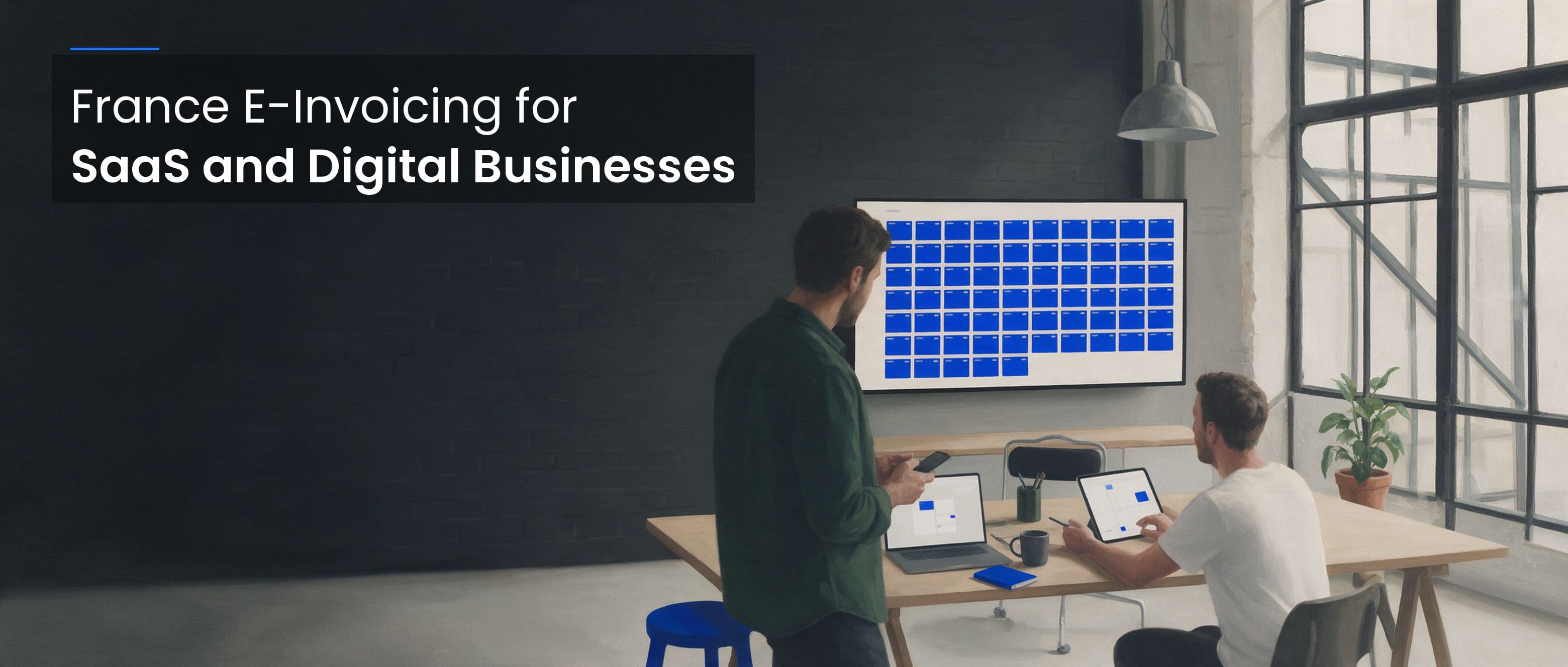
Table of Contents
SaaS and digital businesses often have a billing model that looks simple on the surface. A customer subscribes, the system creates an invoice, and payment is collected.
The reality can be more complicated.
A SaaS company may sell to French businesses, consumers, and customers in other countries. It may use a billing platform, CRM, payment provider, tax engine and ERP at the same time. That means France facturation électronique compliance depends on more than the invoice template.
This guide explains what SaaS and digital businesses need to review as France's e-invoicing reform takes effect.
Key Takeaways
- French domestic B2B e-invoicing depends on the parties, their establishment and French VAT treatment.
- B2C transactions can fall under transaction e-reporting rather than domestic B2B e-invoicing.
- Cross-border transactions require separate VAT classification.
- Subscription billing systems must capture the data needed for the applicable French flow.
- Payment information can matter for e-reporting in specific cases.
- CRM, billing, ERP, payment and tax systems may all contribute to compliance data.
- A technology layer can connect these systems without replacing the core billing or ERP environment.
Why SaaS Businesses Need a Different Approach
A traditional business may create most invoices from one ERP.
A SaaS company can have several systems involved in one customer transaction.
For example:
- CRM stores the customer account.
- Subscription billing stores the plan and billing cycle.
- Payment gateway records collection.
- Tax engine determines VAT treatment.
- ERP records accounting information.
- E-invoicing technology handles structured exchange.
If these systems are not connected, the business may have a correct invoice but incomplete reporting data.
France's reform makes transaction classification and data quality important.
When Does French E-Invoicing Apply to SaaS?
The French reform covers qualifying domestic B2B transactions between businesses established in France and subject to French VAT.
Consider a SaaS provider established in France.
It sells an annual software subscription to another French VAT-taxable company. Where the transaction meets the French domestic B2B conditions, the invoice falls within the e-invoicing framework.
Now change the customer to a French consumer.
That is not a domestic B2B e-invoice. The transaction may instead be subject to transaction e-reporting where the applicable French VAT rules require it.
Now consider a business customer in another country.
That transaction requires a separate VAT analysis. Depending on the nature of the service, customer status and place-of-supply rules, it may be reportable, excluded, or subject to another treatment.
The billing platform therefore needs transaction classification rather than one universal invoice rule.
Subscription Billing Creates Data Challenges
Recurring billing introduces several practical issues.
A subscription may generate:
- Monthly invoices
- Annual invoices
- Credit notes
- Prorated charges
- Upgrades
- Downgrades
- Refunds
- Discounts
- Usage-based charges
- Multiple tax rates
- Different customer establishments
The e-invoicing process needs to preserve the relationship between the commercial event and the invoice.
For example, if a customer upgrades halfway through a billing period, the billing system may create a prorated charge. The resulting invoice still needs accurate customer, tax, amount and transaction information.
If an invoice is later corrected, the correction should reference the original document correctly.
B2B, B2C and Cross-Border Customers
SaaS businesses often have all three customer types.
French B2B Customers
Qualifying domestic B2B invoices enter the French e-invoicing process.
The business should be ready to provide the required structured invoice data, customer identifiers and routing information.
French B2C Customers
Consumer sales are handled through transaction e-reporting where the relevant French VAT rules apply.
The source data may come from the billing platform, checkout system or payment system rather than the ERP.
Foreign Customers
Do not classify all foreign customers in the same way.
An EU business customer, a consumer in another country and a customer outside the EU can have different VAT treatments.
The billing system should therefore capture at least:
- Customer country
- Customer type
- VAT identifier where relevant
- Seller establishment
- Service type
- VAT treatment
- Transaction category
This information supports the later reporting decision.
What About OSS?
Digital businesses should also review whether transactions fall under an applicable EU One Stop Shop scheme.
OSS can apply to certain cross-border B2C supplies, including qualifying intra-EU supplies and services.
Where a transaction is properly covered by an applicable OSS scheme, it can be outside French transaction e-reporting. This does not mean that every international B2C sale is automatically outside French reporting.
The tax treatment needs to be established for each relevant transaction category.
For SaaS businesses, this makes tax classification a core part of the billing architecture.
Payment Data Can Matter
Invoice data is not always the end of the compliance process.
Payment e-reporting can apply to certain transactions where French VAT becomes chargeable on collection, subject to the applicable exceptions.
This can matter for SaaS and professional services models where the tax point depends on payment.
The payment gateway may therefore hold information needed by the reporting process.
A useful data model connects:
- Invoice ID
- Customer ID
- Transaction type
- VAT treatment
- Payment status
- Payment date
- Amount collected
- Refund or adjustment
The objective is not to report every payment in every situation. It is to make the relevant payment information available when the French rules require it.
What Systems Should Be Connected?
A SaaS business should map its source systems before choosing an integration approach.
| System | Typical data |
|---|---|
| CRM | Customer account, legal entity, country |
| Billing platform | Invoice, subscription, lines, discounts |
| ERP | Accounting record, tax data, receivables |
| Payment gateway | Payment and refund events |
| Tax engine | VAT treatment and tax calculation |
| E-commerce platform | Consumer transactions |
| E-invoicing layer | Mapping, validation, routing and exchange |
Not every company needs every system.
The important point is ownership. Each required data element should have a clear source.
Testing SaaS Billing Scenarios
A SaaS company should test more than a standard monthly invoice.
Useful test cases include:
- French B2B monthly subscription.
- French B2B annual subscription.
- French B2C subscription.
- EU B2C transaction covered by an applicable OSS scheme.
- Foreign B2B transaction.
- Upgrade with prorated billing.
- Refund and credit note.
- Failed payment.
- Partial payment where payment reporting applies.
- Customer legal-entity change.
- Multiple establishments under one customer account.
- Duplicate invoice prevention.
The test should verify both the commercial billing result and the French compliance classification.
What Changes for SaaS Finance Teams?
Finance teams should not have to manually inspect every subscription.
The billing process should make the classification visible.
Teams should know:
- Which invoices are domestic B2B e-invoices.
- Which transactions feed e-reporting.
- Which transactions are excluded.
- Which payment events require reporting.
- Which invoices failed validation.
- Which records need correction.
This requires clear ownership between finance, tax, product, billing and engineering teams.
How Complyance Can Fit
Complyance can provide a technology and integration layer between SaaS billing systems, ERP environments and the French e-invoicing infrastructure.
This can help businesses bring invoice and transaction data into a controlled process for mapping, validation, routing and electronic exchange.
For France, the exact PA arrangement, supported formats, API functions and reporting responsibilities should be confirmed for the intended deployment.
The objective is to connect the existing SaaS architecture rather than force the business to rebuild its subscription platform around the tax process.
France E-Invoicing Checklist for SaaS Businesses
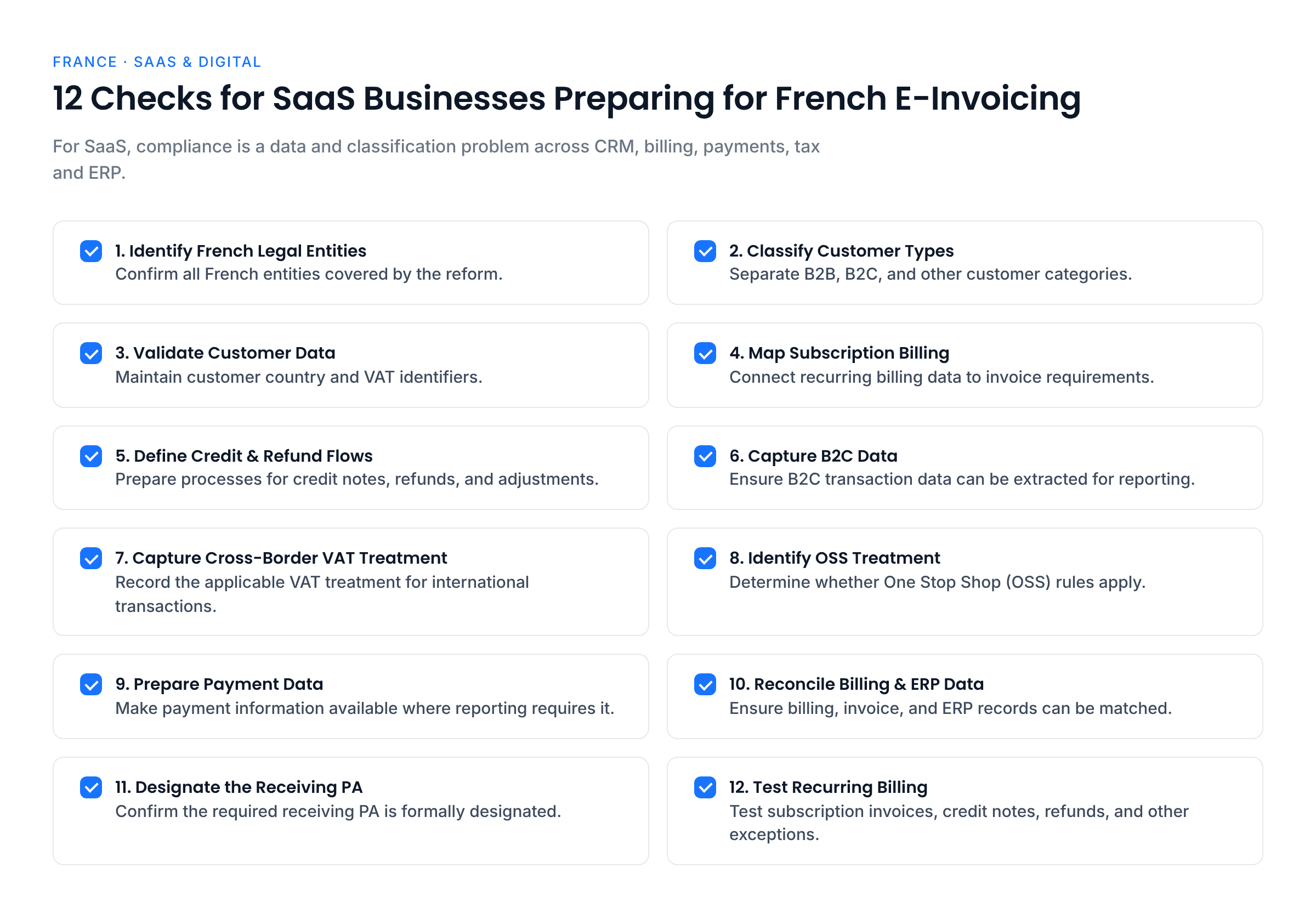
Before implementation, confirm:
- French legal entities are identified.
- Customer types are classified.
- Customer country and VAT identifiers are available.
- Subscription billing data is mapped.
- Credit-note and refund processes are defined.
- B2C transaction data can be extracted.
- Cross-border VAT treatment is captured.
- OSS treatment is identified where relevant.
- Payment data is available where reporting applies.
- ERP and billing records can be reconciled.
- The receiving PA is formally designated where required.
- Testing covers recurring billing and exceptions.
Conclusion
France e-invoicing for SaaS businesses is mainly a data and classification challenge.
The invoice is only one part of the process. Customer type, country, VAT treatment, subscription events, refunds and payment data can all affect what the business needs to do.
A strong implementation connects the billing, tax, ERP and payment systems around a clear transaction model.
Official Sources
DGFiP, discover the French e-invoicing reform
DGFiP, e-invoicing and approved platforms
DGFiP, foreign businesses and e-reporting
Frequently Asked Questions
No. The French domestic e-invoicing requirement applies to qualifying B2B transactions. B2C and cross-border transactions can follow e-reporting or another treatment depending on the VAT rules.
Not necessarily. Existing billing and ERP systems can remain the source systems if they can provide the required data and connect to the appropriate e-invoicing infrastructure.
Not directly. However, payment information may be needed for e-reporting in applicable cases, so the payment system can become an important source of compliance data.
No. Only transactions properly covered by an applicable One Stop Shop scheme may benefit from the relevant exclusion. Other transactions need their own VAT and reporting analysis.
About the Author

Swathy
Content Marketer
I’m a Content Marketer at Complyance, focused on e-invoicing. Over the years, I’ve created a wide range of content, including blog posts, whitepapers, and product guides, which have supported Complyance’s growth across markets such as the UAE and EU regions. My goal is to deliver content that is comprehensive, clear, accurate, and easy to understand, no matter how complex the topic.