France E-Reporting: What Businesses Need to Report

France's e-invoicing reform is not limited to sending electronic invoices between French businesses. It also introduces e-reporting, a separate reporting process for transactions that do not follow the domestic B2B e-invoicing flow.
Table of Contents
France's e-invoicing reform is not limited to sending electronic invoices between French businesses. It also introduces e-reporting, a separate reporting process for transactions that do not follow the domestic B2B e-invoicing flow.
This matters because one business can have several transaction types at the same time. A company may sell to French businesses, French consumers, and customers outside France. It may also receive or make payments for services where VAT becomes due when payment is collected. Each situation can create a different reporting obligation.
Understanding e-reporting in France starts with separating these flows.
What Is E-Reporting in France?
The French reform has three connected components:
- Domestic B2B e-invoicing
- Transaction e-reporting
- Payment e-reporting
Domestic B2B e-invoicing covers qualifying sales and purchases between VAT-taxable businesses established in France, where the transaction falls within the French VAT and invoicing rules.
E-reporting covers defined transactions outside that domestic B2B e-invoicing flow. This can include relevant B2C transactions, certain cross-border transactions, intra-EU acquisitions, and reverse-charge cases.
Payment e-reporting is different again. It concerns certain payment information where VAT becomes due when payment is collected.
For businesses, the important point is that e-reporting is not simply another name for e-invoicing. It is a separate reporting obligation within the same French tax digitisation framework.
Which Transactions Can Fall Under E-Reporting?
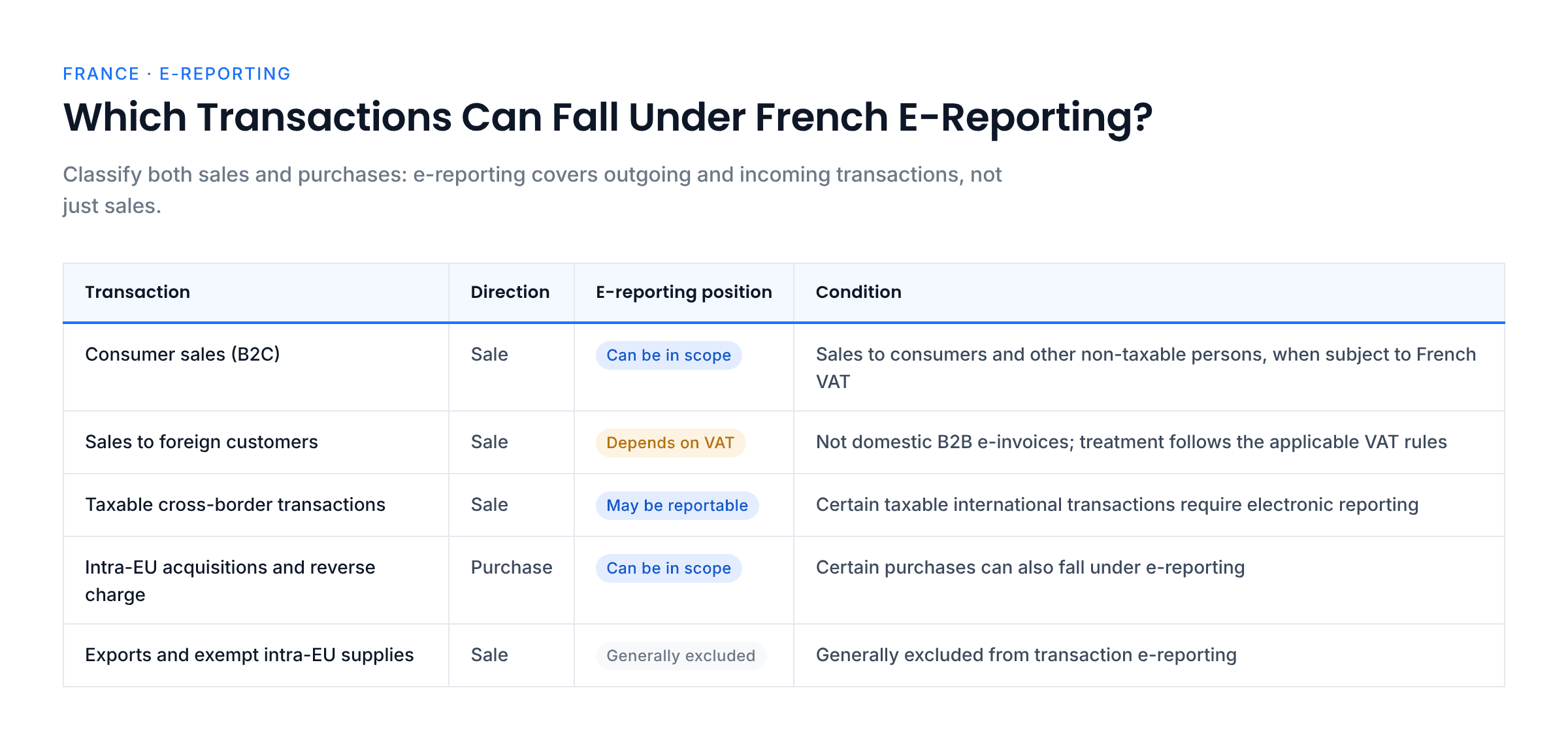
The first category is sales to consumers and other non-taxable persons.
A French business selling goods or services to consumers does not send those sales through the domestic B2B e-invoicing flow. Where the transaction is subject to French VAT, relevant transaction data can instead be reported through e-reporting.
The second category covers certain international transactions.
A French business selling to a foreign customer is not automatically sending a French B2B e-invoice. The e-reporting treatment depends on the VAT treatment of the transaction.
This distinction is important. Exports and exempt intra-EU supplies are generally excluded from transaction e-reporting. Other taxable cross-border operations may be reportable.
For example, a sale to a business established in Germany is not a domestic French B2B e-invoice. If it is an exempt intra-EU supply, it is generally excluded from transaction e-reporting. Another cross-border transaction with a different VAT treatment may have a reporting obligation.
E-reporting can also cover relevant purchases, including certain intra-EU acquisitions and reverse-charge situations. Businesses should therefore classify both sales and purchases rather than assuming that e-reporting applies only to outgoing invoices.
What Is Payment E-Reporting?
Payment e-reporting is separate from transaction e-reporting.
It generally concerns services and advances on goods where French VAT becomes chargeable on collection. The reporting of payment information helps the tax administration identify when the relevant VAT becomes due.
There are important exceptions.
Payment e-reporting does not apply where the supplier has opted to account for VAT on debits or where the transaction is subject to reverse charge by the customer.
This means a domestic B2B service invoice can follow the e-invoicing flow and later have payment reporting associated with it, but only where VAT is due on collection, the supplier has not opted for VAT on debits, and the transaction is not subject to reverse charge.
The invoice itself and the later payment event are therefore two different compliance events.
What Data Needs to Be Reported?
The exact data depends on the transaction and reporting category.
For B2C transactions subject to French VAT, e-reporting is generally based on daily aggregated sales data. The reporting allows the administration to identify VAT-exclusive turnover by VAT rate and the corresponding VAT amounts.
This is different from sending every consumer invoice one by one through the domestic B2B e-invoicing network.
For cross-border and other reportable transactions, the required information depends on the transaction type and VAT treatment. Businesses therefore need source systems that can capture customer status, country, VAT treatment, transaction category, taxable amounts, VAT rates, and relevant payment information where applicable.
A PA can transmit valid data, but in practice it cannot reliably correct or infer key business information that the source systems never captured.
Who Needs to Prepare for E-Reporting?
The reform applies to VAT-taxable businesses established in France according to the applicable timetable.
From 1 September 2026, large enterprises and ETIs enter the issuance and reporting phase. SMEs and micro-enterprises follow no later than 1 September 2027.
All VAT-taxable businesses established in France and concerned by the reform must be able to receive e-invoices from 1 September 2026.
Foreign businesses require a separate analysis.
A foreign business without a French VAT establishment is outside the domestic French e-invoicing issuance and receipt obligation. It can nevertheless be subject to transaction and, where applicable, payment e-reporting for taxable transactions deemed to take place in France where it is liable for French VAT.
For foreign sellers or service providers, the rollout is 1 September 2026 for large enterprises and ETIs and 1 September 2027 for micro, small, and medium-sized businesses.
For foreign businesses reporting as acquirers or recipients liable for VAT, such as in relevant reverse-charge or intra-EU acquisition situations, the official deadline is 1 September 2027 regardless of size.
What Systems Need to Support E-Reporting?
E-reporting is not only a tax configuration exercise. The required information may exist across several business systems.
An ERP may contain customer and invoice information. A POS or e-commerce platform may hold consumer sales. An accounts receivable system, payment gateway, or bank integration may contain collection information. A tax engine may determine VAT treatment.
A practical setup therefore needs a consistent data model across these sources.
For example, a retailer may sell through stores and an online shop. The POS system records consumer transactions, while the ERP manages B2B invoices. The e-commerce system may contain additional consumer sales. E-reporting requires the relevant data to be identified and consolidated according to the applicable reporting rules.
The same principle applies to service companies. A professional services business may issue a domestic B2B invoice and later receive payment. If VAT is due on collection and the exceptions do not apply, the payment event may need to be reported separately.
What Happens When a Transaction Changes?
Businesses also need to consider corrections.
Imagine an online retailer reports consumer sales for a day and later processes a refund. The reporting process needs to account for the correction according to the applicable reporting rules and period.
Similarly, a service invoice may be partially paid rather than fully settled. Where payment reporting applies, the system needs to capture the relevant payment information instead of treating the original invoice as the only compliance event.
This is why e-reporting should be connected to operational transaction and payment data rather than maintained as a separate manual spreadsheet.
How Does a PA Fit Into E-Reporting?
Businesses use a Plateforme Agréée (PA) for regulated e-invoicing and applicable reporting flows.
The PA provides the regulated transmission and exchange layer. The business remains responsible for the quality and classification of its source data.
This distinction is important when selecting an e-invoicing platform. A compatible solution may provide integration, validation, mapping, and workflow capabilities while connecting to a PA for the regulated exchange.
Businesses should therefore understand which entity holds the PA registration, how their systems connect to it, and which reporting flows are supported.
How Complyance Can Support the Process
Businesses can use an e-invoicing platform such as Complyance to connect existing ERP, billing, POS, and other business systems with the required e-invoicing infrastructure.
The practical goal is to bring transaction data together, apply the relevant validation and classification logic, and prepare the required data for the appropriate regulated flow.
The exact PA arrangement should be confirmed as part of implementation so businesses understand how Complyance connects to the selected PA and how each reporting flow is handled.
E-Reporting Readiness Checklist
Before implementation, businesses should be able to answer:
- Which sales are domestic B2B, B2C, or cross-border?
- Which customers are VAT-taxable businesses and which are consumers or other non-taxable persons?
- Which international transactions are taxable and reportable?
- Which exports and exempt intra-EU supplies are excluded?
- Which purchases involve intra-EU acquisitions or reverse charge?
- Which services have VAT due on collection?
- Has VAT on debits been elected where relevant?
- Which systems hold invoice, customer, transaction, and payment data?
- How will refunds, corrections, and partial payments be handled?
- Which PA arrangement will transmit the regulated data?
Getting these answers right is more important than simply connecting a system to a platform.
Conclusion
France e-reporting requires businesses to look beyond the invoice itself. Consumer sales, qualifying cross-border transactions, certain purchases, and payment events can create separate reporting obligations.
The right approach is to classify transactions correctly, connect the systems that hold the required data, validate the information, and establish the appropriate PA arrangement.
For businesses preparing for French e-invoicing, e-reporting should therefore be treated as part of the wider tax data architecture rather than as a separate reporting task.
Frequently Asked Questions
No. Domestic B2B e-invoicing concerns qualifying French B2B transactions. E-reporting covers defined transactions outside that flow, while payment e-reporting covers certain payment information.
No. The VAT treatment matters. Exports and exempt intra-EU supplies are generally excluded from transaction e-reporting, while other taxable cross-border operations may be reportable.
No. Relevant B2C transactions subject to French VAT are generally handled through transaction e-reporting, with reporting that can be aggregated daily by VAT rate.
Yes, where the service or advance payment is subject to VAT on collection and the applicable exceptions do not apply.
No. The business remains responsible for the underlying transaction classification and the completeness and accuracy of the data it provides.
About the Author

Swathy
Content Marketer
I’m a Content Marketer at Complyance, focused on e-invoicing. Over the years, I’ve created a wide range of content, including blog posts, whitepapers, and product guides, which have supported Complyance’s growth across markets such as the UAE and EU regions. My goal is to deliver content that is comprehensive, clear, accurate, and easy to understand, no matter how complex the topic.