How to Test Your France E-Invoicing Integration

France e-invoicing testing is not only about checking whether an invoice can be sent. A production-ready integration must also handle validation, routing, reception, status updates, corrections, e-reporting where applicable, and failures.

Table of Contents
France e-invoicing testing is not only about checking whether an invoice can be sent. A production-ready integration must also handle validation, routing, reception, status updates, corrections, e-reporting where applicable, and failures.
For businesses preparing for the French facturation électronique reform, testing should prove that the full process works with real business data before the system is used in production.
This guide explains what to test, how to structure test cases, and what finance and IT teams should confirm before go-live.
Key Takeaways
- Test the complete invoice lifecycle, not only invoice creation.
- Use realistic ERP and billing data during testing.
- Test both outbound and inbound invoices.
- Include routing, validation, rejection, correction and credit-note scenarios.
- Test e-reporting sources separately from domestic B2B e-invoicing.
- Test duplicate prevention, retries and status reconciliation.
- Keep evidence of every test and its result.
- Confirm the selected Plateforme Agréée (PA) specific test requirements before production.
What Does France E-Invoicing Testing Need to Prove?
A France e-invoicing integration connects several business processes. The ERP or billing system creates business data. An integration layer may transform and validate that data. The selected PA handles regulated exchange and applicable reporting flows.
Testing should prove that these parts work together.
The French administration publishes external specifications for the reform, including invoice formats, business rules, lifecycle information and interfaces. The current external specifications page includes version 3.2, dated 30 April 2026.
Your test plan should therefore cover both regulatory requirements and the actual implementation provided by your PA or technology provider.
1. Start With a Test Inventory
Before creating test cases, list the transaction types your business actually handles.
For a typical company, the inventory may include:
- Domestic B2B sales
- Domestic B2B purchases
- Credit notes
- Invoice corrections
- Multiple VAT rates
- Zero-rated transactions
- Different payment terms
- Multiple legal entities
- Different customer establishments
- B2C sales
- Cross-border sales
- Cross-border purchases
- Payment events where payment reporting applies
Do not test only the most common invoice.
A system can work perfectly for a standard invoice and still fail when a credit note, foreign transaction or unusual tax treatment is processed.
2. Test the Source Data
The first technical test should happen before transmission.
Check seller and buyer identifiers, invoice number and date, line data, quantities, prices, discounts, taxable amounts, VAT rates, totals, payment terms, delivery information, transaction category and correction references.
If the ERP does not hold a required value, the integration layer cannot reliably invent it. The business needs to decide where that information will come from and who owns it.
3. Test Format Validation
France supports structured electronic invoice formats within the applicable technical framework, including UBL, CII and hybrid formats such as Factur-X.
Testing should confirm that the generated document:
- Uses the intended format
- Contains the required structured data
- Uses the correct fields
- Passes syntax validation
- Passes applicable business-rule validation
- Contains consistent totals
- Contains valid tax information
- Contains the identifiers needed for routing
A document can be technically valid and still contain incorrect business data. Both technical and business validation should therefore be tested.
4. Test Routing and Recipient Addressing
An invoice is not successfully processed simply because the sending system receives a successful API response.
The invoice must reach the correct recipient through the applicable PA infrastructure.
Test different recipient situations:
- A customer with correct directory information.
- A customer with multiple establishments.
- A customer whose receiving PA differs from the sender's PA.
- An invalid or incomplete routing value.
- A customer record that has recently changed.
Confirm what happens when routing fails.
The test should show where the error appears, who receives the notification, whether the invoice is stored as failed, and how the corrected invoice can be resubmitted.
5. Test Invoice Lifecycle Statuses
Lifecycle status handling is important for both finance and IT.
The French framework defines common lifecycle concepts, while the way a PA exposes them can differ.
Test the statuses that are relevant to your implementation, including:
- Deposit or submission
- Rejection
- Delivery
- Receipt
- Acceptance where applicable
- Payment where applicable
- Correction or cancellation processes
Do not assume that a provider's status label is identical to the terminology used in your ERP.
Map the provider's status model to an internal status model that finance teams understand.
6. Test Inbound Invoices
Receiving is just as important as sending.
From 1 September 2026, businesses concerned by the reform must be able to receive electronic invoices. SMEs and micro-enterprises may have a later issuance date, but receiving is already part of the operating model.
Test an inbound invoice from a supplier and confirm that:
- The structured invoice reaches the selected receiving PA.
- The invoice is delivered to the correct business system.
- The original structured data is preserved.
- Validation results are recorded.
- Supplier and buyer identifiers are checked.
- Duplicate invoices are detected.
- The invoice can be matched to a purchase order or accounting record.
- AP users can see the processing status.
- Rejected or disputed invoices follow the defined exception process.
Inbound testing should include both a normal invoice and a problematic invoice.
7. Test E-Reporting Separately
Not every transaction becomes a domestic B2B e-invoice.
B2C transactions and certain cross-border transactions can fall under transaction e-reporting. Payment e-reporting can also apply in specific situations, such as services where French VAT becomes chargeable on collection, subject to the applicable exceptions.
Your test plan should therefore include the systems that generate this data.
For example:
- ERP for B2B invoices
- POS for consumer sales
- E-commerce platform for online transactions
- Payment system for collection information
- Tax engine for VAT classification
Test whether the correct data is collected from each source and classified correctly before transmission.
8. Test Failure and Recovery
A good test plan deliberately creates failures.
Test:
- Invalid customer data
- Missing mandatory fields
- Invalid VAT information
- Incorrect totals
- Invalid routing data
- Duplicate submission
- API timeout
- Provider unavailability
- Rejected invoice
- Corrected invoice
- Credit note
- Network interruption
A timeout should not automatically result in a second invoice.
The system should be able to determine whether the original submission was processed before retrying. Use an idempotency or business-level deduplication mechanism where supported, and retain the relationship between the ERP invoice, integration message and PA identifiers.
9. Test Reconciliation
Testing is incomplete until the business can reconcile what happened.
For each outbound invoice, retain enough information to connect:
- ERP invoice ID
- Integration message ID
- PA submission ID
- Validation result
- Routing result
- Lifecycle statuses
- Final accounting state
For inbound invoices, retain the supplier invoice number, PA message identifier, received structured document, validation result and AP record.
This creates a traceable record when finance or tax teams need to investigate an invoice later.
10. Run Business-User Acceptance Testing
Technical tests are not enough. Finance users should test whether they can see acceptance or rejection, understand failures, correct source data, resubmit safely, reconcile invoices and find the evidence needed for an audit.
The objective is not only technical success. It is operational usability.
A Practical France E-Invoicing Test Checklist
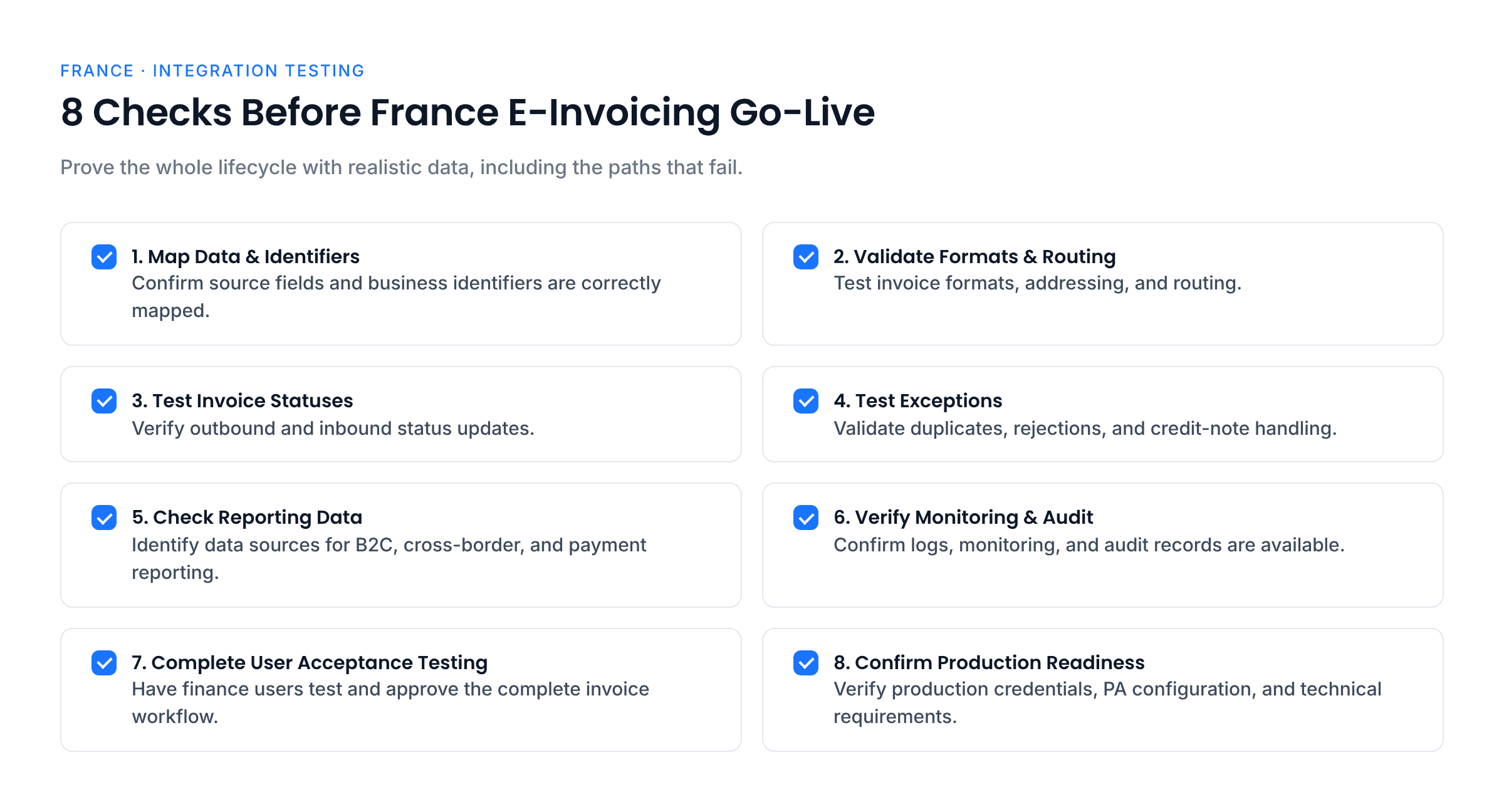
Before production, confirm:
- Source fields and identifiers are mapped.
- Invoice formats and routing validate.
- Outbound and inbound statuses work.
- Duplicates, rejections and credit notes are tested.
- B2C, cross-border and payment reporting sources are identified.
- Monitoring and audit records are available.
- Finance users have completed acceptance testing.
- Production credentials and PA requirements are confirmed.
How Complyance Can Fit
Complyance can provide a technology and integration layer between existing business systems and the French e-invoicing infrastructure.
For a France deployment, the exact PA arrangement, supported formats, API functions and reporting responsibilities should be confirmed for the intended implementation.
The testing approach remains the same: prove the business data, validation, routing, exchange, reporting and reconciliation processes before production.
Conclusion
France e-invoicing testing should prove that the entire process works, including normal invoices and exceptions.
The strongest test plans combine technical validation with business acceptance. They use realistic data, test inbound and outbound flows, include e-reporting where applicable, and preserve enough information to reconcile every transaction.
Testing before go-live gives finance, tax and IT teams a clear view of what works, what fails and who is responsible for fixing it.
Official Sources
DGFiP external specifications for France e-invoicing
Frequently Asked Questions
Businesses should test their integration before production to identify data, routing, validation and operational problems. The exact technical test process depends on the selected PA and implementation.
Use realistic business data, but follow the PA's rules for test data and production documents. Test cases should represent the transactions the business will actually process.
Yes. Receiving is a core part of the French reform and should be tested separately from outbound invoicing.
There is no single test. The most valuable test is an end-to-end scenario that starts with source data and finishes with the expected ERP, PA and finance status.
About the Author

Swathy
Content Marketer
I’m a Content Marketer at Complyance, focused on e-invoicing. Over the years, I’ve created a wide range of content, including blog posts, whitepapers, and product guides, which have supported Complyance’s growth across markets such as the UAE and EU regions. My goal is to deliver content that is comprehensive, clear, accurate, and easy to understand, no matter how complex the topic.