XRechnung vs ZUGFeRD: Which E-Invoice Format Should German Businesses Use?

Compare XRechnung vs ZUGFeRD for German e-invoicing, including format structure, integration, public-sector use, business scenarios, and selection criteria.
Table of Contents
Choosing between XRechnung vs ZUGFeRD is one of the first format questions German businesses ask.
Both can be used within the German E-Rechnung framework when the applicable requirements are met.
But they are built differently.
XRechnung is a pure structured XML format. ZUGFeRD combines structured XML with a visual PDF/A-3 representation.
That difference affects how people read the invoice, how software processes it, how public authorities accept it, and how businesses manage their ERP integration.
There is no universal answer that says one format is always better.
The right format depends on your customer, transaction, systems, and workflow.
Key Takeaways
- XRechnung is a pure structured XML format.
- ZUGFeRD is a hybrid format containing structured XML and a visual PDF/A-3 document.
- Both can meet German E-Rechnung requirements when the applicable requirements are met.
- XRechnung is especially important for German public-sector invoicing.
- ZUGFeRD can be useful when businesses want a visual document alongside structured data.
- Customer requirements should be checked before choosing a format.
XRechnung vs ZUGFeRD: The Basic Difference
XRechnung and ZUGFeRD take different approaches to presenting electronic invoice data.
XRechnung uses structured XML. ZUGFeRD combines structured XML with a visual PDF/A-3 representation.
XRechnung is designed primarily for machine processing.
ZUGFeRD adds a human-readable representation.
This does not mean ZUGFeRD is simply a "better PDF". The structured XML is the important electronic invoice component.
For both formats, the underlying invoice data needs to meet the applicable legal and technical requirements.
XRechnung vs ZUGFeRD: What Is the Difference?
XRechnung and ZUGFeRD are two important formats used for structured electronic invoicing in Germany.
Both can support compliant e-invoicing when the applicable requirements are met. The main difference is how the structured invoice data is packaged and presented.
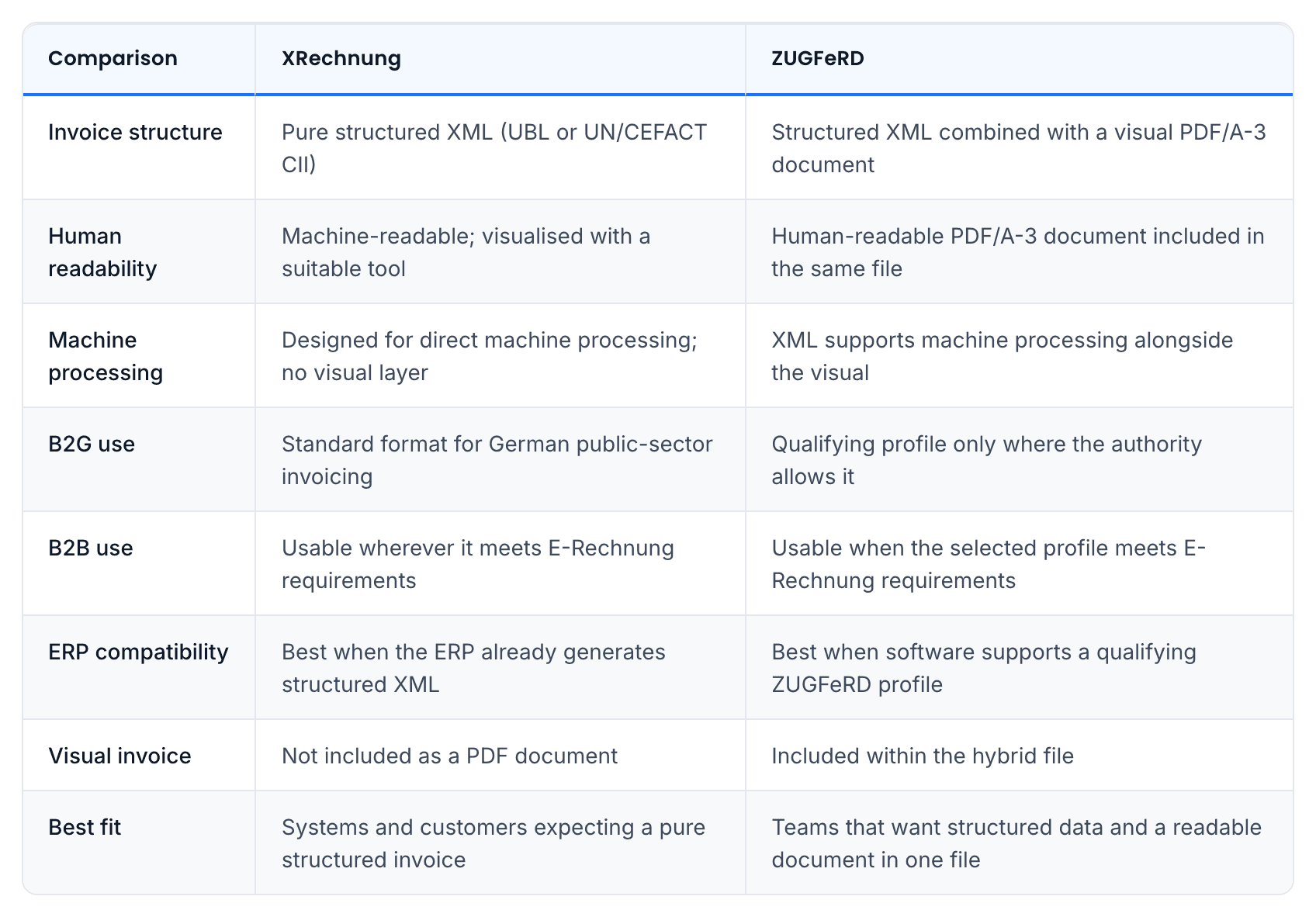
| Comparison | XRechnung | ZUGFeRD |
|---|---|---|
| Invoice structure | Pure structured XML | Structured XML combined with a visual PDF/A-3 document |
| Human readability | XML is machine-readable and can be visualized with a suitable tool | Includes a human-readable PDF/A-3 representation |
| Machine processing | Designed for direct machine processing | Structured XML supports machine processing alongside the visual representation |
| B2G use | Commonly used for German public-sector invoicing | A qualifying profile may be used when the authority and applicable requirements allow it |
| B2B use | Can be used when it meets German E-Rechnung requirements | Can be used when the selected profile meets German E-Rechnung requirements |
| ERP compatibility | Useful when the ERP already generates structured XML | Useful when the ERP or e-invoicing software supports a qualifying ZUGFeRD profile |
| Visual invoice | Not included as a normal PDF document | Included within the hybrid file |
| Best fit | Businesses that need a pure structured invoice or work with systems expecting XRechnung | Businesses that want structured data together with a visual representation |
The table gives the basic difference, but the choice should not be made on format alone.
Your customer's requirements, ERP setup, validation process, transmission method, and archiving workflow all matter.
Which Format Is Easier to Integrate?
There is no universal answer.
The easier format is usually the one that fits the systems you already use.
If your ERP already generates XRechnung, there may be little reason to introduce another invoice format.
If your accounting or invoicing software already supports a qualifying ZUGFeRD profile, the hybrid approach may fit your existing workflow better.
Before choosing, check:
- Which formats your ERP can generate
- Which formats your customers can receive
- Which validation tools are available
- How the invoice will be transmitted
- How the original invoice will be archived
The important question is not simply:
"Which format is better?"
It is:
"Which compliant format fits our existing workflow with the least operational risk?"
Which Format Is Better for Businesses?
There is no single winner between XRechnung and ZUGFeRD.
The right choice depends on how your business creates, sends, receives, and processes invoices.
Choose XRechnung When:
- Your customer requires structured XML.
- You invoice public authorities that require or specify XRechnung.
- Your ERP already supports XRechnung.
- Your workflow is designed around machine-readable invoice data.
Choose ZUGFeRD When:
- A visual representation is useful to your finance team.
- Your software supports a qualifying ZUGFeRD profile.
- Your customer accepts the selected profile.
- You want structured data and a visual representation in the same file.
For B2G invoices, always check the requirements of the specific public authority before selecting a format. Do not assume that every ZUGFeRD profile can be used for every government invoice.
For B2B invoices, businesses generally have more flexibility, provided the selected invoice meets the applicable German E-Rechnung requirements.
What Should Businesses Check Before Choosing?
A format decision should start with the complete invoice workflow.
Instead of choosing a format first, businesses should review the full process, including customer requirements, ERP capabilities, format support, validation, transmission, processing, and archiving.
This is where many businesses make the mistake of choosing a format first and checking the rest later.
For example, a business may already have an ERP that creates XRechnung correctly. In that case, changing the format may add unnecessary work.
Another business may already have software that supports a qualifying ZUGFeRD profile and needs a visual representation for internal review. For that business, ZUGFeRD may be more convenient.
The best format is therefore the one that works reliably across the entire process, not simply the one that looks easiest on paper.
How Complyance Helps
At Complyance, we do not believe businesses should have to build separate systems simply because Germany supports more than one invoice format.
The platform can sit between your ERP and the customer, supporting the appropriate XRechnung or ZUGFeRD format, validation, and transmission.
That lets the business keep its existing accounting system while using the appropriate structured format for each workflow.
Conclusion
The XRechnung vs ZUGFeRD decision is not really about which format is universally better.
It is about fit.
Businesses should consider the customer requirement, transaction type, ERP capability, format, validation, transmission, processing, and archiving before making a decision.
Once those questions are answered, choosing the right German e-invoice format becomes much simpler.
Frequently Asked Questions
Neither is universally better. XRechnung is especially important for public-sector invoicing, while qualifying ZUGFeRD profiles provide structured XML together with a visual document.
Yes. Qualifying versions and profiles can meet the applicable German E-Rechnung requirements.
XRechnung is generally the standard for German federal administration. Always check the specific authority's current requirements.
Both can be suitable when the applicable requirements are met. The best choice depends on the customer and business workflow.
Yes. The structured XML is combined with a visual PDF/A-3 representation.
About the Author

Swathy
Content Marketer
I’m a Content Marketer at Complyance, focused on e-invoicing. Over the years, I’ve created a wide range of content, including blog posts, whitepapers, and product guides, which have supported Complyance’s growth across markets such as the UAE and EU regions. My goal is to deliver content that is comprehensive, clear, accurate, and easy to understand, no matter how complex the topic.