ZUGFeRD in Germany: Format, Versions, Requirements and E-Invoicing Compliance

Learn how ZUGFeRD works in Germany, including its PDF/A-3 and XML structure, profiles, EN 16931 relationship, validation, archiving, and use cases.
Table of Contents
If you have heard about German E-Rechnung formats, you have probably come across ZUGFeRD Germany.
ZUGFeRD is interesting because it combines two components in one invoice. The visual PDF/A-3 representation is designed for people to read, while the structured XML data is designed for software to process.
This makes ZUGFeRD different from a normal PDF.
The PDF part lets a finance employee read the invoice in a familiar way. The XML part gives accounting software structured information that can be processed automatically.
But there is an important warning.
Not every ZUGFeRD profile automatically qualifies as a German E-Rechnung.
The version and profile matter.
Key Takeaways
- ZUGFeRD is a hybrid electronic invoice format.
- It combines structured XML with a visual PDF/A-3 representation.
- Qualifying ZUGFeRD versions and profiles can meet German E-Rechnung requirements.
- The BMF specifically recognises ZUGFeRD from version 2.0.1, excluding MINIMUM and BASIC-WL profiles, when the requirements are met.
- Businesses should check the exact profile before using ZUGFeRD for compliance.
- ZUGFeRD can be useful for both human review and machine processing.
What Is ZUGFeRD?
ZUGFeRD is a German hybrid invoice format.
A ZUGFeRD invoice contains structured invoice data, normally XML, together with a human-readable PDF/A-3 document.
The two parts are packaged together. The PDF provides the visual representation that people can read, while the XML provides the structured information that accounting and business systems can process.
This can make the transition easier for businesses that have traditionally worked with PDFs but now need structured invoice data.
How the ZUGFeRD Format Works
A normal PDF is primarily a visual document. ZUGFeRD adds structured data to the invoice by combining the visual PDF/A-3 representation with the structured XML.
A typical ZUGFeRD process starts with invoice data from an ERP or accounting system. That data is used to generate the ZUGFeRD XML and the corresponding PDF/A-3 representation. The resulting file can then be validated before it is transmitted to the customer.
The structured data is the important compliance layer.
Keeping only the PDF and removing the XML defeats the purpose of the hybrid format and can create archiving problems.
ZUGFeRD and EN 16931
ZUGFeRD versions and profiles need to be checked against EN 16931.
The BMF's current guidance explains that ZUGFeRD from version 2.0.1, except the MINIMUM and BASIC-WL profiles, is based on EN 16931 and can qualify as an E-Rechnung when the legal requirements are met.
This means "ZUGFeRD" alone is not enough information.
Before implementation, businesses should confirm the exact ZUGFeRD version and profile, check whether it meets EN 16931, and verify that it satisfies the applicable German VAT requirements.
ZUGFeRD Versions and Profiles
ZUGFeRD has different profiles because businesses have different invoice data needs.
For compliance, the profile matters.
The BMF specifically excludes the MINIMUM and BASIC-WL profiles from the qualifying ZUGFeRD formats identified in its guidance.
For a current implementation, businesses should use the version and profile supported by their customer and validated against the current German requirements.
Do not choose a profile simply because your software offers it.
ZUGFeRD 2.3 and Current Implementations
Businesses searching for ZUGFeRD 2.3 should separate software-version availability from legal compliance.
A newer software release does not automatically mean that every profile is suitable for every transaction.
A practical implementation check should cover five areas:
- Check the current ZUGFeRD specification.
- Confirm the required profile.
- Check EN 16931 compliance.
- Confirm the customer's requirements.
- Validate the resulting invoice.
This keeps the implementation tied to the actual requirements rather than to a product label.
ZUGFeRD for B2B
ZUGFeRD can be used for German B2B E-Rechnungen when the selected version and profile meet the applicable requirements.
It can be especially useful when businesses want employees to retain a familiar visual document while systems process the structured data.
In a typical B2B setup, the supplier's ERP or accounting system provides the invoice data. The ZUGFeRD file is then generated with both its structured and visual components, after which the customer can receive and process the structured information.
This can reduce the need for businesses to maintain a separate PDF and XML workflow.
ZUGFeRD for B2G
For public-sector invoices, customer-specific requirements matter.
The federal administration generally uses XRechnung. The federal portal also confirms that the ZUGFeRD 2.2.0 XRECHNUNG profile can meet the relevant requirements for submission through federal platforms.
So businesses should not assume that any ZUGFeRD profile can be sent to any public authority.
Always check the authority's current requirements.
ZUGFeRD Validation
Validation should check both the structure and the business information.
A practical validation process can be handled in several stages:
- Generate the ZUGFeRD invoice.
- Validate the XML structure.
- Check consistency between the PDF and XML.
- Validate the applicable business rules.
- Correct any errors before sending.
The structured data should represent the invoice correctly.
For hybrid invoices, the relationship between the visual and structured parts is important.
If the two parts disagree, businesses need to understand which data has legal priority under the applicable German rules.
How to Archive a ZUGFeRD Invoice
ZUGFeRD creates an important archiving question.
A business should not simply save the PDF and discard the structured XML.
The BMF states that for an E-Rechnung, the structured part must be retained in its original form for the applicable retention period.
A practical archiving process should therefore preserve the original ZUGFeRD file, retain the structured XML in its original form, protect the records against alteration, and keep them for the required retention period.
When Should You Choose ZUGFeRD?
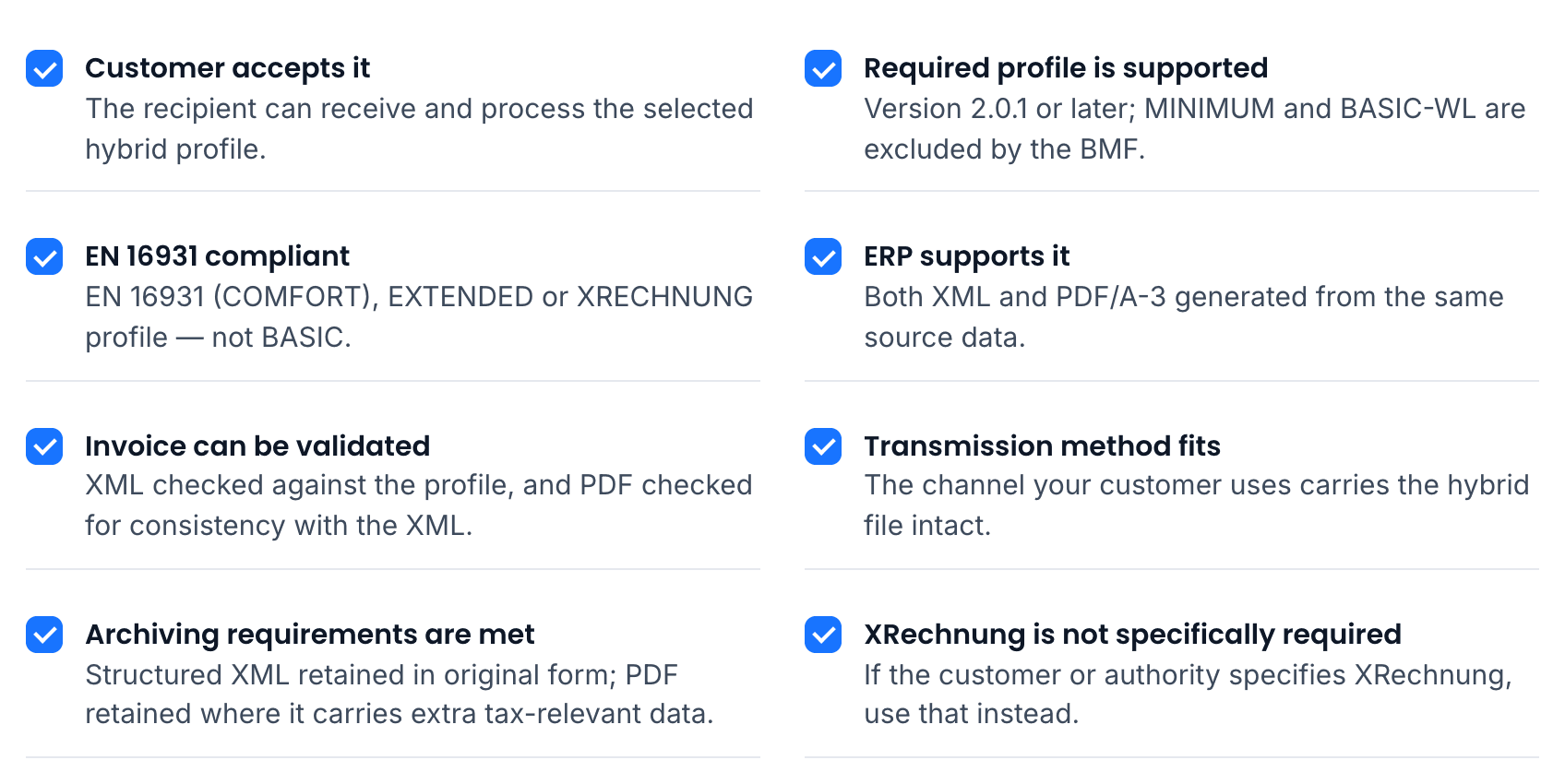
ZUGFeRD can make sense when your business wants a hybrid invoice that is easy for people to read while still providing structured data.
Before selecting it, check:
- Customer acceptance
- Required profile
- EN 16931 compliance
- ERP support
- Validation capability
- Transmission method
- Archiving process
If a customer specifically requires XRechnung, use the format and profile that satisfy that requirement.
What Businesses Should Check Before Choosing a ZUGFeRD Profile
Before putting ZUGFeRD into production, create a checklist.
The review should cover the customer requirement, exact version, profile, EN 16931 compliance, validation, and transmission method.
First, ask what your customer can receive. A format that works perfectly for one customer may not be accepted by another system.
Next, confirm the exact ZUGFeRD version and profile. This is important because ZUGFeRD is a family of profiles rather than one single file definition.
Then test the invoice with the same type of validation that will be used in production.
A good pilot should include:
- A normal invoice
- A credit note
- Different VAT rates
- Discounts
- Multiple invoice lines
- Attachments
- Foreign currency where relevant
- Different payment terms
The purpose is to test the actual business data, not just whether software can create a file.
What Happens When ZUGFeRD Data and the PDF Differ?
Hybrid invoices create another practical question.
The structured data and visual representation should describe the same transaction.
If an employee changes the PDF without updating the structured data, the two parts can disagree.
That is why businesses should control how ZUGFeRD files are generated.
A safer process is to generate both components from the same ERP data, validate their relationship, protect the completed file against unintended changes, and then send it.
Employees should not manually edit the PDF after the structured invoice has been created.
How Complyance Helps
Complyance can help businesses generate and manage qualifying structured invoices without forcing the finance team to manually create XML.
Complyance can sit between the ERP and the customer, supporting ZUGFeRD generation, validation, transmission, and related compliance workflows.
The platform can also provide a common e-invoicing layer when a business needs different formats for different customers.
That is useful because one customer may need XRechnung while another can accept a qualifying ZUGFeRD invoice.
Conclusion
ZUGFeRD is valuable because it brings together human readability and machine processing.
But the name alone is not enough.
The business must select the right version and profile, validate the invoice, transmit it correctly, and retain the structured data.
The practical approach is to select the correct profile, generate the structured invoice data, validate the complete ZUGFeRD file, transmit it through the required channel, and preserve the invoice for the applicable retention period.
That is the practical way to use ZUGFeRD for German e-invoicing.
Frequently Asked Questions
Qualifying ZUGFeRD versions and profiles can meet the German E-Rechnung requirements. The exact version and profile matter.
ZUGFeRD contains a PDF/A-3 visual document, but it also contains structured XML data. That structured part is essential.
The BMF identifies ZUGFeRD from version 2.0.1, excluding MINIMUM and BASIC-WL profiles, when the applicable requirements are met.
Qualifying ZUGFeRD profiles are based on the EN 16931 framework.
Certain ZUGFeRD profiles can be accepted for public-sector invoices where the authority's requirements are met. Federal administration requirements should be checked before submission.
About the Author

Swathy
Content Marketer
I’m a Content Marketer at Complyance, focused on e-invoicing. Over the years, I’ve created a wide range of content, including blog posts, whitepapers, and product guides, which have supported Complyance’s growth across markets such as the UAE and EU regions. My goal is to deliver content that is comprehensive, clear, accurate, and easy to understand, no matter how complex the topic.